During the colonial period in India, what was the purpose of the Whitley Commission?

- ATo review the fitness of India for further political reforms
- BTo report on the existing conditions of labour and to make recommendationsCorrect
- CTo draw up a plan for financial reforms for India
- DTo develop a comprehensive scheme for Civil Services in India
Explanation
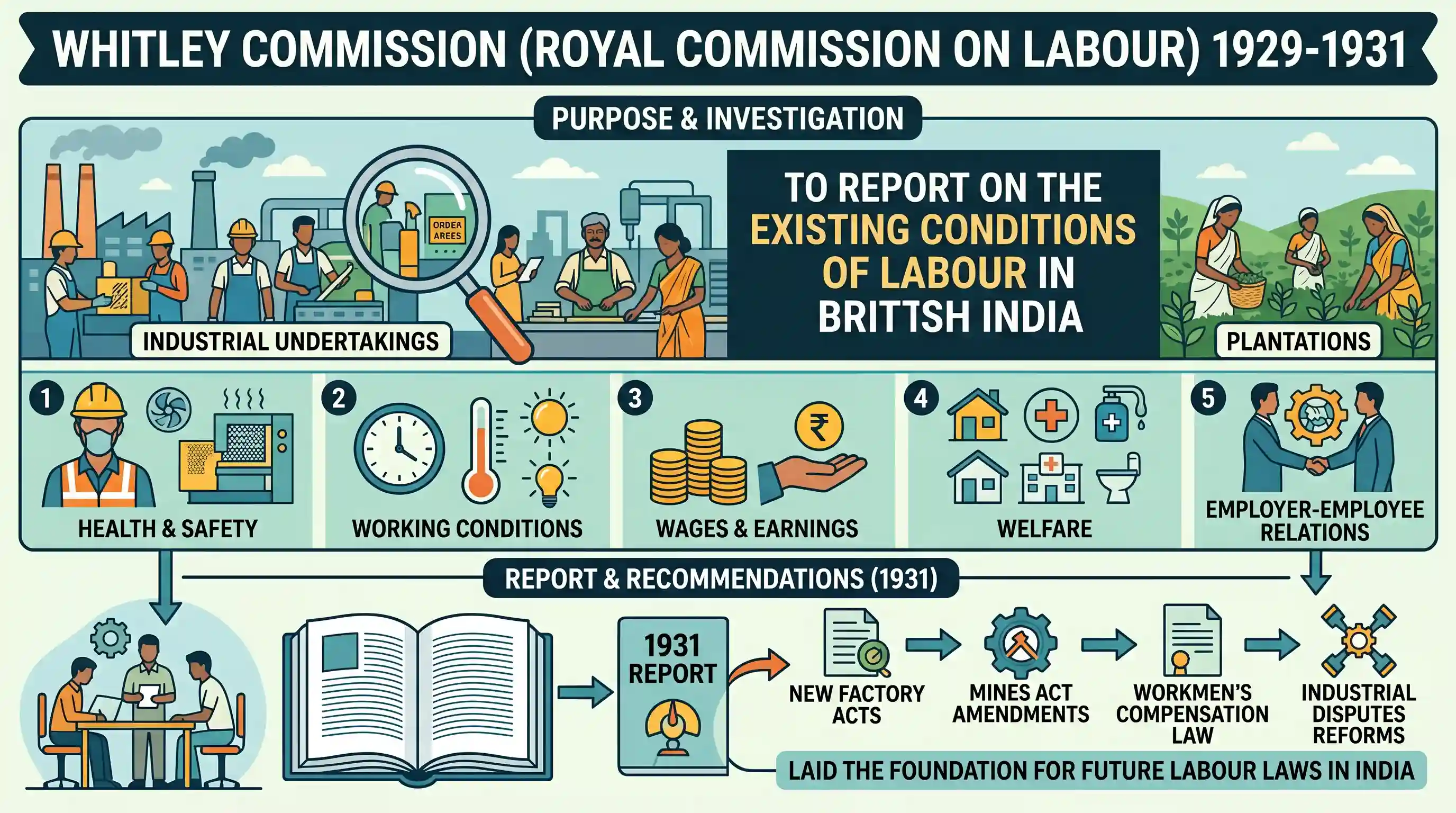
The Royal Commission on Labour, also known as the Whitley Commission, was set up in 1929 under the chairmanship of John Henry Whitley. Its primary purpose was to investigate the existing conditions of labour in industrial undertakings and plantations in British India. The commission examined issues such as health, safety, and welfare of workers, as well as the relations between employers and employees. Its 1931 report provided detailed recommendations that later served as a foundation for various labour laws and reforms in India. Options A, C, and D are incorrect because they refer to constitutional reforms, financial policies, and civil service restructuring, which were handled by other bodies like the Simon Commission or the Aitchison Commission.
Related questions
More UPSC Prelims practice from the same subject and topic.
- Prelims 2003GS1history
Which one of the following statements is correct?
- Prelims 2003GS1history
The aim of education as stated by the Wood’s despatch of 1854 was
- Prelims 2003GS1history
With reference to the entry of European powers into India, which one of the following statements is correct?
- Prelims 2003GS1history
With reference to Indian freedom struggle, which one of the following statements is correct?
- Prelims 2003GS1history
The leader of the Bardoli Satyagraha (1928) was
- Prelims 2003GS1history
Assertion (A): In 1916, Maulana Mohammad Ali and Abul Kalam Azad resigned from the Legislative Council. Reason (R): The Rowlatt Act was passed by the government in spite of being opposed by all Indian…