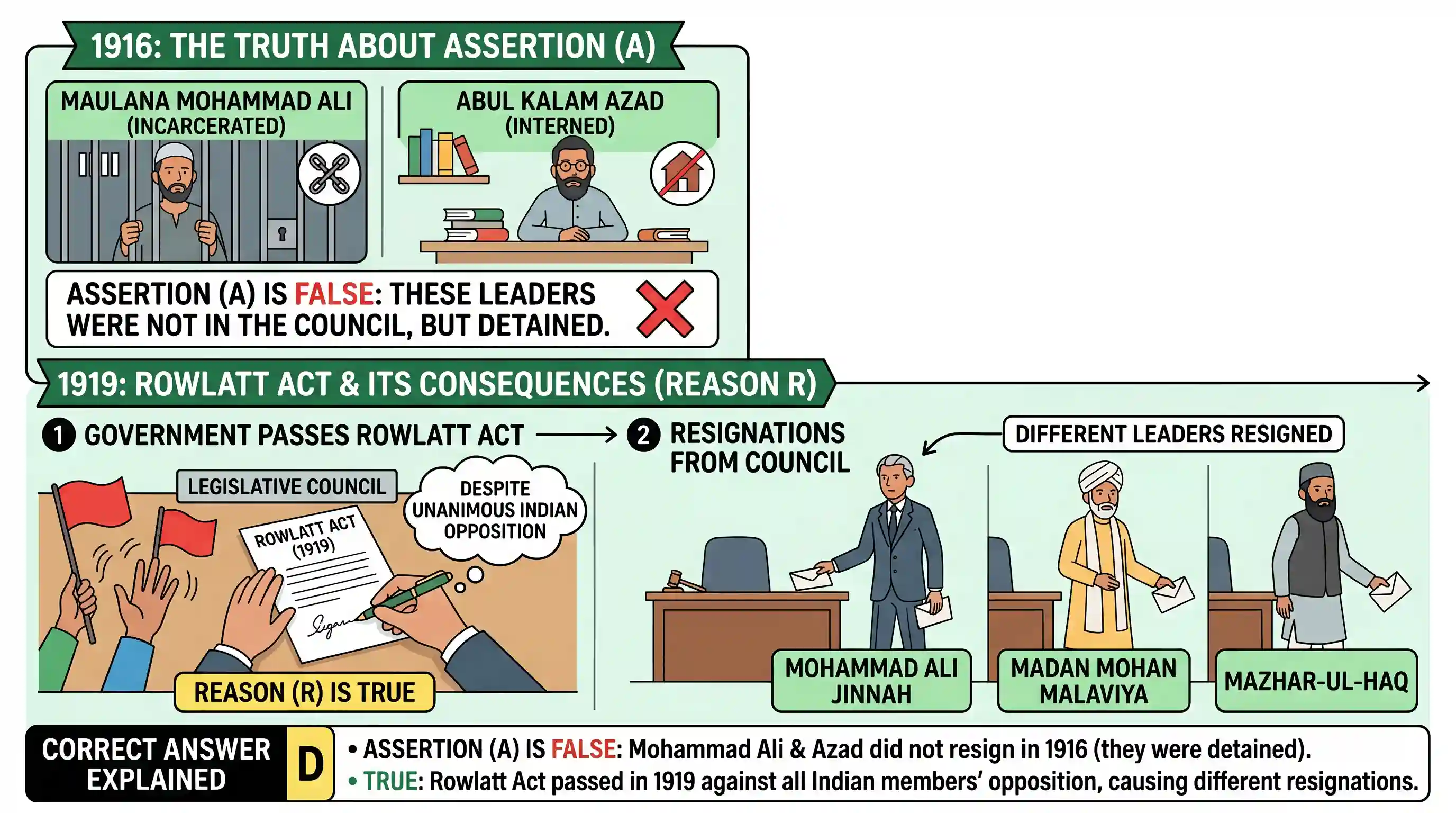
Assertion (A): In 1916, Maulana Mohammad Ali and Abul Kalam Azad resigned from the Legislative Council. Reason (R): The Rowlatt Act was passed by the government in spite of being opposed by all Indian members of the Legislative Council.

- ABoth A and R are individually true and R is the correct explanation of A
- BBoth A and R are individually true but R is NOT the correct explanation of A
- CA is true but R is false
- DA is false but R is trueCorrect
Explanation
The correct answer is D because Assertion A is historically incorrect, while Reason R is true.
Assertion A is false because Maulana Mohammad Ali and Abul Kalam Azad did not resign from the Legislative Council in 1916. In fact, during that time, Mohammad Ali was in prison and Abul Kalam Azad was under internment. The famous resignations from the Legislative Council in protest actually occurred later, in 1919, following the passage of the Rowlatt Act. Notable figures who resigned then included Madan Mohan Malaviya, Mazhar-ul-Haq, and Mohammad Ali Jinnah.
Reason R is true because the Rowlatt Act of 1919 was indeed passed by the Imperial Legislative Council despite unanimous and intense opposition from every non-official Indian member of the council. This total disregard for Indian opinion was the primary cause for the subsequent protests and resignations.
Related questions
More UPSC Prelims practice from the same subject and topic.
- Prelims 2003GS1history
Which one of the following statements is correct?
- Prelims 2003GS1history
The aim of education as stated by the Wood’s despatch of 1854 was
- Prelims 2003GS1history
With reference to the entry of European powers into India, which one of the following statements is correct?
- Prelims 2003GS1history
With reference to Indian freedom struggle, which one of the following statements is correct?
- Prelims 2003GS1history
The leader of the Bardoli Satyagraha (1928) was
- Prelims 2003GS1history
During the colonial period in India, what was the purpose of the Whitley Commission?