Regarding the atom of a chemical element, the magnetic quantum number refers to

- AorientationCorrect
- Bshape
- Csize
- Dspin
Explanation
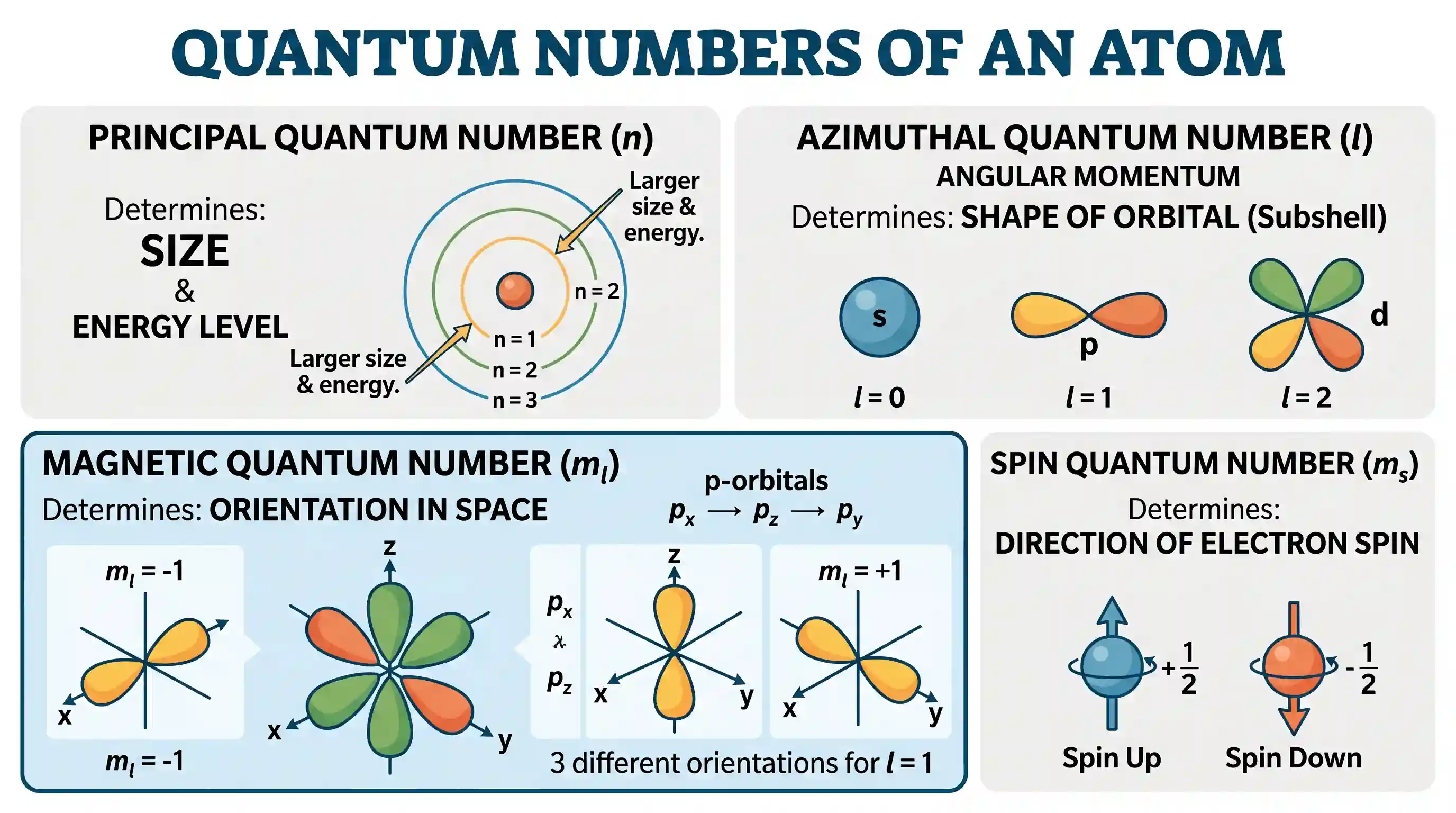
The magnetic quantum number (ml) describes the orientation of an atomic orbital in space. For a given subshell (determined by the azimuthal quantum number, l), the magnetic quantum number specifies the number of orbitals and their spatial arrangement relative to each other. For example, for l=1 (p subshell), ml can be -1, 0, +1, corresponding to the px, py, and pz orbitals which are oriented along the x, y, and z axes respectively.
A) orientation: This is correct. The magnetic quantum number dictates how an orbital is oriented in three-dimensional space. B) shape: The shape of an orbital is determined by the azimuthal (angular momentum) quantum number (l). For example, l=0 (s orbital) is spherical, l=1 (p orbital) is dumbbell-shaped. C) size: The size and energy of an orbital are primarily determined by the principal quantum number (n). Higher n means a larger orbital. D) spin: The spin of an electron is described by the spin quantum number (ms), which can be +1/2 or -1/2, indicating the intrinsic angular momentum of the electron.
Related questions
More UPSC Prelims practice from the same subject and topic.
- Prelims 2003GS1science-and-technology
With reference to the work of human kidney, consider the following statements: 1. After the waste is removed in the kidney, the cleaner blood is sent back through renal artery. 2. From Bowman’s capsul…
- Prelims 2003GS1science-and-technology
Consider the following statements: 1. Steam at 100° C and boiling water at 100° C contain same amount of heat. 2. Latent heat of fusion of ice is equal to the latent heat of vaporization of water. 3. …
- Prelims 2003GS1science-and-technology
Consider the following statements: A 4-wheel vehicle moving a sharp circular path at high speed will 1. Overturn about its outer wheels 2. Overturn about its inner wheels 3. Skid outwards 4. Skid inwa…
- Prelims 2003GS1science-and-technology
Four different candles, which can last for 5 hours, 4 hours. 3 hours and 2 hours of burning, respectively, are lit in a room at the same instant and allowed to burn till such time that the three candl…
- Prelims 2003GS1science-and-technology
Which one of the following statements is correct?
- Prelims 2003GS1science-and-technology
Which one of the following statements is correct?