Assertion (A): In the periodic table of chemical elements, electron affinity is always found to increase from top to bottom in a group. Reason (R): In a group, the atomic radial generally increases from top to bottom.

- ABoth A and R are individually true and R is the correct explanation of A
- BBoth A and R are individually true but R is NOT the correct explanation of A
- CA is true but R is false
- DA is false but R is trueCorrect
Explanation
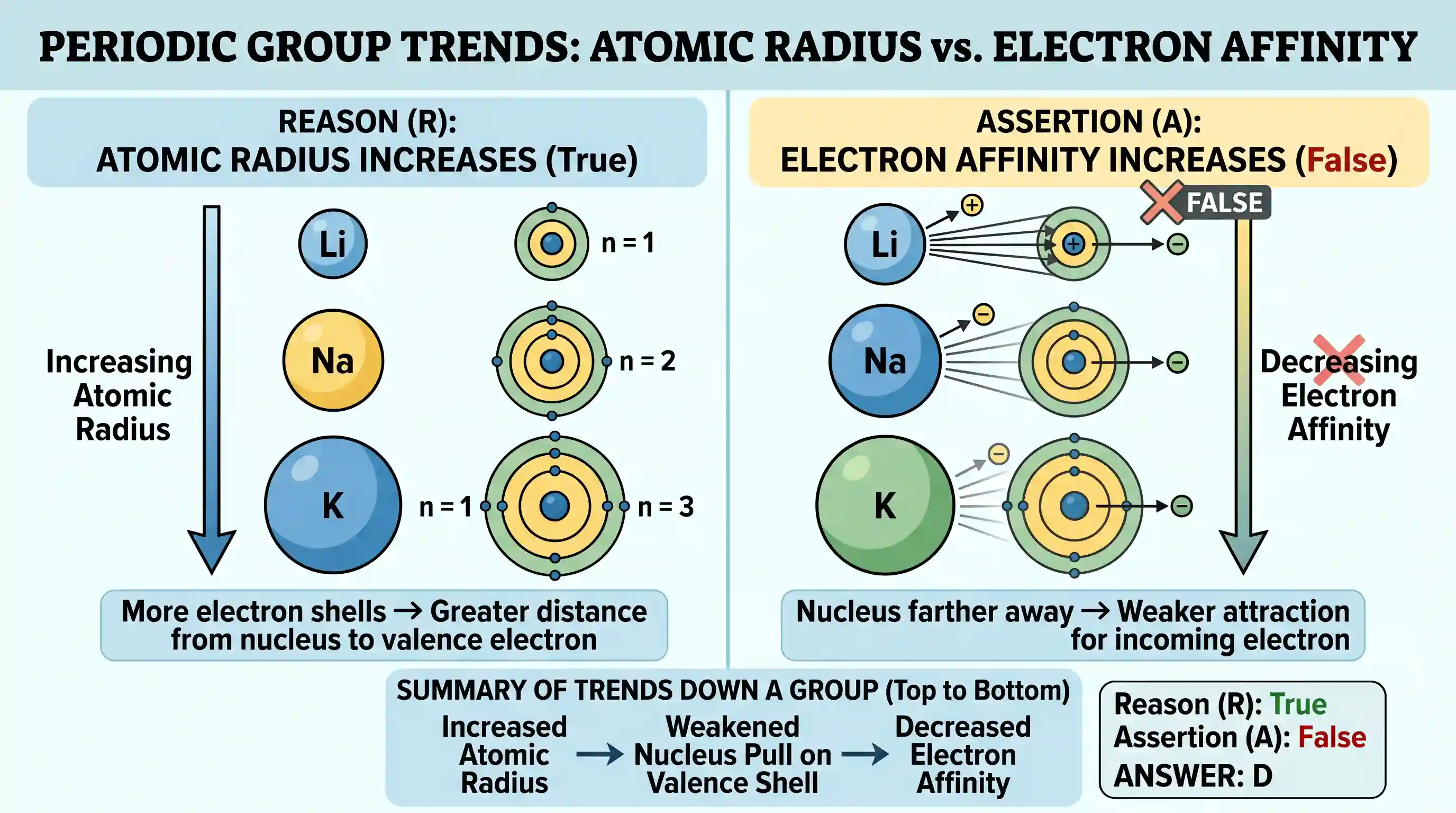
The correct answer is D because the assertion is false while the reason is true.
In the periodic table, electron affinity generally decreases from top to bottom in a group, not increases. This is because as you move down a group, the atomic radius increases due to the addition of new electron shells. This increase in atomic radius means the nucleus is farther away from the outermost shell, making it harder for the atom to attract and bind an incoming electron. Therefore, while the reason correctly describes the trend of atomic radii, the assertion incorrectly describes the trend of electron affinity.
Related questions
More UPSC Prelims practice from the same subject and topic.
- Prelims 2003GS1science-and-technology
With reference to the work of human kidney, consider the following statements: 1. After the waste is removed in the kidney, the cleaner blood is sent back through renal artery. 2. From Bowman’s capsul…
- Prelims 2003GS1science-and-technology
Consider the following statements: 1. Steam at 100° C and boiling water at 100° C contain same amount of heat. 2. Latent heat of fusion of ice is equal to the latent heat of vaporization of water. 3. …
- Prelims 2003GS1science-and-technology
Consider the following statements: A 4-wheel vehicle moving a sharp circular path at high speed will 1. Overturn about its outer wheels 2. Overturn about its inner wheels 3. Skid outwards 4. Skid inwa…
- Prelims 2003GS1science-and-technology
Four different candles, which can last for 5 hours, 4 hours. 3 hours and 2 hours of burning, respectively, are lit in a room at the same instant and allowed to burn till such time that the three candl…
- Prelims 2003GS1science-and-technology
Which one of the following statements is correct?
- Prelims 2003GS1science-and-technology
Which one of the following statements is correct?