Consider the following statements: 1. The Chinese pilgrim Fa-Hien attended the fourth Great Buddhist Council held by Kanishka. 2. The Chinese pilgrim Huen-Tsangmet Harsha and found him to be antagonistic to Buddhism. Which of the statements given above is/are correct?

- A1 only
- B2 only
- CBoth 1 and 2
- DNeither 1 nor 2Correct
Explanation
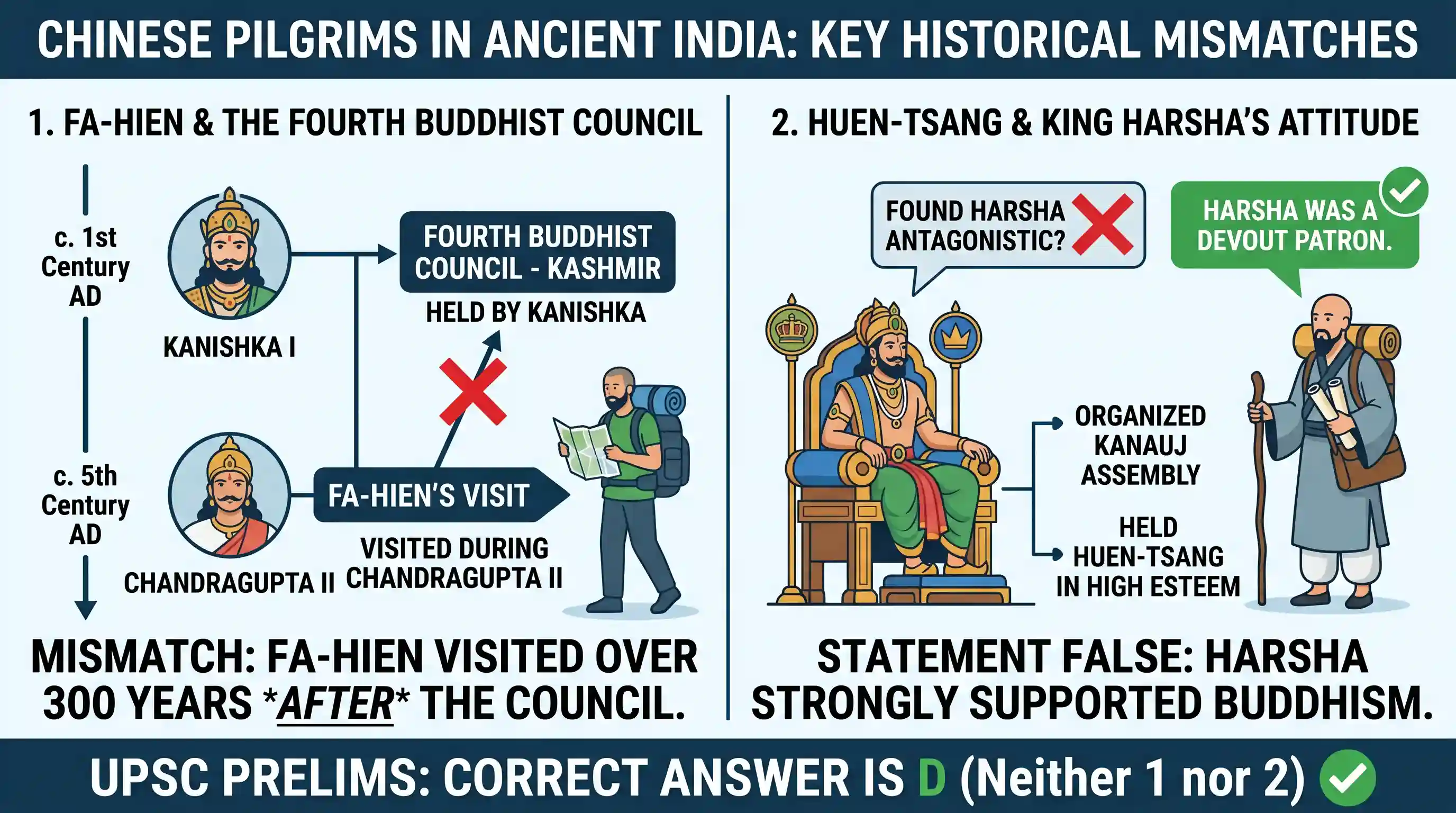
The correct answer is D because both statements are historically inaccurate.
Regarding Statement 1, the fourth Great Buddhist Council was held during the reign of Kanishka around the 1st century AD. However, the Chinese pilgrim Fa-Hien visited India much later, during the reign of Chandragupta II in the 5th century AD. Therefore, Fa-Hien could not have attended the council.
Regarding Statement 2, Huen-Tsang did meet King Harsha Vardhana during the 7th century AD. However, he did not find Harsha antagonistic to Buddhism. On the contrary, Harsha was a great patron of Buddhism and held Huen-Tsang in high regard, even organizing the Kanauj Assembly to propagate Mahayana Buddhism.
Since both statements are false, the answer is neither 1 nor 2.
Related questions
More UPSC Prelims practice from the same subject and topic.
- Prelims 2004GS1history
Consider the following statements: 1. Narasimha Saluva ended the Sangama dynasty and seized the throne for himself and started the Saluva dynasty. Vira Narasimha deposed the last Saluva ruler and seiz…
- Prelims 2004GS1history
With reference to ancient Jainism, which one of the following statements is correct?
- Prelims 2004GS1history
Which one of the following sequences indicates the correct chronological order?
- Prelims 2004GS1history
Consider the following statements about Sikh Gurus: 1. Banda Bahadur was appointed as the military leader of the Sikhs by Guru Tegh Bahadur. 2. Guru Arjan Dev became the Sikh Guru after Guru Ram Das. …
- Prelims 2004GS1history
Consider the following statements: 1. The First Session of the Indian National Congress was held in Calcutta. 2. The Second Session of the Indian National Congress was held under the presidentship of …
- Prelims 2004GS1history
Who was the last ruler of the Tughluq dynasty of the Delhi Sultanate?