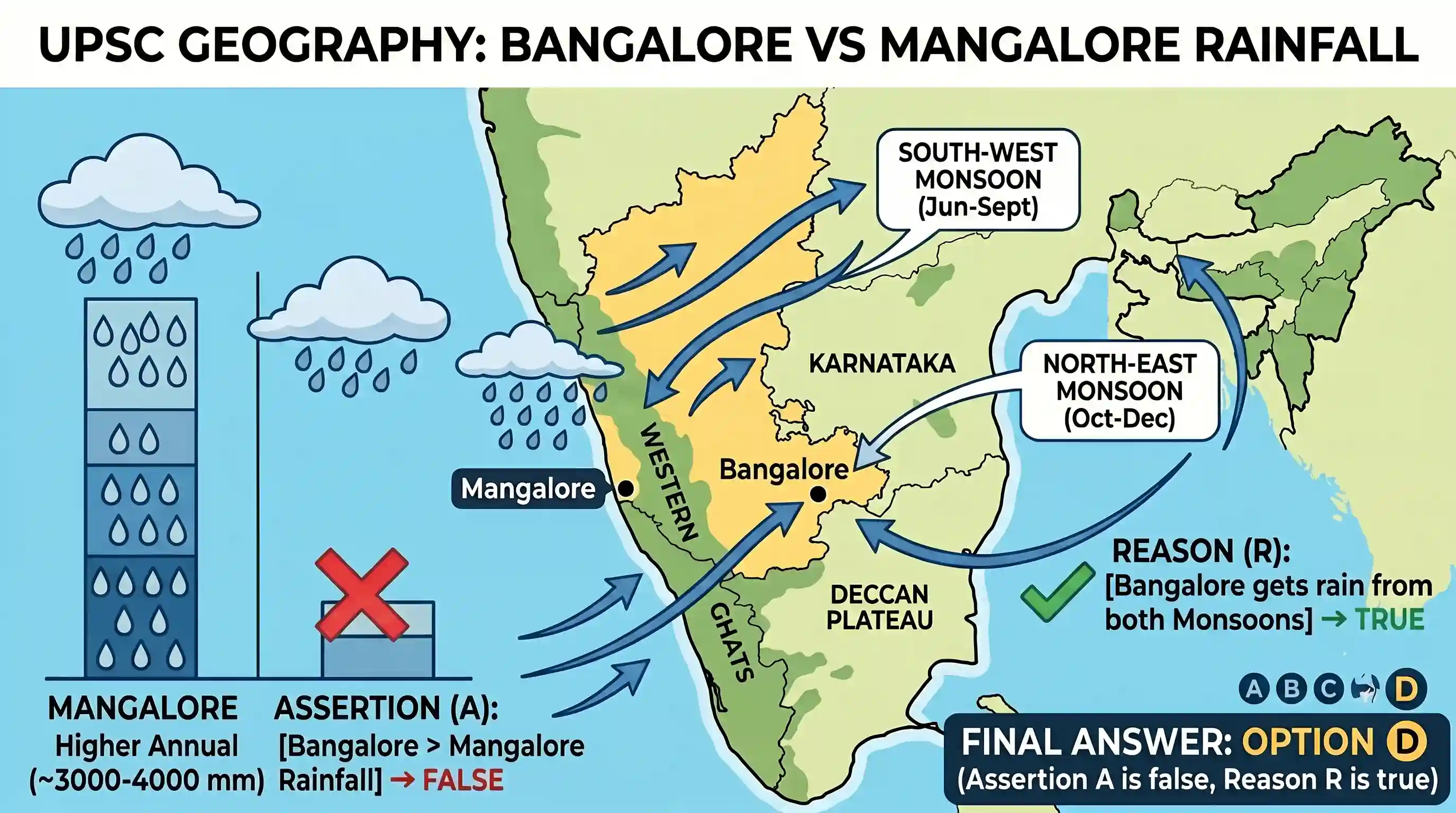
Assertion (A): Bangalore receives much higher average annual rainfall than that of Mangalore. Reason (R): Bangalore has the benefit of receiving rainfall both from south-west and north-east monsoons.

- ABoth A and R are individually true and R is the correct explanation of A
- BBoth A and R are individually true but R is not the correct explanation of A
- CA is true but R is false
- DA is false but R is trueCorrect
Explanation
Assertion (A) is false. Mangalore, being on the west coast and at the foot of the Western Ghats, receives significantly higher average annual rainfall (typically 3000-4000 mm) than Bangalore (typically 900-1000 mm), which is inland on the Deccan Plateau.
Reason (R) is true. Bangalore, located in southern Karnataka, receives rainfall from both the South-West Monsoon (June-September) and the North-East Monsoon (October-December), which brings rainfall to parts of South India as it picks up moisture from the Bay of Bengal.
Since A is false and R is true, option D is the correct answer.
Related questions
More UPSC Prelims practice from the same subject and topic.
- Prelims 2004GS1geography
Which one of the following statements is correct?
- Prelims 2004GS1geography
Assertion (A): The thickness of the atmosphere is maximum over the Equator. Reason (R): High insolation and strong convection currents occur over the Equator.
- Prelims 2004GS1geography
Consider the following statements: 1. Toothless mammals such as pangolins are not found in India. 2. Gibbon is the only ape found in India. Which of the statements given above is are correct?
- Prelims 2004GS1geography
In which one of the following union territories, do the people of the Onge tribe live?
- Prelims 2004GS1geography
Consider the following crops: 1. Cotton 2. Groundnut 3. Maize 4. Mustard Which of the above are Kharif crops?
- Prelims 2004GS1geography
The great Asian river Mekong does run through: