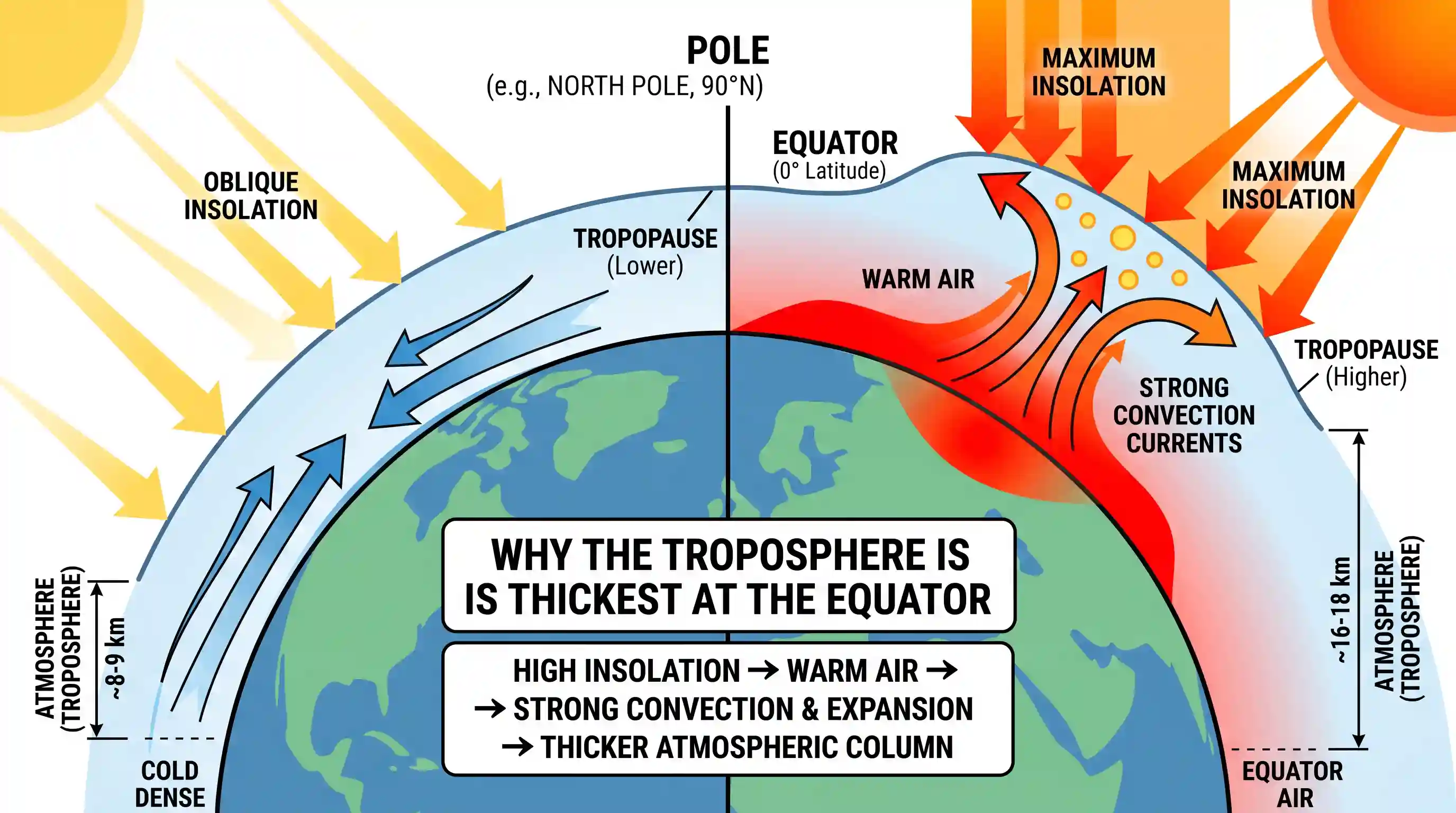
Assertion (A): The thickness of the atmosphere is maximum over the Equator. Reason (R): High insolation and strong convection currents occur over the Equator.

- ABoth A and R are individually true and R is the correct explanation of ACorrect
- BBoth A and R are individually true but R is not the correct explanation of A
- CA is true but R is false
- DA is false but R is true
Explanation
Assertion (A) is true. The troposphere, the lowest and densest layer of the atmosphere where most weather occurs, is indeed thickest over the Equator (around 16-18 km) and thinnest over the poles (around 8-9 km).
Reason (R) is true. The Equator receives maximum direct solar radiation (insolation) throughout the year, leading to significant heating of the surface and the air above it. This warm air becomes less dense and rises, creating strong convection currents.
Reason (R) is the correct explanation for Assertion (A). The high insolation at the Equator causes the air to heat up considerably. This heated air expands and rises due to strong convection. This thermal expansion and upward movement of air push the tropopause (the boundary between the troposphere and stratosphere) to a greater height, making the atmospheric column, particularly the troposphere, thicker over the Equator compared to the colder, denser air at the poles.
Related questions
More UPSC Prelims practice from the same subject and topic.
- Prelims 2004GS1geography
Which one of the following statements is correct?
- Prelims 2004GS1geography
Assertion (A): Bangalore receives much higher average annual rainfall than that of Mangalore. Reason (R): Bangalore has the benefit of receiving rainfall both from south-west and north-east monsoons.
- Prelims 2004GS1geography
Consider the following statements: 1. Toothless mammals such as pangolins are not found in India. 2. Gibbon is the only ape found in India. Which of the statements given above is are correct?
- Prelims 2004GS1geography
In which one of the following union territories, do the people of the Onge tribe live?
- Prelims 2004GS1geography
Consider the following crops: 1. Cotton 2. Groundnut 3. Maize 4. Mustard Which of the above are Kharif crops?
- Prelims 2004GS1geography
The great Asian river Mekong does run through: