Consider the following statements: 1. Ikshvaku rulers were antagonistic towards Buddhism. 2. Pala rulers were patrons of Buddhism. Which of the statements given above is/are correct?

- A1 only
- B2 onlyCorrect
- CBoth 1 and 2
- DNeither 1 nor 2
Explanation
The correct answer is B because of the following reasons:
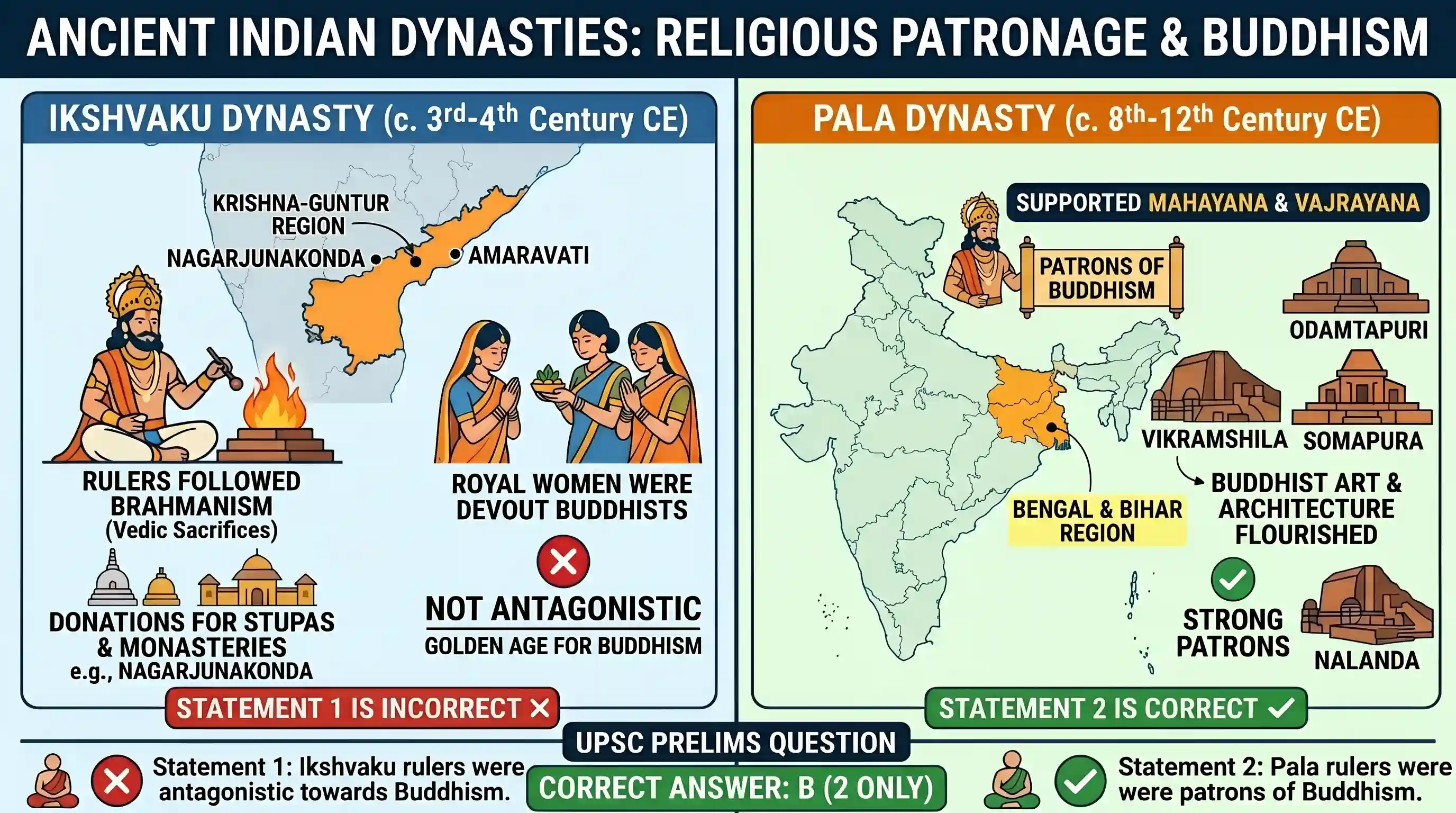
Statement 1 is incorrect. While the Ikshvaku kings of the Krishna Guntur region generally followed Brahmanism and performed Vedic sacrifices, they were not antagonistic towards Buddhism. In fact, the Ikshvaku period was a golden age for Buddhism in Andhra Pradesh. Many royal women of the Ikshvaku family were devout Buddhists and made significant donations for the construction and maintenance of monasteries and stupas, such as those at Nagarjunakonda.
Statement 2 is correct. The Pala rulers of Bengal and Bihar were great patrons of Mahayana and Vajrayana Buddhism. They founded several famous Buddhist universities, including Vikramshila, Somapura, and Odantapuri, and continued to support the established university at Nalanda. Under their patronage, Buddhist art and architecture flourished significantly.
Related questions
More UPSC Prelims practice from the same subject and topic.
- Prelims 2006GS1history
Match List . I with Likst . II and select the correct answer using the code given below the lists: List . I (Place of (State) Archaeological Monument) List I: A. Sisupalgarh, B. Piprahwa, C. Goalpara,…
- Prelims 2006GS1history
Match List. I with List. II and select the correct answer using the code given below the lists: List. I (Finding/Invention/Calculation) List I: A. Time Earth takes to orbit Sun, B. Calculation of π, C…
- Prelims 2006GS1history
Claims to the historical Macedonian territory have been a bone of contention between which of the following countries?
- Prelims 2006GS1history
Who among the following laid the foundation of Rashtrakuta Empire?
- Prelims 2006GS1history
When Raja Wodeyar founded the kingdom of Mysore, who was the ruler of the Vijayanagar Empire?
- Prelims 2006GS1history
Between which of the following was the ancient town of Takshasila located?