The “Instrument of Instructions” contained in the Government of India Act 1935 have been incorporated in the Constitution of India in the year 1950 as

- AFundamental Rights
- BDirective Principles of State PolicyCorrect
- CExtent of executive power of State
- DConduct of business of the Government of India
Explanation
The correct answer is B) Directive Principles of State Policy.
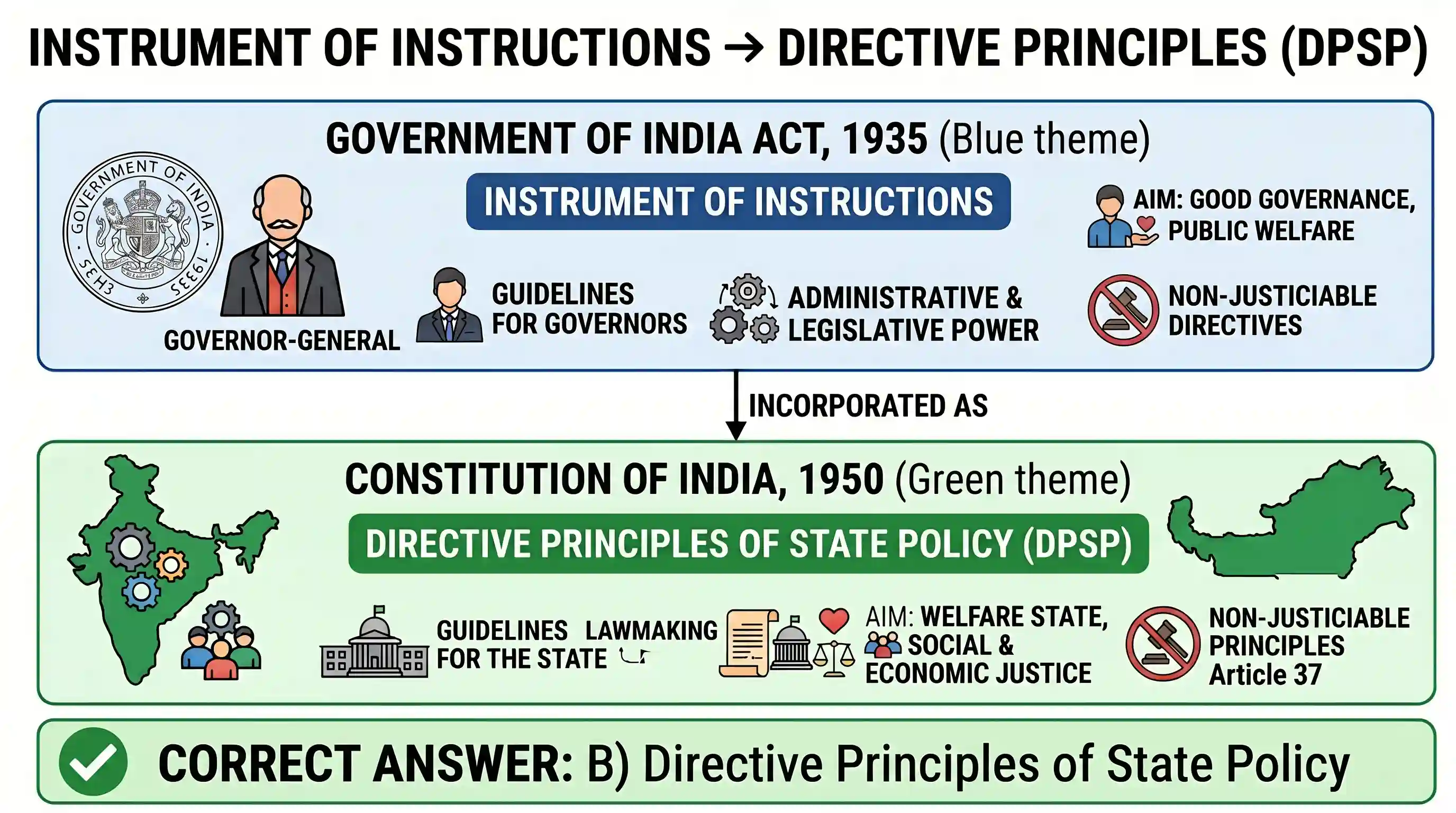
Explanation: The "Instrument of Instructions" contained in the Government of India Act 1935 were directives issued to the Governor-General and Governors of the provinces, guiding them in the exercise of their administrative and legislative powers. These instructions were essentially a set of recommendations for good governance, aiming to promote the welfare of the people.
In the Constitution of India, 1950, these "Instrument of Instructions" were largely incorporated as the Directive Principles of State Policy (DPSP) in Part IV. The DPSP are non-justiciable guidelines for the State to keep in mind while formulating laws and policies, aiming to establish a welfare state and achieve social and economic justice. They reflect the same spirit and purpose as the Instrument of Instructions – to guide the state in its governance towards the well-being of its citizens.
Analysis of options: A) Fundamental Rights: These are justiciable rights enforceable by citizens against the state. The Instrument of Instructions were directives to the state, not rights against it. B) Directive Principles of State Policy: This is correct. The DPSP are non-justiciable guidelines for the state, directly mirroring the nature and purpose of the Instrument of Instructions. C) Extent of executive power of State: While the Instrument of Instructions guided the exercise of executive power, they were more about the principles guiding it rather than merely defining its extent. The extent of executive power is defined by other constitutional provisions. D) Conduct of business of the Government of India: This refers to procedural rules for government functioning (e.g., how orders are authenticated). The Instrument of Instructions were about substantive principles of governance and welfare, not just procedural conduct.
Related questions
More UPSC Prelims practice from the same subject and topic.
- Prelims 2010GS1polity-and-governance
Consider the following statements: The Supreme Court of India tenders advice to the President of India on matters of law or fact 1. on its own initiative (on any matter of larger public interest). 2. …
- Prelims 2010GS1polity-and-governance
With reference to Lok Adalats, which of the following statements is correct?
- Prelims 2010GS1polity-and-governance
In order to comply with TRIPS Agreement, India enacted the Geographical Indications of Goods (Registration | Protection) Act, 1999. The difference/differences between a “Trade Mark” and a Geographical…
- Prelims 2010GS1polity-and-governance
Consider the following statements : 1. The boundaries of a National Park are defined by legislation. 2. A Biosphere Reserve is declared to conserve a few specific species of flora and fauna. 3. In a W…
- Prelims 2010GS1polity-and-governance
Six books A, B, C, D, E and F are placed side by side. B, C and E have blue cover and the other books have red cover. Only D and F are new books and the rest are old. A, C and D are law reports and ot…
- Prelims 2010GS1polity-and-governance
Six persons M, N, O, P, Q and R are sitting in two rows, three in each. Q is not at the end of any row. P is second to the left of R. O is the neighbour of Q and is sitting diagonally opposite to P. N…