The following items consists of four statements. Of these four statements, two cannot both be true, but both can be false. Study the statements carefully and identify the two that satisfy the above condition. Select the correct answer using the codes given below each set of statements: Examine the following statements: 1. All trains are run by diesel engine. 2. Some trains are run by diesel engine. 3. No train is run by diesel engine. 4. Some trains are not run by diesel engine. Codes:

- A1 and 2
- B2 and 3
- C1 and 3Correct
- D1 and 4
Explanation
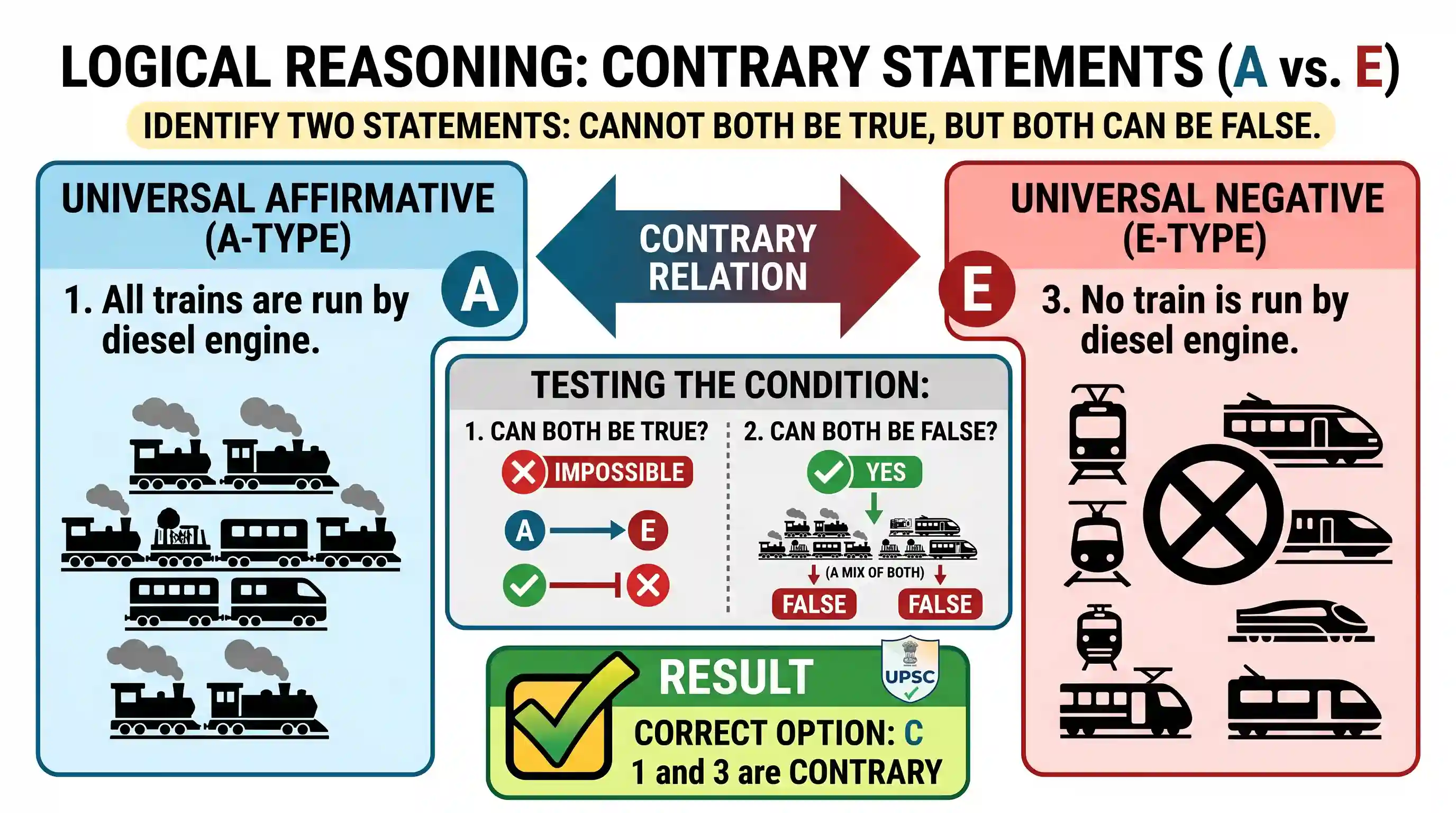
The question asks to identify two statements that "cannot both be true, but both can be false." This is the definition of "contrary" statements in logic, which typically applies to Universal Affirmative (A) and Universal Negative (E) propositions.
Let's analyze each statement:
- All trains are run by diesel engine. (Universal Affirmative - A type)
- Some trains are run by diesel engine. (Particular Affirmative - I type)
- No train is run by diesel engine. (Universal Negative - E type)
- Some trains are not run by diesel engine. (Particular Negative - O type)
Now let's evaluate the options based on the condition:
A) 1 and 2:
- Can they both be true? Yes. If all trains are run by diesel (1 is true), then it logically follows that some trains are run by diesel (2 is true).
- Since they can both be true, this pair does not satisfy the condition "cannot both be true."
B) 2 and 3:
- Can they both be true? No. If "Some trains are run by diesel" (2 is true), then it's impossible that "No train is run by diesel" (3 is true). They are contradictory.
- Can they both be false? No. If "Some trains are run by diesel" (2) is false, it means "No train is run by diesel" (3) must be true. Similarly, if (3) is false, (2) must be true. They cannot both be false.
- This pair represents contradictory statements (I and E), which cannot both be true and cannot both be false. It does not satisfy the condition.
C) 1 and 3:
- Can they both be true? No. If "All trains are run by diesel" (1 is true), it's impossible that "No train is run by diesel" (3 is true). They directly contradict each other in the universal sense.
- Can they both be false? Yes. Consider a scenario where some trains are run by diesel engines, and some are run by electric engines.
- In this scenario, "All trains are run by diesel engine" (1) is false (because some are electric).
- And "No train is run by diesel engine" (3) is also false (because some are diesel).
- This pair satisfies both parts of the condition: they cannot both be true, but they can both be false. This is the definition of "contrary" statements (A and E).
D) 1 and 4:
- Can they both be true? No. If "All trains are run by diesel" (1 is true), then it's impossible that "Some trains are not run by diesel" (4 is true). They are contradictory.
- Can they both be false? No. If "All trains are run by diesel" (1) is false, it means it's not true that all are diesel, which implies that some are not diesel (4 must be true). They cannot both be false.
- This pair represents contradictory statements (A and O), which cannot both be true and cannot both be false. It does not satisfy the condition.
Therefore, statements 1 and 3 are the two that satisfy the given condition.
The final answer is C
Related questions
More UPSC Prelims practice from the same subject and topic.
- Prelims 2011CSATLogical Reasoning
Consider the following three statements: 1. Only students can participate in the race. 2. Some participants in the race are girls. 3. All girl participants in the race are invited for coaching. Which …
- Prelims 2011CSATLogical Reasoning
Each of the following two items consists of four statements. Of these four statements, two cannot both be true, but both can be false. Study the statements carefully and identify the two that satisfy …
- Prelims 2011CSATLogical Reasoning
Consider the following argument: "In, order to be a teacher one must graduate from college. All poets are poor. Some Mathematicians are poets. No college graduate is poor." Which one of the following …
- Prelims 2011CSATLogical Reasoning
The houses of A and B face each other on a road going north-south, A's being on the western side. A comes out of his house, turns left, travels 5 km, turns right, travels 5 km to the front of D's hous…
- Prelims 2011CSATLogical Reasoning
Read the following passage and answer that follow: A, B, C, D and E are members of the same family. There are two fathers, two sons, two wives, three males and two females. The teacher was the, wife o…
- Prelims 2011CSATLogical Reasoning
Read the following passage and answer that follow: A, B, C, D and E are members of the same family. There are two fathers, two sons, two wives, three males and two females. The teacher was the, wife o…