Read the following passage and answer that follow: A, B, C, D and E are members of the same family. There are two fathers, two sons, two wives, three males and two females. The teacher was the, wife of a lawyer who was the son of a doctor. E is not male, neither also a wife of a professional. C is the youngest person in the family and D is the eldest. B is a male. How is D related to E?

- AHusbandCorrect
- BSon
- CFather
- DWife
Explanation
Here's a step-by-step breakdown:
-
Analyze the family composition:
- 5 members: A, B, C, D, E.
- 3 males, 2 females.
- Two fathers, two sons, two wives. This structure implies a 3-generation family with two married couples.
-
Identify the professional roles and their relationships:
- "The teacher was the, wife of a lawyer who was the son of a doctor."
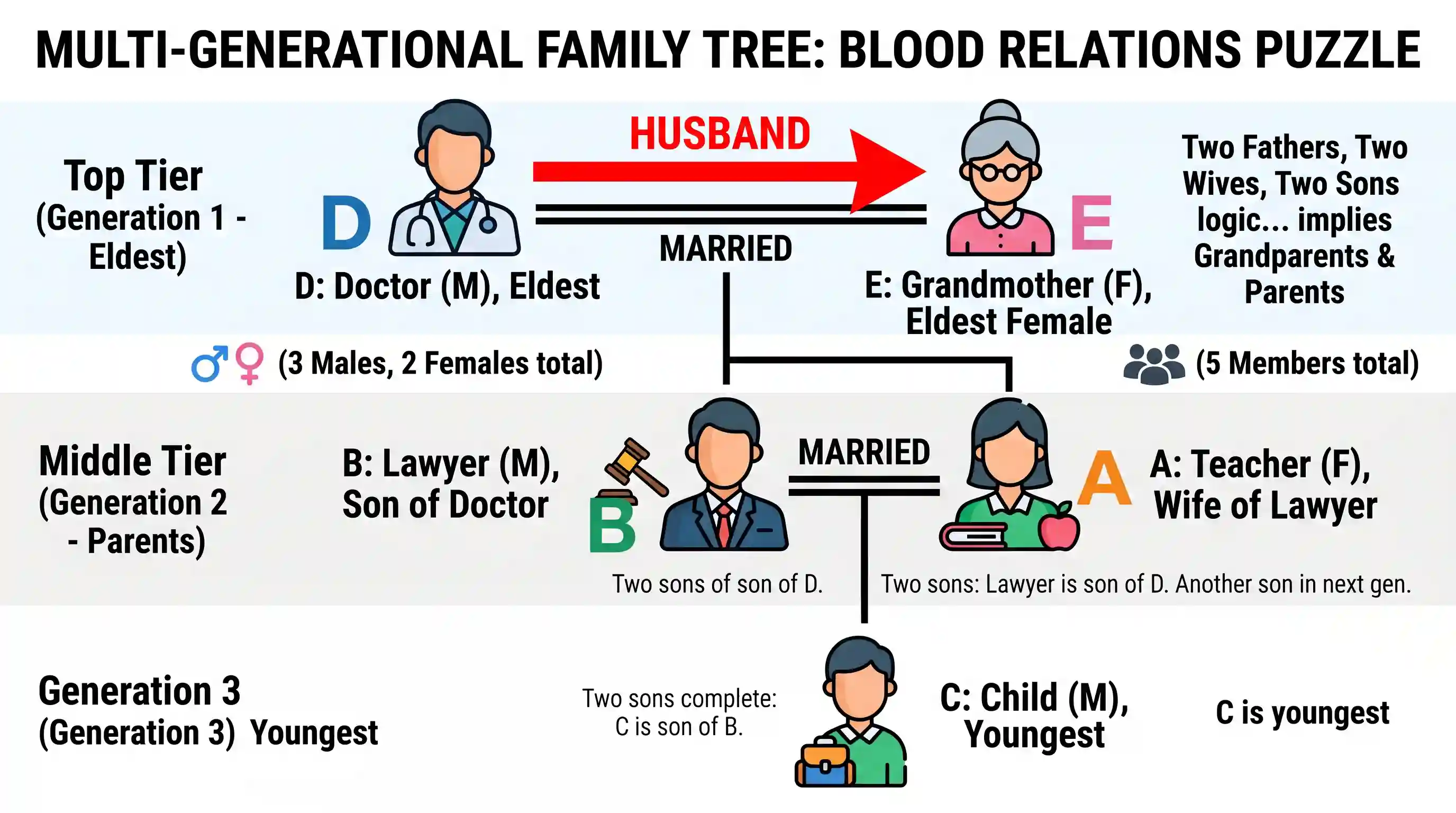
- This establishes a 3-generation lineage: Doctor (male) -> Lawyer (male, son of Doctor) -> Teacher (female, wife of Lawyer).
-
Combine with family composition:
- We have Doctor (M), Lawyer (M), Teacher (F). This is 2 males, 1 female.
- To get 3 males and 2 females, we need one more male and one more female.
- The additional female must be the wife of the Doctor (let's call her Grandmother).
- The additional male must be the child of the Lawyer and Teacher (let's call him Child).
- So, the family roles are: Doctor (M), Grandmother (F), Lawyer (M), Teacher (F), Child (M).
-
Map specific members to roles using clues:
- "C is the youngest person in the family": C = Child (M).
- "D is the eldest": D = Doctor (M) or Grandmother (F).
- "B is a male": B = Doctor (M) or Lawyer (M).
- "E is not male, neither also a wife of a professional."
- "E is not male" means E is female. The two females are Grandmother and Teacher.
- "neither also a wife of a professional": This is the crucial part. The "Teacher" is explicitly described as "the wife of a lawyer who was the son of a doctor." This phrase "wife of a professional" most likely refers specifically to the Teacher in this context. If E is not the Teacher, then E must be the other female, the Grandmother.
- So, E = Grandmother (F).
-
Complete the mapping:
- We have: C (Child, M), E (Grandmother, F).
- Remaining members: A, B, D.
- Remaining roles: Doctor (M), Lawyer (M), Teacher (F).
- "D is the eldest": Since E is Grandmother, D must be the Doctor (M) to be the eldest male and E's spouse.
- "B is a male": B must be the Lawyer (M).
- "A" is the last member: A must be the Teacher (F).
-
Verify the complete family structure:
- D (Doctor, M) is married to E (Grandmother, F).
- B (Lawyer, M) is their son, married to A (Teacher, F).
- C (Child, M) is the son of B and A.
- All conditions (2 fathers, 2 sons, 2 wives, 3 males, 2 females, professions, ages, genders) are met.
-
Answer the question:
- How is D related to E?
- D is the Doctor (M), and E is the Grandmother (F). They are married.
- Therefore, D is the Husband of E.
The final answer is A) Husband.
Related questions
More UPSC Prelims practice from the same subject and topic.
- Prelims 2011CSATLogical Reasoning
Read the following passage and answer that follow: A, B, C, D and E are members of the same family. There are two fathers, two sons, two wives, three males and two females. The teacher was the, wife o…
- Prelims 2011CSATLogical Reasoning
Read the following passage and answer that follow: A, B, C, D and E are members of the same family. There are two fathers, two sons, two wives, three males and two females. The teacher was the, wife o…
- Prelims 2011CSATLogical Reasoning
Consider the following three statements: 1. Only students can participate in the race. 2. Some participants in the race are girls. 3. All girl participants in the race are invited for coaching. Which …
- Prelims 2011CSATLogical Reasoning
Each of the following two items consists of four statements. Of these four statements, two cannot both be true, but both can be false. Study the statements carefully and identify the two that satisfy …
- Prelims 2011CSATLogical Reasoning
The following items consists of four statements. Of these four statements, two cannot both be true, but both can be false. Study the statements carefully and identify the two that satisfy the above co…
- Prelims 2011CSATLogical Reasoning
Consider the following argument: "In, order to be a teacher one must graduate from college. All poets are poor. Some Mathematicians are poets. No college graduate is poor." Which one of the following …