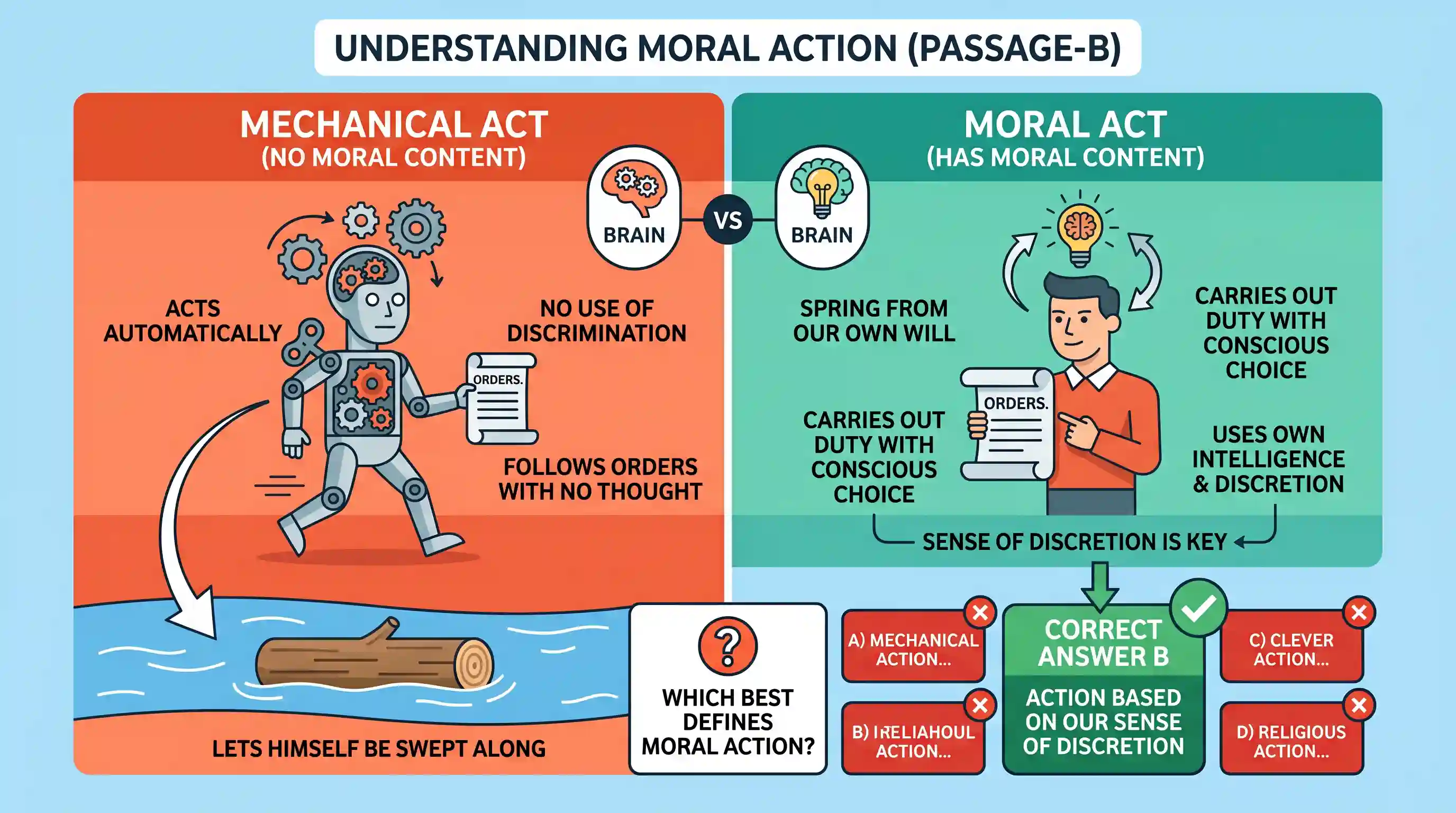
Passage-B: A moral act must be our own act; must spring from our own will. If we act mechanically, these is no moral content in our act. Such action would be moral, If we think it proper to act like a machine and do so. For, in doing so, we use our discrimination. We should bear in mind the distinction between acting mechanically and acting intentionally. It may be moral of a king to pardon a culprit. But the messenger carrying out the order of pardon plays only a mechanical part in the king's moral act. But if the messenger were to carry out the king's order considering it to be his duty, his action would be a moral one. How can a man understand morality who does not use his own intelligence and power of thought, but lets himself be swept along like a log of wood by a current? Sometimes a man defies convention and acts on his own with a view to absolute good. Which of the following statements best describe/describes the thought of the writer? Which of the following statements is the nearest definition of moral action, according to the writer?

- Ait is a mechanical action based on official orders from superiors
- BIt is an action based on our sence of discretionCorrect
- CIt is a clever action based on the clarity of purpose
- DIt is a religious action based on understanding.
Explanation
The writer emphasizes that a moral act must be our own act, springing from our own will, and involving the use of our intelligence and power of thought. Mechanical actions lack moral content unless they are consciously chosen through "discrimination."
Let's analyze the options:
A) it is a mechanical action based on official orders from superiors: The passage explicitly states that if we act mechanically, there is no moral content. The messenger's mechanical act is contrasted with a moral act where he considers it his duty. So, this is incorrect.
B) It is an action based on our sense of discretion: The passage uses terms like "use our discrimination," "use his own intelligence and power of thought," and acting "on his own with a view to absolute good." "Discretion" means the freedom to decide what should be done in a particular situation, which perfectly aligns with using one's own judgment, intelligence, and will, as opposed to acting mechanically. This is the nearest definition.
C) It is a clever action based on the clarity of purpose: While clarity of purpose might be involved, the passage does not emphasize "cleverness" as a defining characteristic of moral action. The core is about agency and conscious choice, not necessarily strategic cleverness.
D) It is a religious action based on understanding: The passage does not mention religion at all. The discussion is purely philosophical/ethical, focusing on individual will, thought, and discrimination, not religious tenets.
Therefore, option B is the most accurate description of moral action according to the writer.
Related questions
More UPSC Prelims practice from the same subject and topic.
- Prelims 2011CSATReading Comprehension
Read each of the following two passages and answer the items that follow. Your answers to these items should be based on the passages only. Passage-I For achieving inclusive growth there is- a critica…
- Prelims 2011CSATReading Comprehension
Passage-I For achieving inclusive growth there is- a critical need to rethink the- role of the State. The early debate among economists about the size of the Government can be misleading. The need of …
- Prelims 2011CSATReading Comprehension
Passage-I For achieving inclusive growth there is- a critical need to rethink the- role of the State. The early debate among economists about the size of the Government can be misleading. The need of …
- Prelims 2011CSATReading Comprehension
Passage- I For achieving inclusive growth there is- a critical need to rethink the- role of the State. The early debate among economists about the size of the Government can be misleading. The need of…
- Prelims 2011CSATReading Comprehension
Passage-I For achieving inclusive growth there is- a critical need to rethink the- role of the State. The early debate among economists about the size of the Government can be misleading. The need of …
- Prelims 2011CSATReading Comprehension
Passage-2 The concept of 'creative society' refers to a phase of development of a society in which a large number of potential contradictions become articulate and active. This is most evident when op…