Passage- B: A moral act must be our own act; must spring from our own will. If we act mechanically, these is no moral content in our act. Such action would be moral, If we think it proper to act like a machine and do so. For, in doing so, we use our discrimination. We should bear in mind the distinction between acting mechanically and acting intentionally. It may be moral of a king to pardon a culprit. But the messenger carrying out the order of pardon plays only a mechanical part in the king's moral act. But if the messenger were to carry out the king's order considering it to be his duty, his action would be a moral one. How can a man understand morality who does not use his own intelligence and power of thought, but lets himself be swept along like a log of wood by a current? Sometimes a man defies convention and acts on his own with a view to absolute good. The passage contains a statement "lets himself be swept along like a log of wood by a current." Among the following statements, which is/are nearest in meaning to this? 1. A person does not use his own reason. 2. He is susceptible to influence/pressure. 3. He cannot withstand difficulties/challenges. 4. He is like a log of wood. Select the correct answer using the codes given below:

- A1 onlyCorrect
- B1 and 2
- C2 and 3
- D1 and 4
Explanation
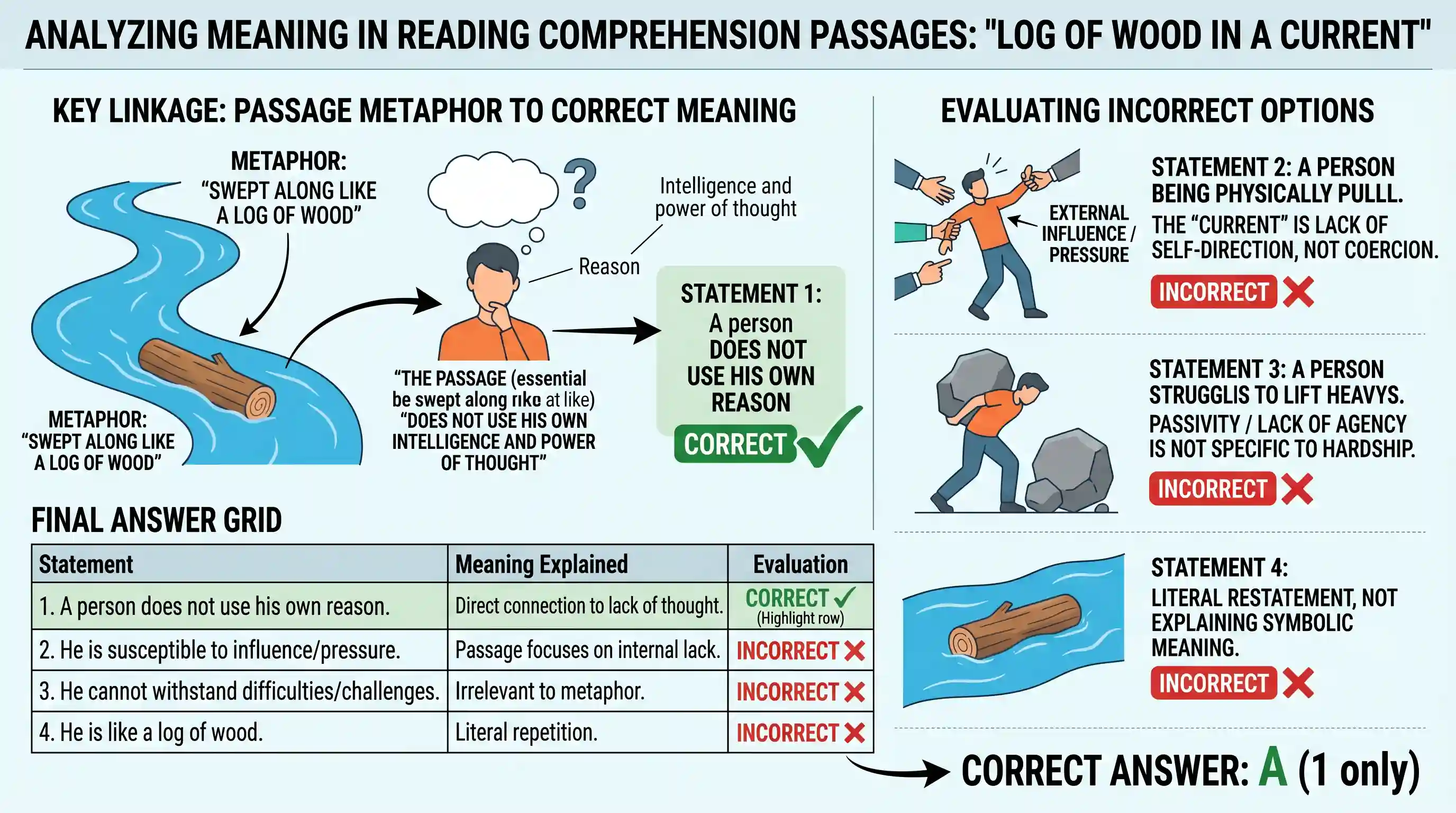
The passage explicitly links "lets himself be swept along like a log of wood by a current" with "does not use his own intelligence and power of thought."
-
A person does not use his own reason. This statement directly reflects the passage's explanation: "How can a man understand morality who does not use his own intelligence and power of thought, but lets himself be swept along like a log of wood by a current?" "Intelligence and power of thought" is synonymous with "reason." This is the core meaning conveyed.
-
He is susceptible to influence/pressure. While being "swept along" implies a lack of control, the passage's emphasis is on the absence of internal thought and will, not necessarily external influence or pressure from others. The "current" represents a lack of self-direction based on one's own mind, rather than succumbing to external human pressure.
-
He cannot withstand difficulties/challenges. The simile of a log being swept by a current speaks to passivity and lack of agency, not specifically an inability to cope with hardships or challenges.
-
He is like a log of wood. This is a literal restatement of part of the simile, not an explanation of its intended meaning or implication within the passage's context. The question asks for the meaning, not a repetition of the phrase itself.
Therefore, statement 1 is the nearest in meaning as it directly captures the essence of not using one's own intelligence and independent thought, which the passage contrasts with a moral act.
The final answer is A) 1 only
Related questions
More UPSC Prelims practice from the same subject and topic.
- Prelims 2011CSATReading Comprehension
Read each of the following two passages and answer the items that follow. Your answers to these items should be based on the passages only. Passage-I For achieving inclusive growth there is- a critica…
- Prelims 2011CSATReading Comprehension
Passage-I For achieving inclusive growth there is- a critical need to rethink the- role of the State. The early debate among economists about the size of the Government can be misleading. The need of …
- Prelims 2011CSATReading Comprehension
Passage-I For achieving inclusive growth there is- a critical need to rethink the- role of the State. The early debate among economists about the size of the Government can be misleading. The need of …
- Prelims 2011CSATReading Comprehension
Passage- I For achieving inclusive growth there is- a critical need to rethink the- role of the State. The early debate among economists about the size of the Government can be misleading. The need of…
- Prelims 2011CSATReading Comprehension
Passage-I For achieving inclusive growth there is- a critical need to rethink the- role of the State. The early debate among economists about the size of the Government can be misleading. The need of …
- Prelims 2011CSATReading Comprehension
Passage-2 The concept of 'creative society' refers to a phase of development of a society in which a large number of potential contradictions become articulate and active. This is most evident when op…