Passage- Ill In spring, polar bear mothers emerge from dens with three month old cubs. The mother bear has fasted for as long as eight months but that does not stop the young from demanding full access to her remaining reserves. If there are triplets, the most persistent stands to gain an extra meal and it may have the meal at the expense of others. The smallest of the litter forfeits many meals to stronger siblings. Females are protective of their cubs but tend to ignore family rivalry over food. In 21 years of photographing polar bears, I've only once seen the smallest of triplets survive till autumn. With reference to the passage, the following assumptions have been made: 1. Polar bears fast as long as eight months due to non-availability of prey. 2. Polar bears always give birth to triplets. Which of the assumptions given above is/are valid?

- A1 only
- B2 only
- CBoth 1 and 2
- DNeither 1 nor 2Correct
Explanation
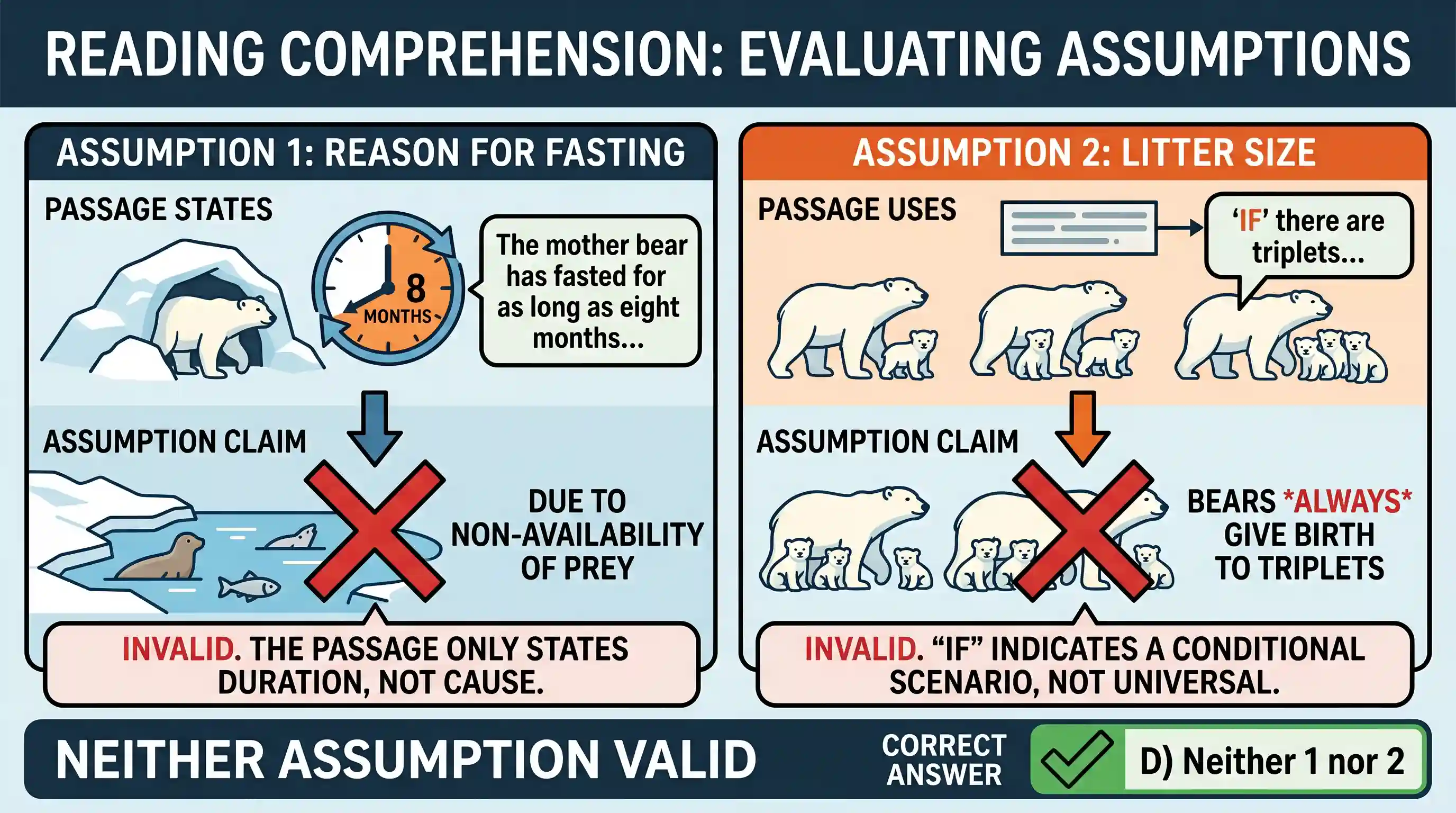
Neither assumption is valid based on the passage.
Assumption 1: The passage states the mother bear "has fasted for as long as eight months" but does not provide any reason for this fast. It does not mention prey availability or lack thereof. Therefore, assuming the fast is due to non-availability of prey is an unsupported inference.
Assumption 2: The passage mentions "If there are triplets" and "the smallest of triplets survive". This indicates that triplets are a possibility and have been observed, but it does not state that polar bears always give birth to triplets. The phrasing "If there are triplets" implies it's a conditional scenario, not a universal rule.
Since neither assumption can be directly inferred or supported by the information given in the passage, option D is correct.
Related questions
More UPSC Prelims practice from the same subject and topic.
- Prelims 2011CSATReading Comprehension
Read each of the following two passages and answer the items that follow. Your answers to these items should be based on the passages only. Passage-I For achieving inclusive growth there is- a critica…
- Prelims 2011CSATReading Comprehension
Passage-I For achieving inclusive growth there is- a critical need to rethink the- role of the State. The early debate among economists about the size of the Government can be misleading. The need of …
- Prelims 2011CSATReading Comprehension
Passage-I For achieving inclusive growth there is- a critical need to rethink the- role of the State. The early debate among economists about the size of the Government can be misleading. The need of …
- Prelims 2011CSATReading Comprehension
Passage- I For achieving inclusive growth there is- a critical need to rethink the- role of the State. The early debate among economists about the size of the Government can be misleading. The need of…
- Prelims 2011CSATReading Comprehension
Passage-I For achieving inclusive growth there is- a critical need to rethink the- role of the State. The early debate among economists about the size of the Government can be misleading. The need of …
- Prelims 2011CSATReading Comprehension
Passage-2 The concept of 'creative society' refers to a phase of development of a society in which a large number of potential contradictions become articulate and active. This is most evident when op…