Each item describes a situation and is followed by four possible responses. Indicate the response you find most appropriate. Choose only one response for each item. The responses will be evaluated based on the level of appropriateness for the given situation You, as an administrative authority, have been approached, by the daughter-in-law of an influential person regarding harassment by her in-laws on account of insufficient dowry. Her parents are not able to approach you because of social pressures. You would

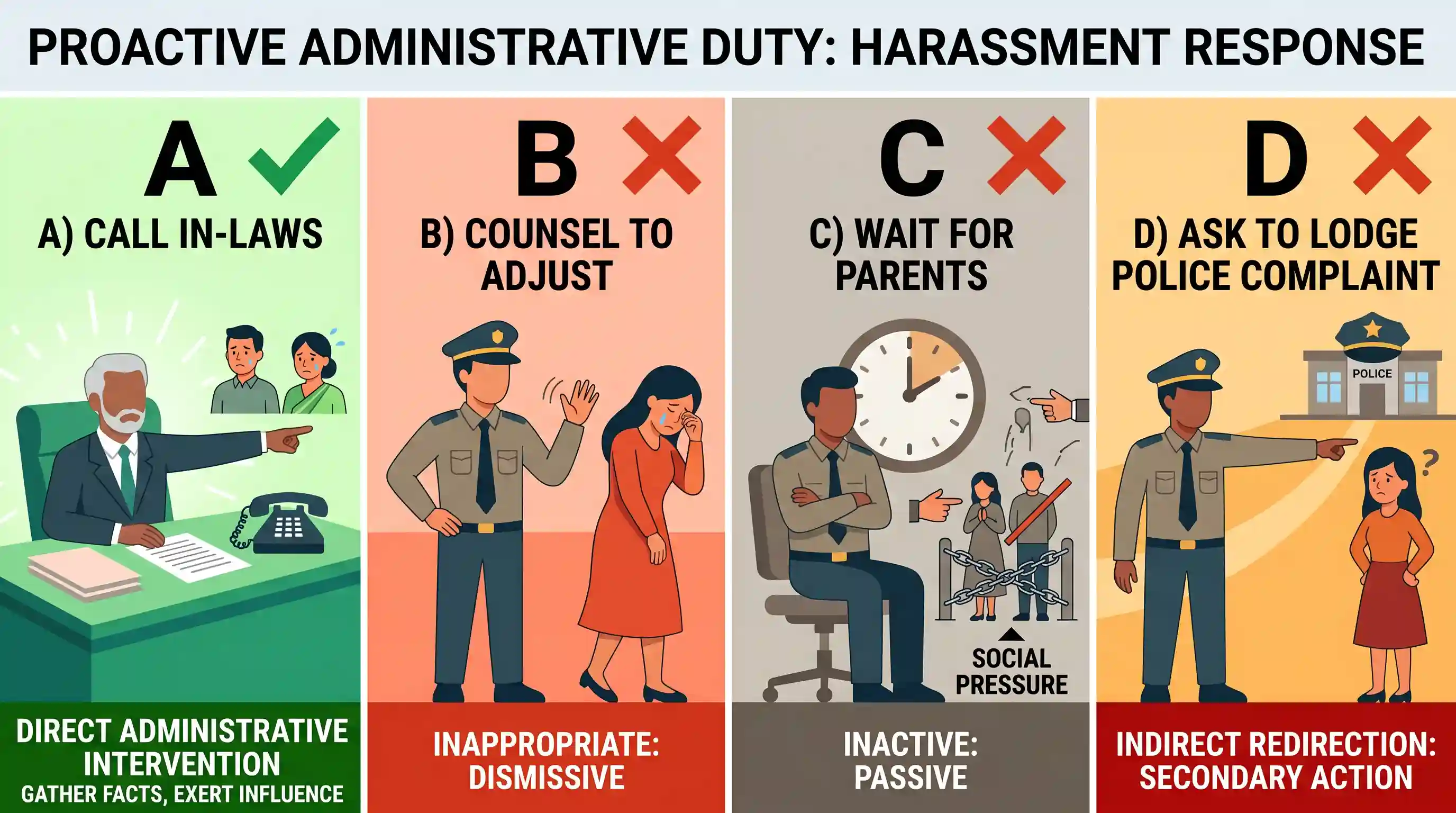
- Acall the in-laws for an explanationCorrect
- Bcounsel the lady to adjust, given such a circumstance
- Ctake action after her parents approach you
- Dask her to lodge complaint with the police.
Explanation
Explanation:
Option A is correct because as an administrative authority, your primary duty is to address grievances directly and proactively, especially when a vulnerable person approaches you. Calling the in-laws for an explanation is an immediate, appropriate first step to investigate the complaint, gather facts, and exert administrative pressure to resolve the issue. It demonstrates your commitment to justice and protection of rights.
Option B is incorrect because it is unethical and dismisses the victim's suffering, normalizing harassment instead of addressing it. An administrative authority must never counsel a victim to adjust to harassment.
Option C is incorrect because it ignores the specific detail that the parents cannot approach due to social pressure. An administrative authority should act on a direct complaint from the victim herself, rather than waiting for others, especially when they are constrained.
Option D is incorrect because while lodging a police complaint is a valid legal step, as an administrative authority, your first response should be to engage directly with the complaint using your administrative powers (like calling parties for explanation/mediation) rather than simply redirecting the complainant. Calling the in-laws is a direct administrative intervention that can precede or facilitate further legal action.
Related questions
More UPSC Prelims practice from the same subject and topic.
- Prelims 2011CSATDecision Making
Each item describes a situation and is followed by four possible responses. Indicate the response you find most appropriate. Choose only one response for each item. The responses will be evaluated bas…
- Prelims 2011CSATDecision Making
Each item describes a situation and is followed by four possible responses. Indicate the response you find most appropriate. Choose only one response for each item. The responses will be evaluated bas…
- Prelims 2011CSATDecision Making
Each item describes a situation and is followed by four possible responses. Indicate the response you find most appropriate. Choose only one response for each item. The responses will be evaluated bas…
- Prelims 2011CSATDecision Making
Each item describes a situation and is followed by four possible responses. Indicate the response you find most appropriate. Choose only one response for each item. The responses will be evaluated bas…
- Prelims 2011CSATDecision Making
Each item describes a situation and is followed by four possible responses. Indicate the response you find most appropriate. Choose only one response for each item. The responses will be evaluated bas…
- Prelims 2011CSATDecision Making
Each item describes a situation and is followed by four possible responses. Indicate the response you find most appropriate. Choose only one response for each item. The responses will be evaluated bas…