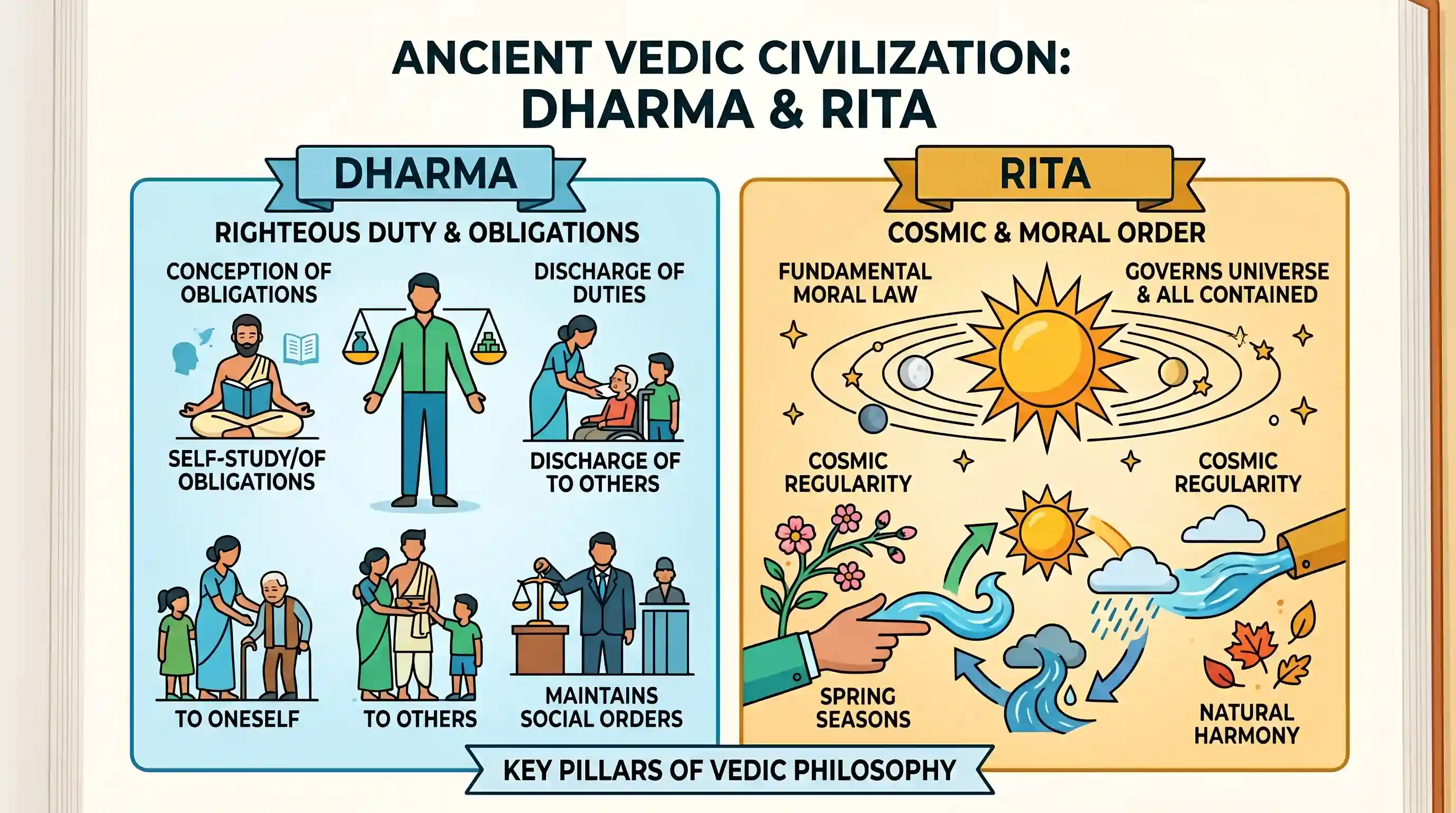
The “dharma” and “rita” depict a central idea of ancient Vedic civilization of India. In this context, consider the following statements: 1. Dharma was a conception of obligations and of the discharge of one’s duties to oneself and to others. 2. Rita was the fundamental moral law governing the functioning of the universe and all it contained. Which of the statements given above is/are correct?

- A1 only
- B2 only
- CBoth 1 and 2Correct
- DNeither 1 nor 2
Explanation
The correct answer is C because both statements accurately describe the Vedic concepts of Dharma and Rita.
Statement 1 is correct because Dharma refers to the individual and social duties, ethical obligations, and righteous conduct that a person must follow to maintain social order and personal growth. It emphasizes the discharge of responsibilities toward oneself, family, and society.
Statement 2 is correct because Rita represents the cosmic and moral order of the universe. In Vedic philosophy, it is the underlying principle that regulates the movement of the sun, the seasons, and the moral conduct of living beings. It ensures that the universe functions in a balanced and orderly manner.
Since both statements correctly define these fundamental pillars of ancient Indian civilization, option C is the right choice.
Related questions
More UPSC Prelims practice from the same subject and topic.
- Prelims 2011GS1history
Regarding the Indus Valley Civilization, consider the following statements: 1. It was predominantly a secular civilization and the religious element, though present, did not dominate the scene. 2. Dur…
- Prelims 2011GS1history
The tendency for increased litigation was visible after the introduction of the land settlement system of Lord Cornwallis in 1793. The reason for this is normally traced to which of the following prov…
- Prelims 2011GS1history
Which one of the following observations is not true about the Quit India Movement of 1942?
- Prelims 2011GS1history
Which amongst the following provided a common factor for tribal insurrection in India in the 19th century?
- Prelims 2011GS1history
With reference to the period of colonial rule in India, “Home Charges” formed an important part of drain of wealth from India. Which of the following funds constituted “Home Charges”? 1. Funds used to…
- Prelims 2011GS1history
What was the reason for Mahatma Gandhi to organize a satyagraha on behalf of the peasants of Kheda? 1. The Administration did not suspend the land revenue collection in spite of a drought. 2. The Admi…