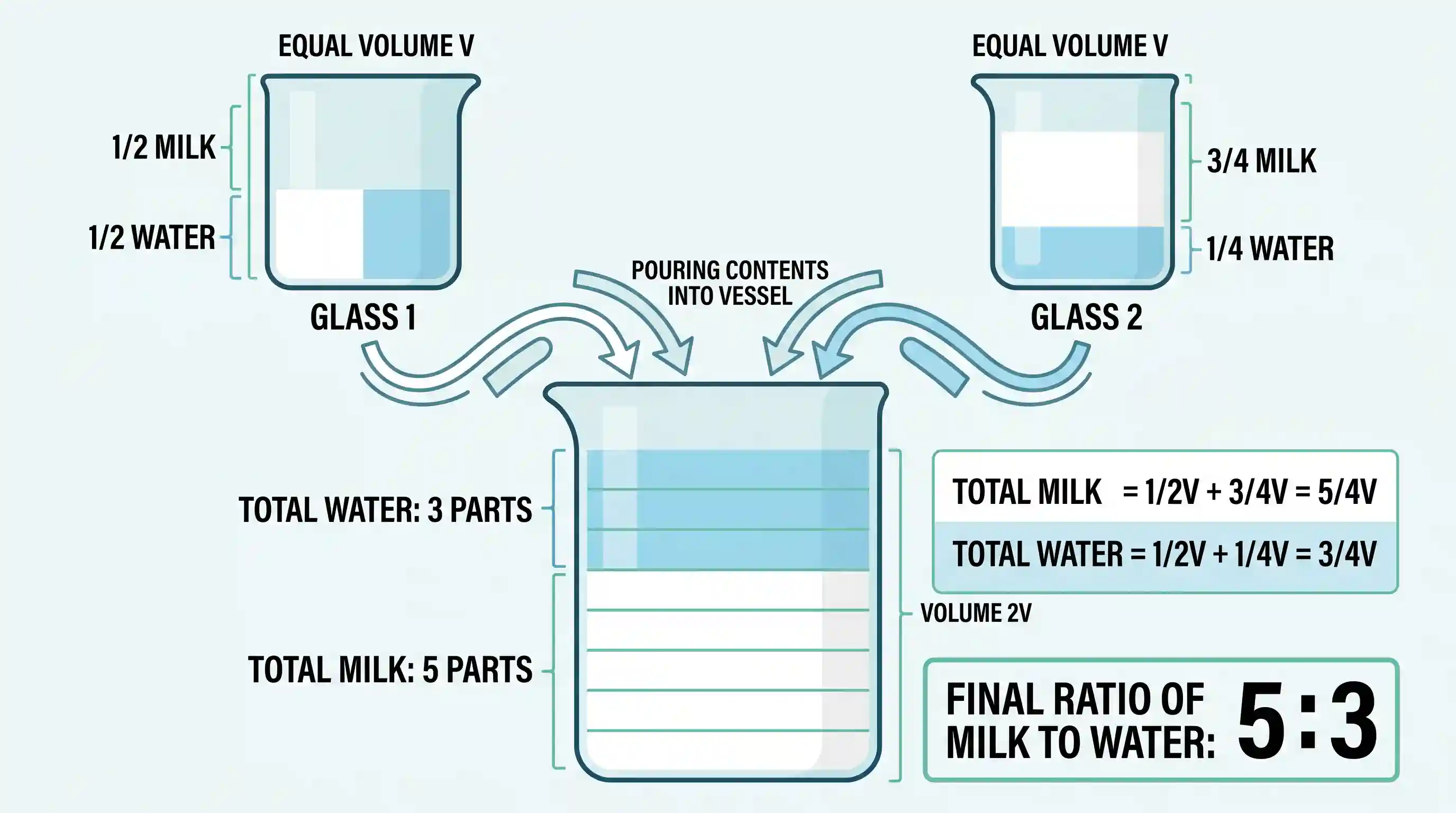
Two glasses of equal volume are respectively half and three-fourths filled with milk. They are then filled to the brim by adding water. Their contents are then poured into another vessel. What will be the ratio of milk to water in this vessel?

- A1:3
- B2:3
- C3:2
- D5:3Correct
Explanation
Let the volume of each glass be V.
Glass 1: Milk = V/2 Water added to fill = V - V/2 = V/2
Glass 2: Milk = 3V/4 Water added to fill = V - 3V/4 = V/4
When contents are poured into another vessel: Total Milk = Milk from Glass 1 + Milk from Glass 2 Total Milk = V/2 + 3V/4 = 2V/4 + 3V/4 = 5V/4
Total Water = Water from Glass 1 + Water from Glass 2 Total Water = V/2 + V/4 = 2V/4 + V/4 = 3V/4
Ratio of Milk to Water = (Total Milk) : (Total Water) Ratio = (5V/4) : (3V/4) Ratio = 5:3
Therefore, the ratio of milk to water in the vessel is 5:3.
Option A (1:3): Incorrect. This would imply much less milk relative to water. Option B (2:3): Incorrect. This would mean 2 parts milk for 3 parts water. Option C (3:2): Incorrect. This would mean more milk than water, but not the correct proportion. Option D (5:3): Correct. This matches our calculation of 5 parts milk to 3 parts water.
Related questions
More UPSC Prelims practice from the same subject and topic.
- Prelims 2012CSATQuantitative Aptitude
Mr. Kumar drives to work at an average speed of 48 km per hour. The time taken to cover the first 60% of the distance is 10 minutes more than the time taken to cover the remaining distance. How far is…
- Prelims 2012CSATQuantitative Aptitude
Consider the following information regarding the performance of a class of 1000 students in four different tests: If a student scores 74 marks in each of the four tests, In which one of the following …
- Prelims 2025CSATQuantitative Aptitude
A natural number N is such that it can be expressed as N = p + q + r , where p, q and r are distinct factors of N. How many numbers below 50 have this property?
- Prelims 2025CSATQuantitative Aptitude
Three prime numbers p, q and r, each less than 20, are such that p - q = q - r . How many distinct possible values can we get for (p + q + r) ?
- Prelims 2025CSATQuantitative Aptitude
How many possible values of (p + q + r) are there satisfying (1)/(p) + (1)/(q) + (1)/(r) = 1 , where p, q and r are natural numbers (not necessarily distinct)?
- Prelims 2025CSATQuantitative Aptitude
Team X scored a total of N runs in 20 overs. Team Y tied the score in 10% less overs. Had team Y's average run rate (runs per over) been 50% higher, the scores would have been tied in 12 overs. How ma…