How many possible values of (p + q + r) are there satisfying (1)/(p) + (1)/(q) + (1)/(r) = 1 , where p, q and r are natural numbers (not necessarily distinct)?

- ANone
- BOne
- CThreeCorrect
- DMore than three
Explanation
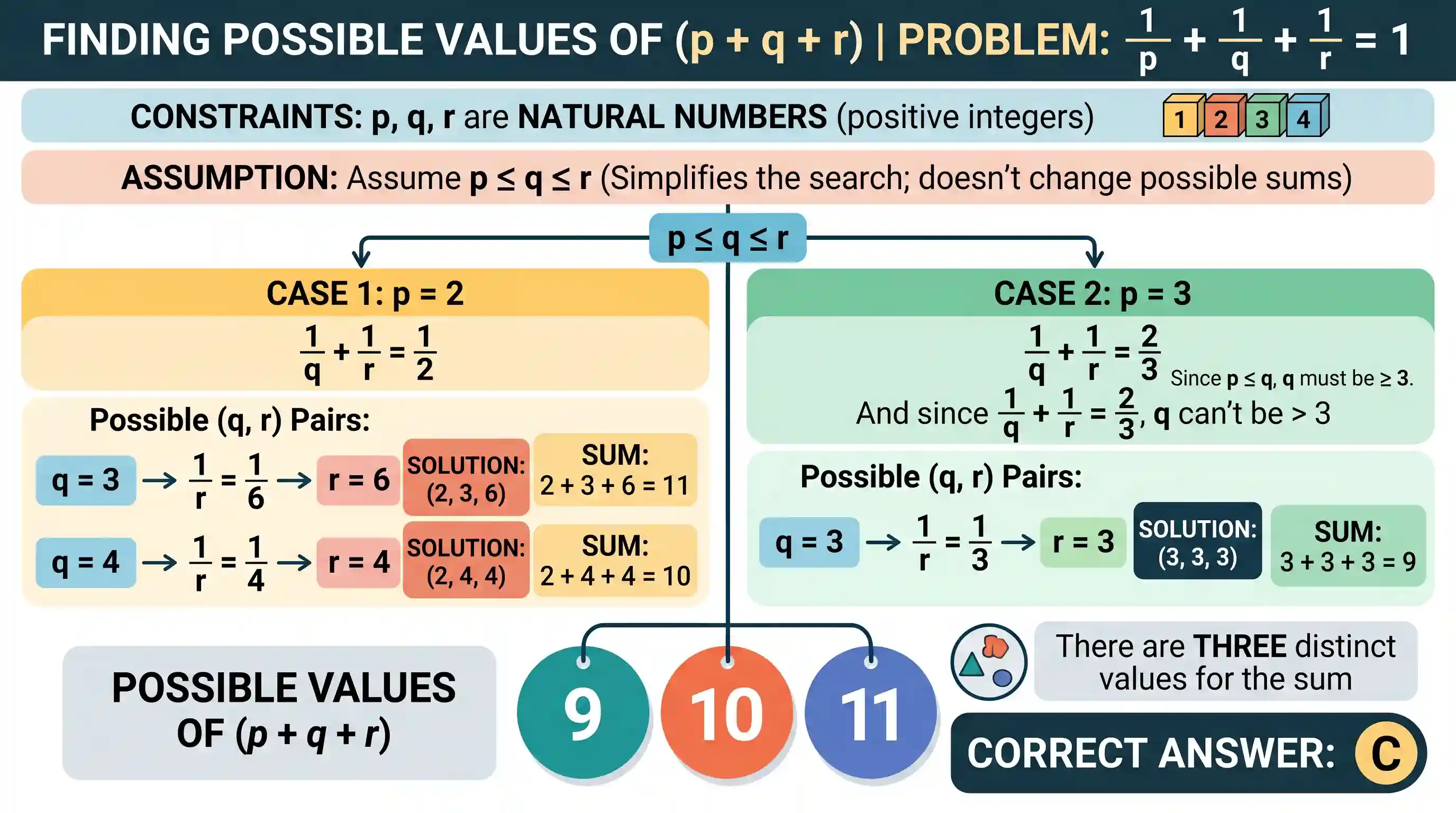
To solve the equation 1/p + 1/q + 1/r = 1 where p, q, and r are natural numbers, we can assume p is less than or equal to q, and q is less than or equal to r.
If p equals 1, the sum would exceed 1, so p must be at least 2.
Case 1: If p = 2 The equation becomes 1/q + 1/r = 1/2. The possible pairs for (q, r) are (3, 6), (4, 4), and (2, infinity is not possible).
- For (2, 3, 6), the sum p + q + r is 2 + 3 + 6 = 11.
- For (2, 4, 4), the sum p + q + r is 2 + 4 + 4 = 10.
Case 2: If p = 3 The equation becomes 1/q + 1/r = 2/3. The only possible pair for (q, r) where q is at least 3 is (3, 3).
- For (3, 3, 3), the sum p + q + r is 3 + 3 + 3 = 9.
If p is greater than 3, the sum 1/p + 1/q + 1/r will always be less than 1.
The possible values for the sum (p + q + r) are 11, 10, and 9. This gives a total of three distinct possible values. Therefore, the correct option is C.
Related questions
More UPSC Prelims practice from the same subject and topic.
- Prelims 2025CSATQuantitative Aptitude
A natural number N is such that it can be expressed as N = p + q + r , where p, q and r are distinct factors of N. How many numbers below 50 have this property?
- Prelims 2025CSATQuantitative Aptitude
Three prime numbers p, q and r, each less than 20, are such that p - q = q - r . How many distinct possible values can we get for (p + q + r) ?
- Prelims 2025CSATQuantitative Aptitude
A 4-digit number N is such that when divided by 3, 5, 6, 9 leaves a remainder 1, 3, 4, 7 respectively. What is the smallest value of N?
- Prelims 2025CSATQuantitative Aptitude
What is the unit digit in the multiplication of 1× 3× 5× 7× 9× … × 999 ?
- Prelims 2025CSATQuantitative Aptitude
Consider the first 100 natural numbers. How many of them are not divisible by any one of 2, 3, 5, 7 and 9?
- Prelims 2025CSATQuantitative Aptitude
Let both p and k be prime numbers such that (p² + k) is also a prime number less than 30 What is the number of possible values of k?