Consider the first 100 natural numbers. How many of them are not divisible by any one of 2, 3, 5, 7 and 9?

- A20
- B21
- C22Correct
- D23
Explanation
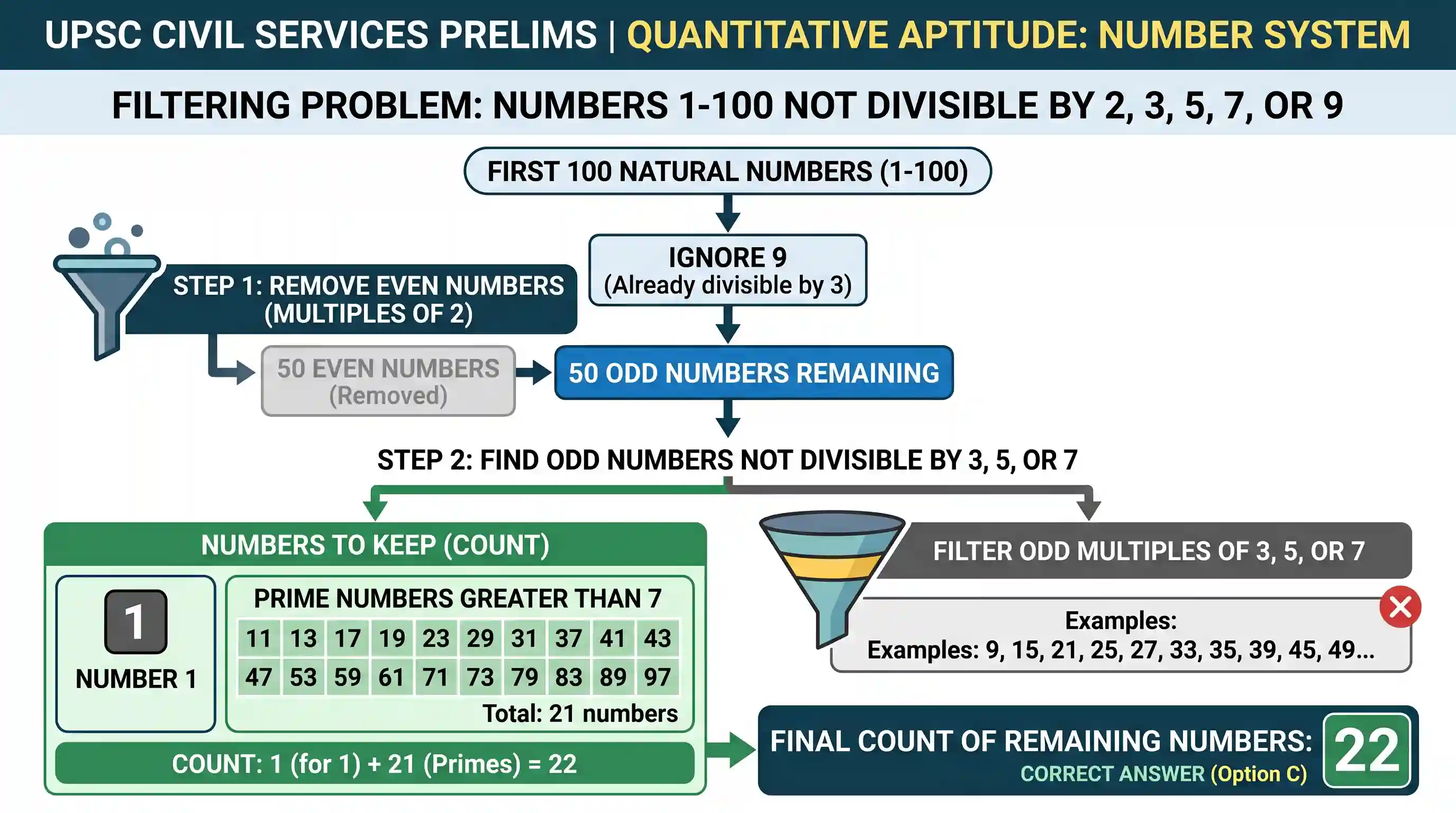
To solve this, we need to find numbers between 1 and 100 that are not divisible by 2, 3, 5, 7, and 9.
First, notice that any number divisible by 9 is already divisible by 3. Therefore, we only need to find numbers not divisible by the prime numbers 2, 3, 5, and 7.
Numbers not divisible by 2 are odd numbers. There are 50 odd numbers between 1 and 100. From these 50 odd numbers, we must remove those divisible by 3, 5, or 7.
List of odd numbers not divisible by 3, 5, or 7: 1 (1 is not divisible by any of them) Primes greater than 7: 11, 13, 17, 19, 23, 29, 31, 37, 41, 43, 47, 53, 59, 61, 67, 71, 73, 79, 83, 89, 97 (Total 21 numbers) Products of these primes: The only product less than 100 is 11 times 11, which is 121 (too large), so there are no others.
Counting them up: The number 1 plus the 21 prime numbers listed above equals 22.
Therefore, there are 22 such numbers. The correct option is C.
Related questions
More UPSC Prelims practice from the same subject and topic.
- Prelims 2025CSATQuantitative Aptitude
A natural number N is such that it can be expressed as N = p + q + r , where p, q and r are distinct factors of N. How many numbers below 50 have this property?
- Prelims 2025CSATQuantitative Aptitude
Three prime numbers p, q and r, each less than 20, are such that p - q = q - r . How many distinct possible values can we get for (p + q + r) ?
- Prelims 2025CSATQuantitative Aptitude
How many possible values of (p + q + r) are there satisfying (1)/(p) + (1)/(q) + (1)/(r) = 1 , where p, q and r are natural numbers (not necessarily distinct)?
- Prelims 2025CSATQuantitative Aptitude
A 4-digit number N is such that when divided by 3, 5, 6, 9 leaves a remainder 1, 3, 4, 7 respectively. What is the smallest value of N?
- Prelims 2025CSATQuantitative Aptitude
What is the unit digit in the multiplication of 1× 3× 5× 7× 9× … × 999 ?
- Prelims 2025CSATQuantitative Aptitude
Let both p and k be prime numbers such that (p² + k) is also a prime number less than 30 What is the number of possible values of k?