In our country, handlooms are equated with a culture that ensures a continuity of tradition. This idea has become part of the public policy- framing and provides a legitimate basis for the State to support the sector. But the notion of tradition as a single, linear entity is being strongly contested today. The narratives dominant in defining culture/tradition in a particular way are seen to have emerged as the identities and histories of large sections. The discounted and, at times, forcibly stifled identities are fighting for their rightful place in history. Against this backdrop, when we promote handloom as a traditional industry, it is not surprising that large sections of our population choose to ignore it. With reference to the above passage, the following assumptions have been made: I. There is no need for the State to be involved in any manner in the handloom sector. II. Handloom products are no longer appealing and attractive in the rapidly changing modern world. Which of the above assumptions is/are valid?

- AI only
- BII only
- CBoth I and II
- DNeither I nor IICorrect
Explanation
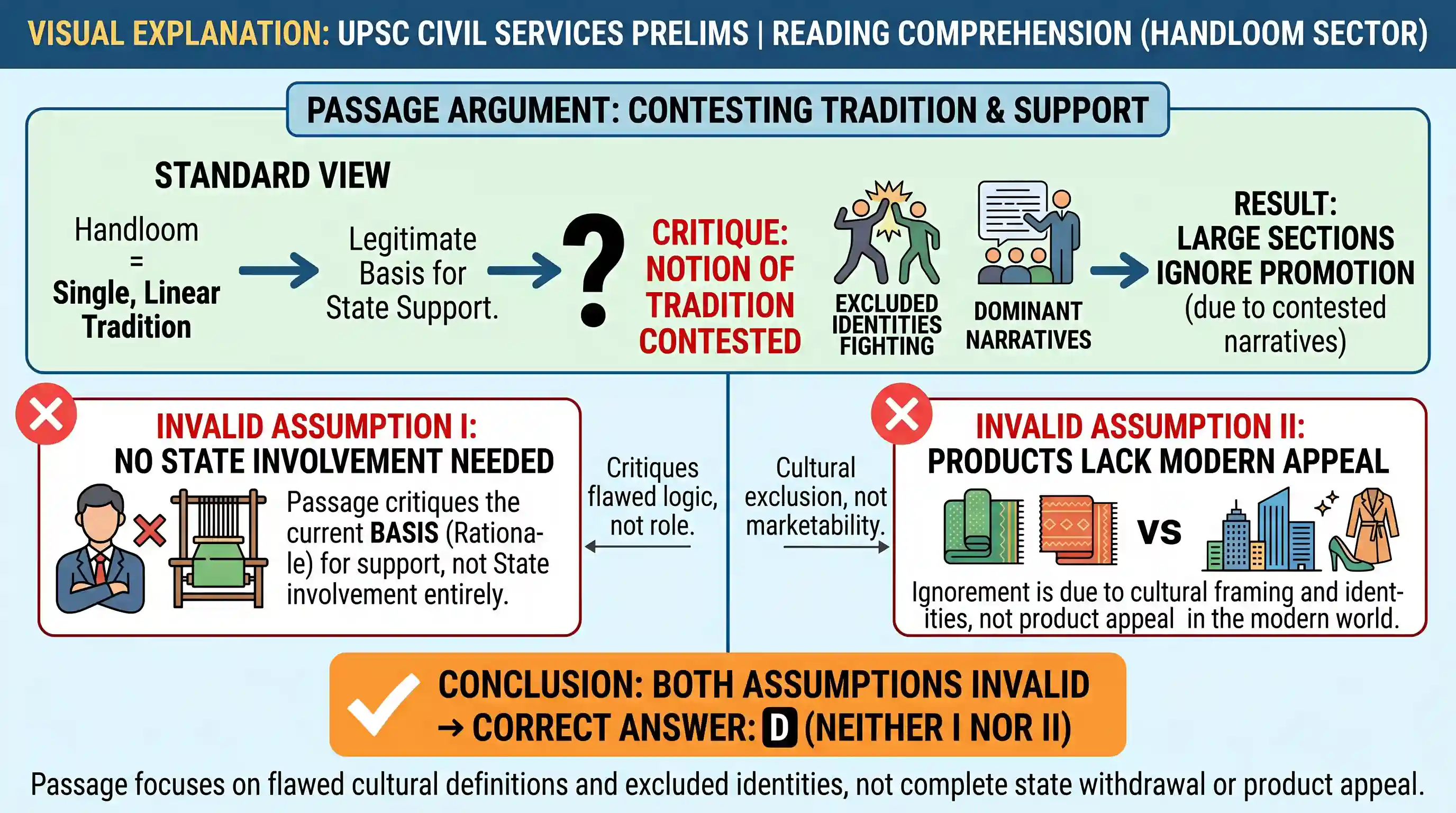
The passage critiques the basis for state support of handlooms (the notion of a single, linear tradition) and explains why certain sections ignore it (due to contested narratives of tradition), but it does not make the assumptions in statements I or II.
Statement I: "There is no need for the State to be involved in any manner in the handloom sector." The passage questions the legitimacy of the current basis for state support, not the need for state involvement altogether. It implies that the current approach is flawed, leading to exclusion, but doesn't advocate for complete state withdrawal. Thus, this assumption is invalid.
Statement II: "Handloom products are no longer appealing and attractive in the rapidly changing modern world." The passage states that large sections ignore handlooms because of how they are promoted as a traditional industry based on contested narratives, not because the products themselves lack appeal or attractiveness in the modern world. The problem is with the cultural framing and identity, not the product's inherent marketability. Thus, this assumption is invalid.
Since neither assumption is valid, D is the correct answer.
Related questions
More UPSC Prelims practice from the same subject and topic.
- Prelims 2025CSATReading Comprehension
Maintaining an ecosystem just to conserve biodiversity will affect its commercial potential as well as the livelihoods dependent on the ecosystem. There is also a conflict between using an ecosystem o…
- Prelims 2025CSATReading Comprehension
Maintaining an ecosystem just to conserve biodiversity will affect its commercial potential as well as the livelihoods dependent on the ecosystem. There is also a conflict between using an ecosystem o…
- Prelims 2025CSATReading Comprehension
]The history of renewable energy suggests there is a steep learning curve, meaning that, as more is produced, costs fall rapidly because of economies of scale and learning by doing. The firms' green i…
- Prelims 2025CSATReading Comprehension
]The history of renewable energy suggests there is a steep learning curve, meaning that, as more is produced, costs fall rapidly because of economies of scale and learning by doing. The firms' green i…
- Prelims 2025CSATReading Comprehension
Each State in India faces a distinctive set of challenges regarding the impact of warming, but also offers its own set of opportunities for reducing emissions depending on its natural resources. For e…
- Prelims 2025CSATReading Comprehension
Each State in India faces a distinctive set of challenges regarding the impact of warming, but also offers its own set of opportunities for reducing emissions depending on its natural resources. For e…