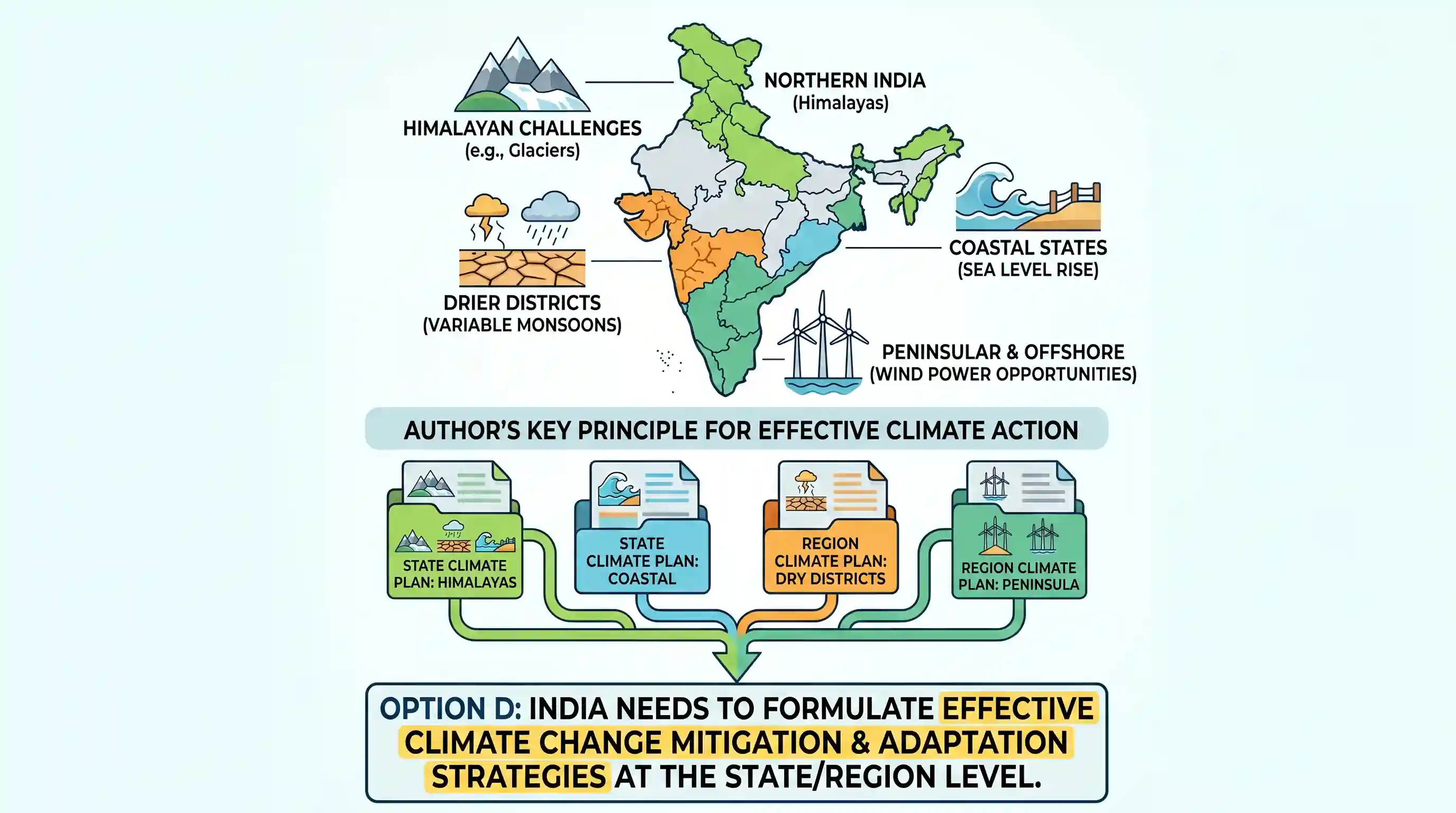
Each State in India faces a distinctive set of challenges regarding the impact of warming, but also offers its own set of opportunities for reducing emissions depending on its natural resources. For example, coastal States need to take action to protect their shores from sea level rise, districts that are drier need to prepare for variable monsoon precipitation. Himalayan regions have their own unique challenges, and selected parts of peninsular India and offshore areas offer great opportunities for harnessing wind power. These various aspects need to be considered for developing clear and sustainable goals for the future. Which one of the following statements best reflects the most logical, rational and pragmatic message conveyed by the author of the passage?

- AThe mitigation and adaptation strategies to address/tackle the climate change is essentially the responsibility of each State.
- BIndia is too diverse to implement any effective strategy or programme to address/tackle the climate change.
- CIt is basically the responsibility of the Union Government to implement the climate action plans and ensure net zero emissions.
- DIndia needs to formulate effective climate change mitigation and adaptation strategies at the State/region level.Correct
Explanation
The passage highlights that each State/region in India has unique climate change challenges and opportunities due to its natural resources and geographical characteristics. It gives examples like coastal states needing to protect shores, drier districts preparing for variable monsoons, Himalayan regions having unique challenges, and specific parts of peninsular India offering wind power opportunities. The concluding sentence emphasizes that "These various aspects need to be considered for developing clear and sustainable goals for the future."
Analyzing the options: A) The mitigation and adaptation strategies to address/tackle the climate change is essentially the responsibility of each State. While states have a role, the passage focuses on the nature of the strategies (tailored to the state/region) rather than solely assigning responsibility. It doesn't exclude national coordination or support. B) India is too diverse to implement any effective strategy or programme to address/tackle the climate change. This contradicts the passage's message. The passage implies that diversity requires specific, tailored strategies, not that it makes all strategies ineffective. C) It is basically the responsibility of the Union Government to implement the climate action plans and ensure net zero emissions. The passage does not discuss the Union Government's primary responsibility or net zero emissions. Its focus is on the regional variation of challenges and opportunities. D) India needs to formulate effective climate change mitigation and adaptation strategies at the State/region level. This option perfectly captures the essence of the passage. The passage repeatedly emphasizes that challenges and opportunities are "distinctive" to "each State" and gives examples that are region-specific, directly implying that strategies must be formulated at that level to be effective and sustainable.
The final answer is D because it most accurately reflects the passage's emphasis on tailoring climate action to the specific, diverse conditions of India's states and regions.
Related questions
More UPSC Prelims practice from the same subject and topic.
- Prelims 2025CSATReading Comprehension
Maintaining an ecosystem just to conserve biodiversity will affect its commercial potential as well as the livelihoods dependent on the ecosystem. There is also a conflict between using an ecosystem o…
- Prelims 2025CSATReading Comprehension
Maintaining an ecosystem just to conserve biodiversity will affect its commercial potential as well as the livelihoods dependent on the ecosystem. There is also a conflict between using an ecosystem o…
- Prelims 2025CSATReading Comprehension
]The history of renewable energy suggests there is a steep learning curve, meaning that, as more is produced, costs fall rapidly because of economies of scale and learning by doing. The firms' green i…
- Prelims 2025CSATReading Comprehension
]The history of renewable energy suggests there is a steep learning curve, meaning that, as more is produced, costs fall rapidly because of economies of scale and learning by doing. The firms' green i…
- Prelims 2025CSATReading Comprehension
Each State in India faces a distinctive set of challenges regarding the impact of warming, but also offers its own set of opportunities for reducing emissions depending on its natural resources. For e…
- Prelims 2025CSATReading Comprehension
If the social inequality is the most acutely felt social problem in India, insecurity, more than poverty, is the most acutely felt economic problem. Besides those below the official poverty line, even…