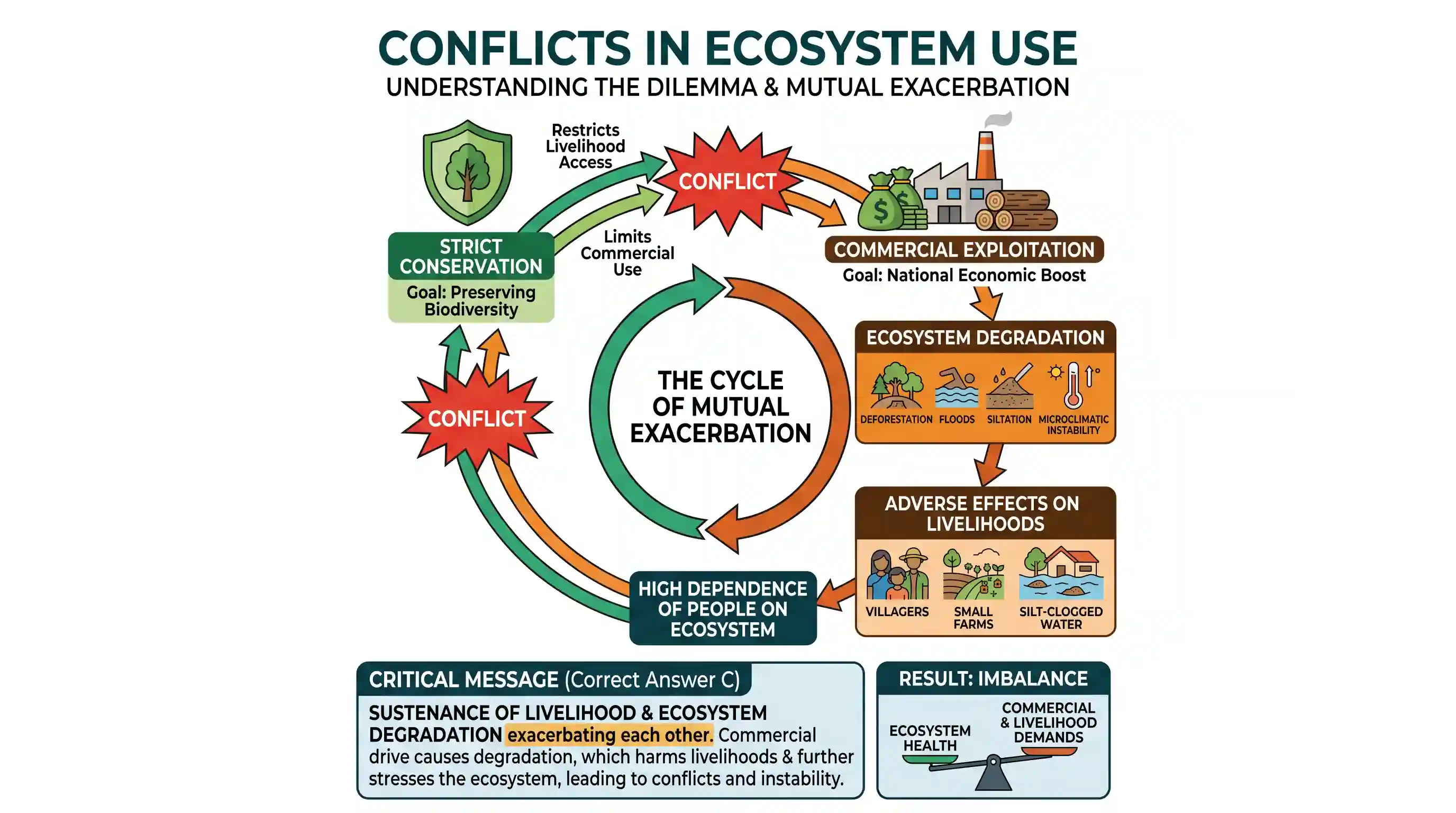
Maintaining an ecosystem just to conserve biodiversity will affect its commercial potential as well as the livelihoods dependent on the ecosystem. There is also a conflict between using an ecosystem only for livelihoods, for commercial exploitation, or strictly for conservation. Deforestation caused due to commercial exploitation will lead to indirect harm like floods, siltation problems and microclimatic instability, apart from adversely affecting livelihoods dependent on forests. These conflicts are particularly acute in developing countries where the dependence of people on the ecosystem is significant, and commercial exploitation has the potential to boost national income. Which one of the following statements best reflects the critical message conveyed by the author of the passage?

- AConservation of biodiversity is not an issue to be worried about when some people depend on ecosystems for their livelihoods.
- BCommercial exploitation of forests goes against the fundamental rights of the people dependent on forests for food and shelter.
- CSustenance of livelihood and degradation of ecosystem while being together exacerbate one another, leading to conflicts and imbalance.Correct
- DCommercial exploitation of ecosystems should be completely stopped.
Explanation
The passage highlights the inherent conflicts arising from different uses of ecosystems: conservation, livelihoods, and commercial exploitation. It explains how commercial exploitation leads to ecosystem degradation (deforestation, floods, siltation, microclimatic instability) which, in turn, adversely affects livelihoods. These conflicts are particularly acute in developing countries where people's dependence on the ecosystem is high, but commercial exploitation also offers economic benefits.
Let's analyze the options:
A) Conservation of biodiversity is not an issue to be worried about when some people depend on ecosystems for their livelihoods. This contradicts the passage, which states that conservation will affect livelihoods, implying it is an issue to be worried about, and discusses the conflict between them.
B) Commercial exploitation of forests goes against the fundamental rights of the people dependent on forests for food and shelter. While the passage mentions adverse effects on livelihoods, it does not frame this in terms of "fundamental rights." It focuses on the practical conflicts and consequences.
C) Sustenance of livelihood and degradation of ecosystem while being together exacerbate one another, leading to conflicts and imbalance. This statement perfectly captures the critical message. The passage describes how the pursuit of livelihoods (dependence of people on the ecosystem) and commercial exploitation (leading to ecosystem degradation like deforestation) are often in conflict. This interaction exacerbates problems, leading to "indirect harm like floods, siltation problems and microclimatic instability" and "conflicts" between different uses. This option synthesizes the core elements of the passage: human dependence, environmental harm, and the resulting societal and ecological instability.
D) Commercial exploitation of ecosystems should be completely stopped. The passage describes the problems with commercial exploitation but also acknowledges its potential to "boost national income." It highlights the dilemma and conflicts, but does not advocate for a complete halt, which would be an extreme interpretation not supported by the nuanced discussion.
Therefore, option C best reflects the critical message by encapsulating the complex interplay between human needs, environmental degradation, and the resulting conflicts and imbalances.
The final answer is C.
Related questions
More UPSC Prelims practice from the same subject and topic.
- Prelims 2025CSATReading Comprehension
Maintaining an ecosystem just to conserve biodiversity will affect its commercial potential as well as the livelihoods dependent on the ecosystem. There is also a conflict between using an ecosystem o…
- Prelims 2025CSATReading Comprehension
]The history of renewable energy suggests there is a steep learning curve, meaning that, as more is produced, costs fall rapidly because of economies of scale and learning by doing. The firms' green i…
- Prelims 2025CSATReading Comprehension
]The history of renewable energy suggests there is a steep learning curve, meaning that, as more is produced, costs fall rapidly because of economies of scale and learning by doing. The firms' green i…
- Prelims 2025CSATReading Comprehension
Each State in India faces a distinctive set of challenges regarding the impact of warming, but also offers its own set of opportunities for reducing emissions depending on its natural resources. For e…
- Prelims 2025CSATReading Comprehension
Each State in India faces a distinctive set of challenges regarding the impact of warming, but also offers its own set of opportunities for reducing emissions depending on its natural resources. For e…
- Prelims 2025CSATReading Comprehension
If the social inequality is the most acutely felt social problem in India, insecurity, more than poverty, is the most acutely felt economic problem. Besides those below the official poverty line, even…