Each State in India faces a distinctive set of challenges regarding the impact of warming, but also offers its own set of opportunities for reducing emissions depending on its natural resources. For example, coastal States need to take action to protect their shores from sea level rise, districts that are drier need to prepare for variable monsoon precipitation. Himalayan regions have their own unique challenges, and selected parts of peninsular India and offshore areas offer great opportunities for harnessing wind power. These various aspects need to be considered for developing clear and sustainable goals for the future. With reference to the passage, the following assumptions have been made: I. Green energy production can be linked to/integrated with the climate change mitigation and adaptation strategies. II. Effects of climate change are much more severe in coastal and mountainous regions. Which of the above assumptions is/are valid?

- AI only
- BII only
- CBoth I and II
- DNeither I nor IICorrect
Explanation
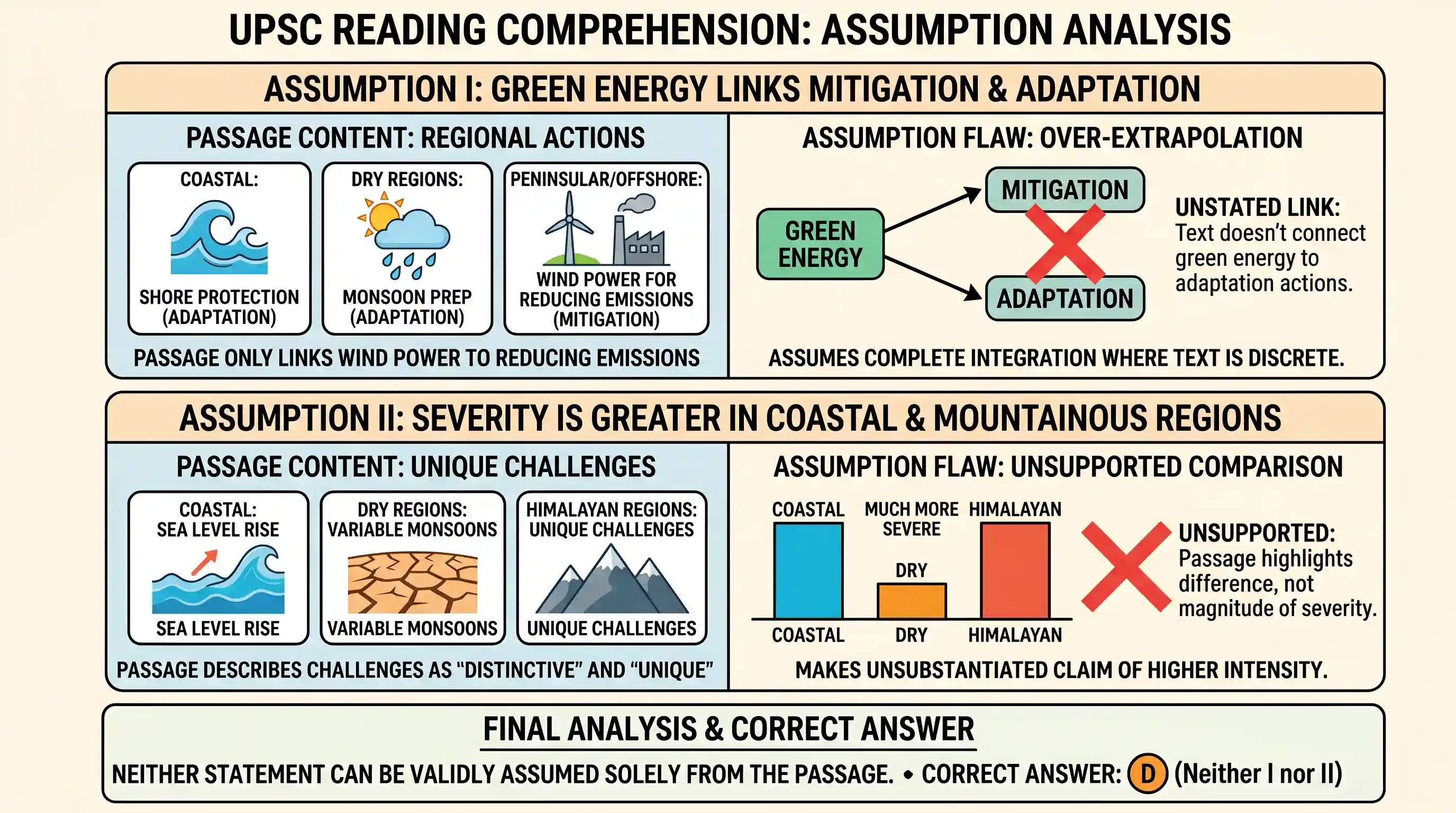
Analysis of Statement I: "Green energy production can be linked to/integrated with the climate change mitigation and adaptation strategies." The passage mentions "selected parts of peninsular India and offshore areas offer great opportunities for harnessing wind power," which is a form of green energy. It places this in the context of "reducing emissions" (a mitigation strategy). However, the passage does not explicitly state or imply that green energy production can be linked to or integrated with adaptation strategies (like protecting shores or preparing for variable monsoon precipitation). It presents wind power as an opportunity for reducing emissions, which is mitigation, but doesn't connect it to adaptation. Thus, this assumption is not fully supported by the passage.
Analysis of Statement II: "Effects of climate change are much more severe in coastal and mountainous regions." The passage states that "coastal States need to take action to protect their shores from sea level rise" and "Himalayan regions have their own unique challenges." It also mentions that "districts that are drier need to prepare for variable monsoon precipitation." The passage highlights different challenges for different regions but does not compare the severity of these challenges across regions. It describes them as "distinctive" and "unique" but does not claim that the effects are "much more severe" in coastal and mountainous regions compared to other areas. This is an unsupported comparative claim.
Conclusion: Neither statement I nor statement II can be validly assumed based solely on the information provided in the passage.
The final answer is D
Related questions
More UPSC Prelims practice from the same subject and topic.
- Prelims 2025CSATReading Comprehension
Maintaining an ecosystem just to conserve biodiversity will affect its commercial potential as well as the livelihoods dependent on the ecosystem. There is also a conflict between using an ecosystem o…
- Prelims 2025CSATReading Comprehension
Maintaining an ecosystem just to conserve biodiversity will affect its commercial potential as well as the livelihoods dependent on the ecosystem. There is also a conflict between using an ecosystem o…
- Prelims 2025CSATReading Comprehension
]The history of renewable energy suggests there is a steep learning curve, meaning that, as more is produced, costs fall rapidly because of economies of scale and learning by doing. The firms' green i…
- Prelims 2025CSATReading Comprehension
]The history of renewable energy suggests there is a steep learning curve, meaning that, as more is produced, costs fall rapidly because of economies of scale and learning by doing. The firms' green i…
- Prelims 2025CSATReading Comprehension
Each State in India faces a distinctive set of challenges regarding the impact of warming, but also offers its own set of opportunities for reducing emissions depending on its natural resources. For e…
- Prelims 2025CSATReading Comprehension
If the social inequality is the most acutely felt social problem in India, insecurity, more than poverty, is the most acutely felt economic problem. Besides those below the official poverty line, even…