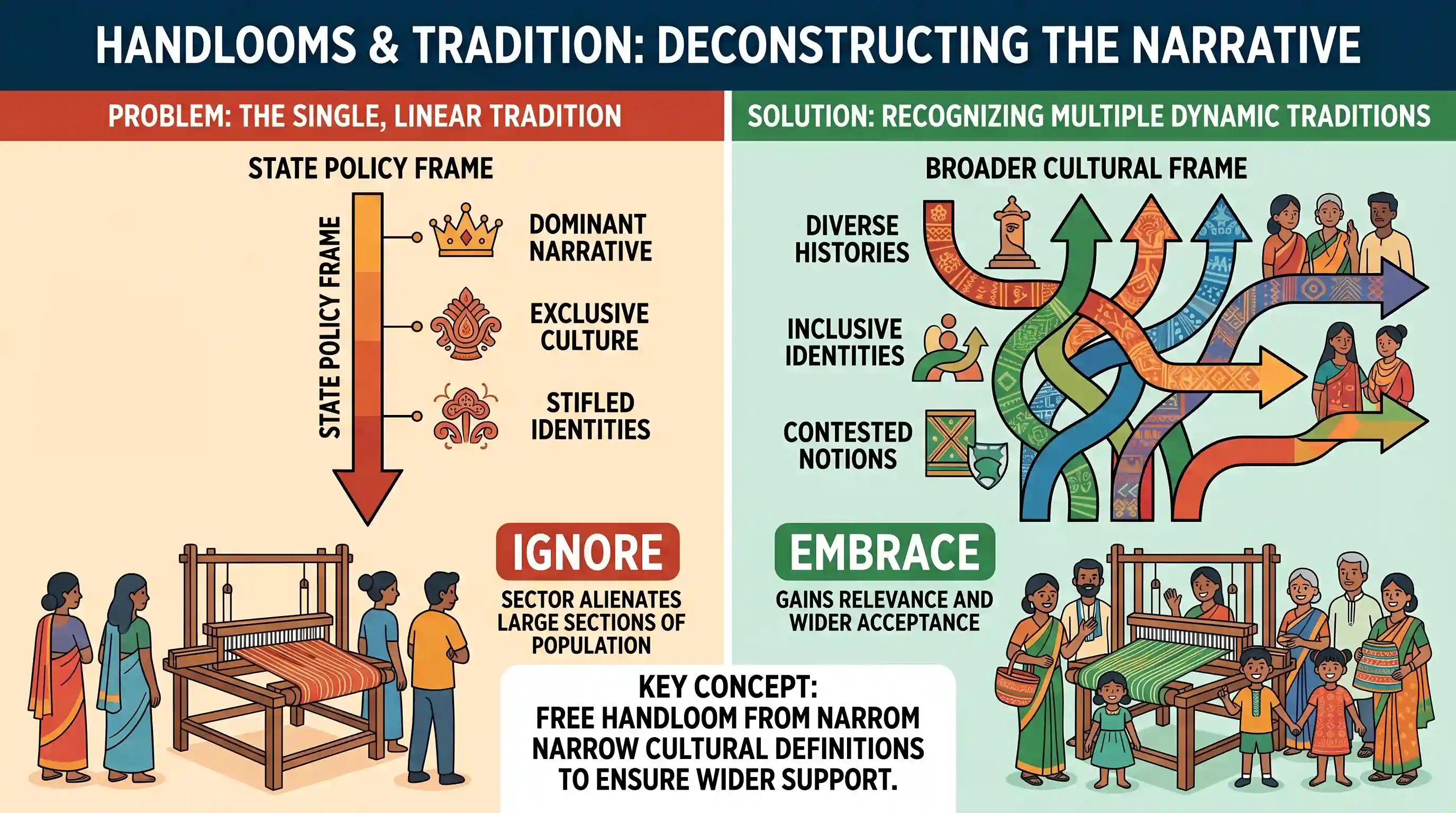
In our country, handlooms are equated with a culture that ensures a continuity of tradition. This idea has become part of the public policy- framing and provides a legitimate basis for the State to support the sector. But the notion of tradition as a single, linear entity is being strongly contested today. The narratives dominant in defining culture/tradition in a particular way are seen to have emerged as the identities and histories of large sections. The discounted and, at times, forcibly stifled identities are fighting for their rightful place in history. Against this backdrop, when we promote handloom as a traditional industry, it is not surprising that large sections of our population choose to ignore it. Which one of the following statements best reflects the most logical and rational message conveyed by the author of the passage?

- AWe need to free the handloom industry from the limited narrative linked to preserving cultural heritage.Correct
- BContinued State support to the handloom industry ensures the preservation of some of our glorious art forms and old traditions.
- CHousehold units of the handloom sector should be modernized and made an economically viable organized industry.
- DHandloom products need to be converted to machine-made designer products so as to make them more popular.
Explanation
The author criticizes the current public policy framing of handlooms, which equates them with a "single, linear" idea of tradition. This narrow definition of tradition, often dominated by certain narratives, excludes and alienates large sections of the population, causing them to ignore handlooms.
Let's analyze the options:
A) We need to free the handloom industry from the limited narrative linked to preserving cultural heritage. This statement directly reflects the author's main point. The passage argues that the "notion of tradition as a single, linear entity is being strongly contested" and that "narratives dominant in defining culture/tradition in a particular way" lead to handlooms being ignored. Therefore, freeing handlooms from this "limited narrative" is the logical solution conveyed by the author.
B) Continued State support to the handloom industry ensures the preservation of some of our glorious art forms and old traditions. This option supports the very premise that the author is critiquing. The author is not against preservation itself, but against the limited and contested narrative of tradition used for preservation, which leads to alienation.
C) Household units of the handloom sector should be modernized and made an economically viable organized industry. The passage focuses on the cultural and traditional narrative surrounding handlooms and its impact on public perception, not on the economic structure or modernization of the industry itself. While modernization might be beneficial, it's not the primary message conveyed by this specific passage.
D) Handloom products need to be converted to machine-made designer products so as to make them more popular. This option suggests abandoning handlooms in favor of machine-made products, which goes against the spirit of supporting the handloom sector, even if its current promotion strategy is flawed. The author critiques the framing of handlooms, not the handlooms themselves.
Therefore, option A best captures the author's most logical and rational message, which is to broaden or rethink the narrative around handlooms to make them more inclusive and appealing to a wider audience.
Related questions
More UPSC Prelims practice from the same subject and topic.
- Prelims 2025CSATReading Comprehension
Maintaining an ecosystem just to conserve biodiversity will affect its commercial potential as well as the livelihoods dependent on the ecosystem. There is also a conflict between using an ecosystem o…
- Prelims 2025CSATReading Comprehension
Maintaining an ecosystem just to conserve biodiversity will affect its commercial potential as well as the livelihoods dependent on the ecosystem. There is also a conflict between using an ecosystem o…
- Prelims 2025CSATReading Comprehension
]The history of renewable energy suggests there is a steep learning curve, meaning that, as more is produced, costs fall rapidly because of economies of scale and learning by doing. The firms' green i…
- Prelims 2025CSATReading Comprehension
]The history of renewable energy suggests there is a steep learning curve, meaning that, as more is produced, costs fall rapidly because of economies of scale and learning by doing. The firms' green i…
- Prelims 2025CSATReading Comprehension
Each State in India faces a distinctive set of challenges regarding the impact of warming, but also offers its own set of opportunities for reducing emissions depending on its natural resources. For e…
- Prelims 2025CSATReading Comprehension
Each State in India faces a distinctive set of challenges regarding the impact of warming, but also offers its own set of opportunities for reducing emissions depending on its natural resources. For e…