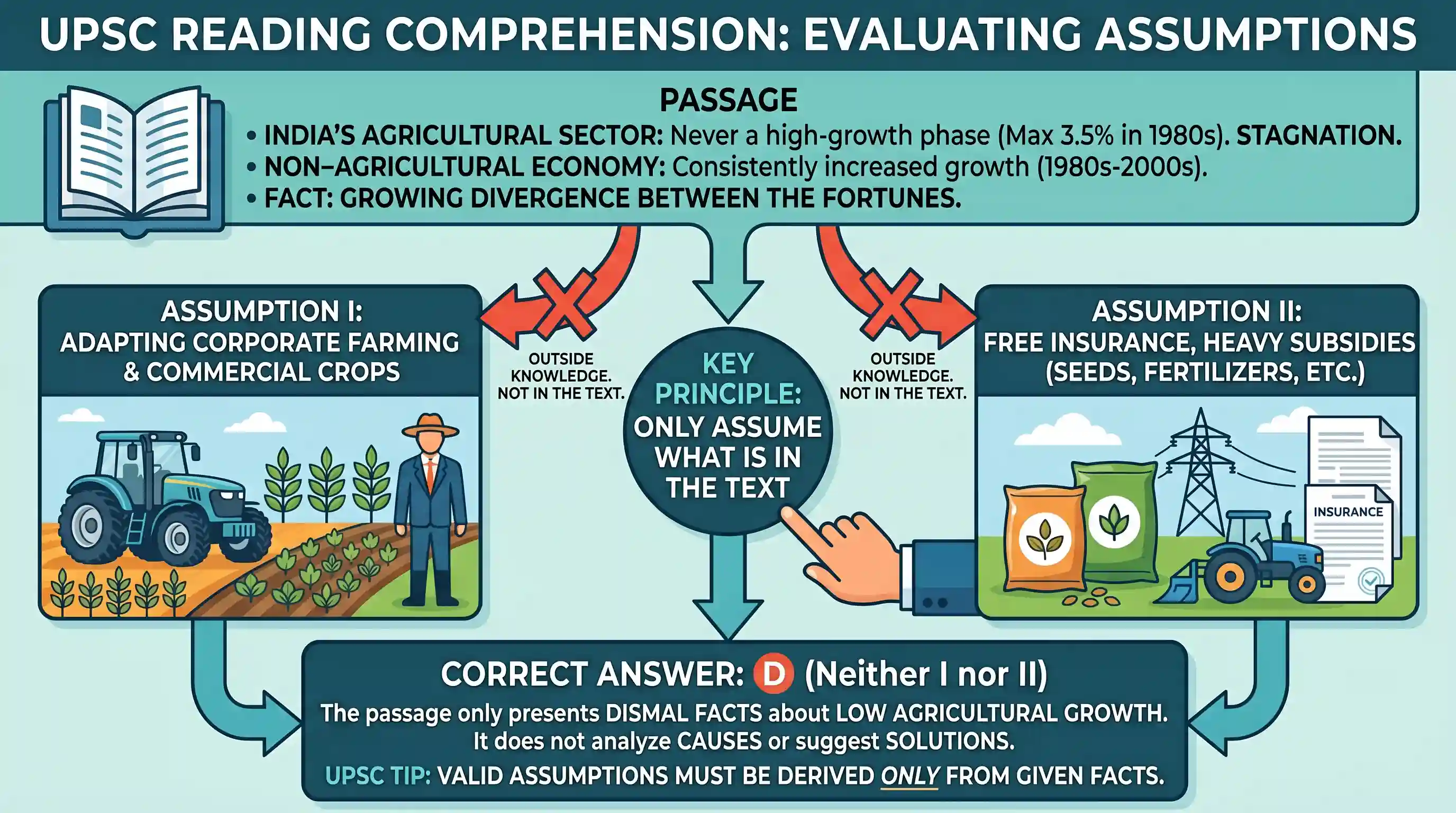
One of the dismal realities of the agricultural sector in independent India has been that it never experienced a high- growth phase, unlike the non- agricultural economy. The highest decadal growth (compound annual growth rate or CAGR) for agriculture has been just 3.5% in the 1980s. Also, after experiencing a spurt in decadal growth during the 1980s, agricultural growth suffered relative stagnation thereafter. This is in harp contrast to non- agricultural growth, which consistently increased from the 1980s to 2000s. With reference to the passage, the following assumptions have been made: The growing divergence between the fortunes of the agricultural and non- agricultural economy in India could have been reduced/contained by: I. adapting large-scale cultivation of commercial crops and viable corporate farming. II. providing free insurance for all crops and heavily subsidizing seeds, fertilizers, electricity and farm machinery at par with developed countries. Which of the above assumptions is/are valid?

- AI only
- BII only
- CBoth I and II
- DNeither I nor IICorrect
Explanation
The passage describes the historical trend of low agricultural growth and its divergence from non-agricultural growth in India. It presents a factual observation about the "dismal realities" of the sector. The passage does not delve into the causes of this low growth or suggest any specific solutions to reduce the divergence.
Statement I: "adapting large-scale cultivation of commercial crops and viable corporate farming." The passage does not discuss the type of cultivation (commercial vs. subsistence) or the structure of farming (corporate vs. individual). Therefore, it makes no assumption that these measures would reduce the divergence.
Statement II: "providing free insurance for all crops and heavily subsidizing seeds, fertilizers, electricity and farm machinery at par with developed countries." The passage does not mention government policies, subsidies, or insurance schemes. It provides no basis to assume that these measures are implied as solutions by the passage.
Since the passage merely states a historical fact about growth rates and does not offer any analysis of causes or solutions, neither of the proposed assumptions can be inferred or considered valid based solely on the information provided in the passage.
The final answer is D.
Related questions
More UPSC Prelims practice from the same subject and topic.
- Prelims 2025CSATReading Comprehension
Maintaining an ecosystem just to conserve biodiversity will affect its commercial potential as well as the livelihoods dependent on the ecosystem. There is also a conflict between using an ecosystem o…
- Prelims 2025CSATReading Comprehension
Maintaining an ecosystem just to conserve biodiversity will affect its commercial potential as well as the livelihoods dependent on the ecosystem. There is also a conflict between using an ecosystem o…
- Prelims 2025CSATReading Comprehension
]The history of renewable energy suggests there is a steep learning curve, meaning that, as more is produced, costs fall rapidly because of economies of scale and learning by doing. The firms' green i…
- Prelims 2025CSATReading Comprehension
]The history of renewable energy suggests there is a steep learning curve, meaning that, as more is produced, costs fall rapidly because of economies of scale and learning by doing. The firms' green i…
- Prelims 2025CSATReading Comprehension
Each State in India faces a distinctive set of challenges regarding the impact of warming, but also offers its own set of opportunities for reducing emissions depending on its natural resources. For e…
- Prelims 2025CSATReading Comprehension
Each State in India faces a distinctive set of challenges regarding the impact of warming, but also offers its own set of opportunities for reducing emissions depending on its natural resources. For e…