One of the dismal realities of the agricultural sector in independent India has been that it never experienced a high- growth phase, unlike the non- agricultural economy. The highest decadal growth (compound annual growth rate or CAGR) for agriculture has been just 3.5% in the 1980s. Also, after experiencing a spurt in decadal growth during the 1980s, agricultural growth suffered relative stagnation thereafter. This is in harp contrast to non- agricultural growth, which consistently increased from the 1980s to 2000s. Which one of the following statements best reflects the corollary to the above passage?

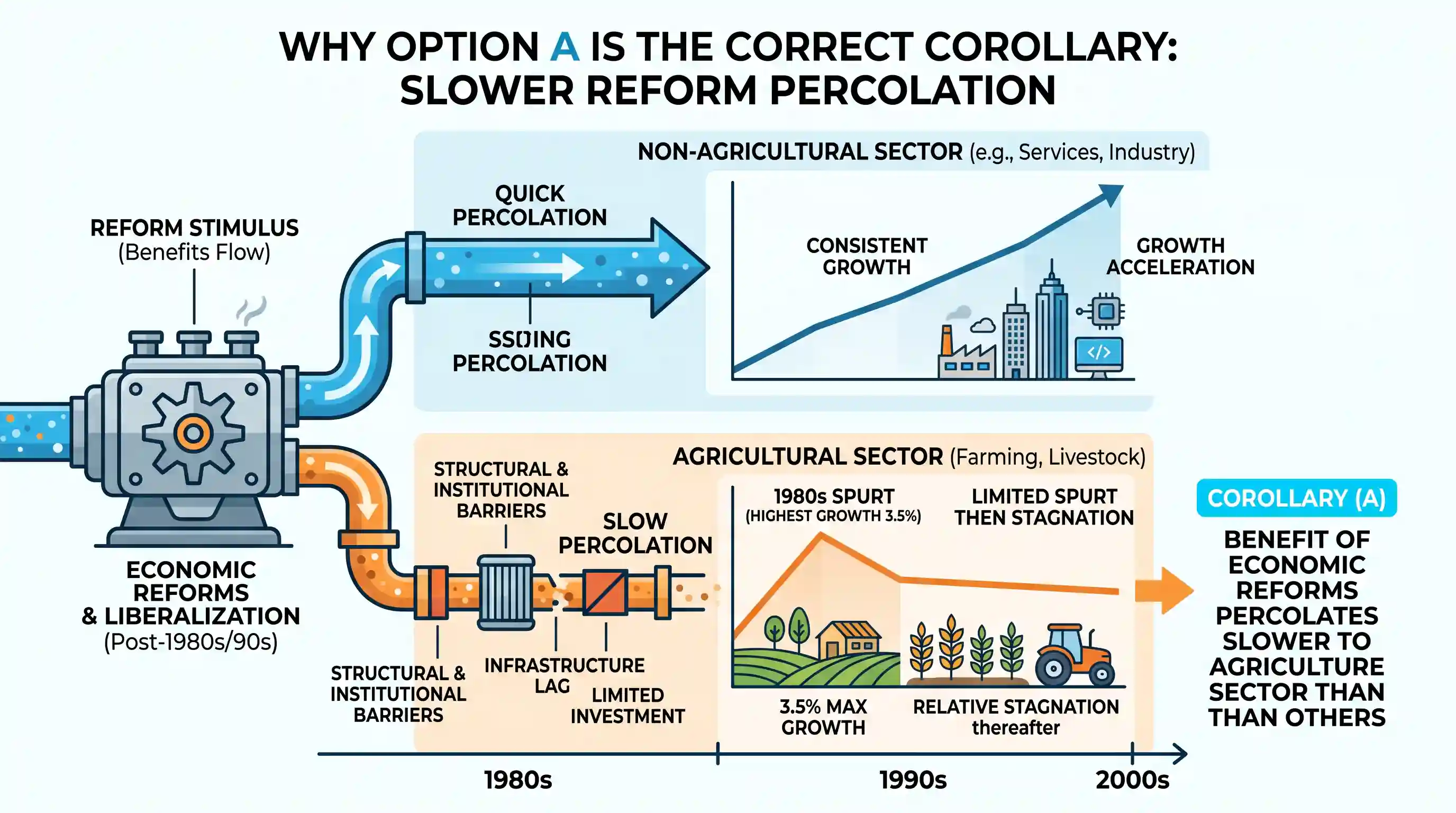
- AThe benefit of economic reforms percolates down more slowly to the agriculture sector than in other sectors of the economy.Correct
- BFor India, the green revolution was not as useful as it was expected to be.
- CIndia lagged behind other countries in adapting mechanized and modern farming.
- DRural-to-urban migration resulted in the stagnant agriculture sector.
Explanation
The passage highlights a stark contrast: non-agricultural growth consistently increased from the 1980s to 2000s, a period marked by significant economic reforms in India. In contrast, agricultural growth, after a spurt in the 1980s, suffered relative stagnation thereafter.
Let's analyze the options:
A) The benefit of economic reforms percolates down more slowly to the agriculture sector than in other sectors of the economy. This statement directly addresses the observed divergence. The 1980s and 1990s were periods of increasing economic liberalization and reforms. If the non-agricultural sector saw consistent growth during this time while agriculture stagnated, it strongly suggests that the benefits or impetus from these reforms either did not reach agriculture effectively or did so at a much slower pace. This is a direct corollary to the contrasting growth trends presented.
B) For India, the green revolution was not as useful as it was expected to be. The passage states that agriculture had its highest decadal growth (3.5%) in the 1980s. This growth spurt is largely attributed to the Green Revolution's impact. The issue highlighted is the stagnation thereafter, not the initial usefulness of the Green Revolution.
C) India lagged behind other countries in adapting mechanized and modern farming. The passage focuses on India's internal economic performance, comparing its agricultural sector to its non-agricultural sector over time. It does not provide any information or comparison with other countries, making this statement an unsupported external conclusion.
D) Rural-to-urban migration resulted in the stagnant agriculture sector. While rural-to-urban migration is a socioeconomic phenomenon, the passage describes stagnant growth in the agricultural sector. It does not provide any evidence to directly link this migration as the primary cause of the stagnation in growth rates. Stagnation could be due to various other factors like lack of investment, policy neglect, or market failures.
Therefore, option A best reflects the corollary, as it directly explains the differential growth patterns observed between the agricultural and non-agricultural sectors during a period of significant economic change (reforms).
The final answer is A.
Related questions
More UPSC Prelims practice from the same subject and topic.
- Prelims 2025CSATReading Comprehension
Maintaining an ecosystem just to conserve biodiversity will affect its commercial potential as well as the livelihoods dependent on the ecosystem. There is also a conflict between using an ecosystem o…
- Prelims 2025CSATReading Comprehension
Maintaining an ecosystem just to conserve biodiversity will affect its commercial potential as well as the livelihoods dependent on the ecosystem. There is also a conflict between using an ecosystem o…
- Prelims 2025CSATReading Comprehension
]The history of renewable energy suggests there is a steep learning curve, meaning that, as more is produced, costs fall rapidly because of economies of scale and learning by doing. The firms' green i…
- Prelims 2025CSATReading Comprehension
]The history of renewable energy suggests there is a steep learning curve, meaning that, as more is produced, costs fall rapidly because of economies of scale and learning by doing. The firms' green i…
- Prelims 2025CSATReading Comprehension
Each State in India faces a distinctive set of challenges regarding the impact of warming, but also offers its own set of opportunities for reducing emissions depending on its natural resources. For e…
- Prelims 2025CSATReading Comprehension
Each State in India faces a distinctive set of challenges regarding the impact of warming, but also offers its own set of opportunities for reducing emissions depending on its natural resources. For e…