Let both p and k be prime numbers such that (p² + k) is also a prime number less than 30 What is the number of possible values of k?

- A4
- B5Correct
- C6
- D7
Explanation
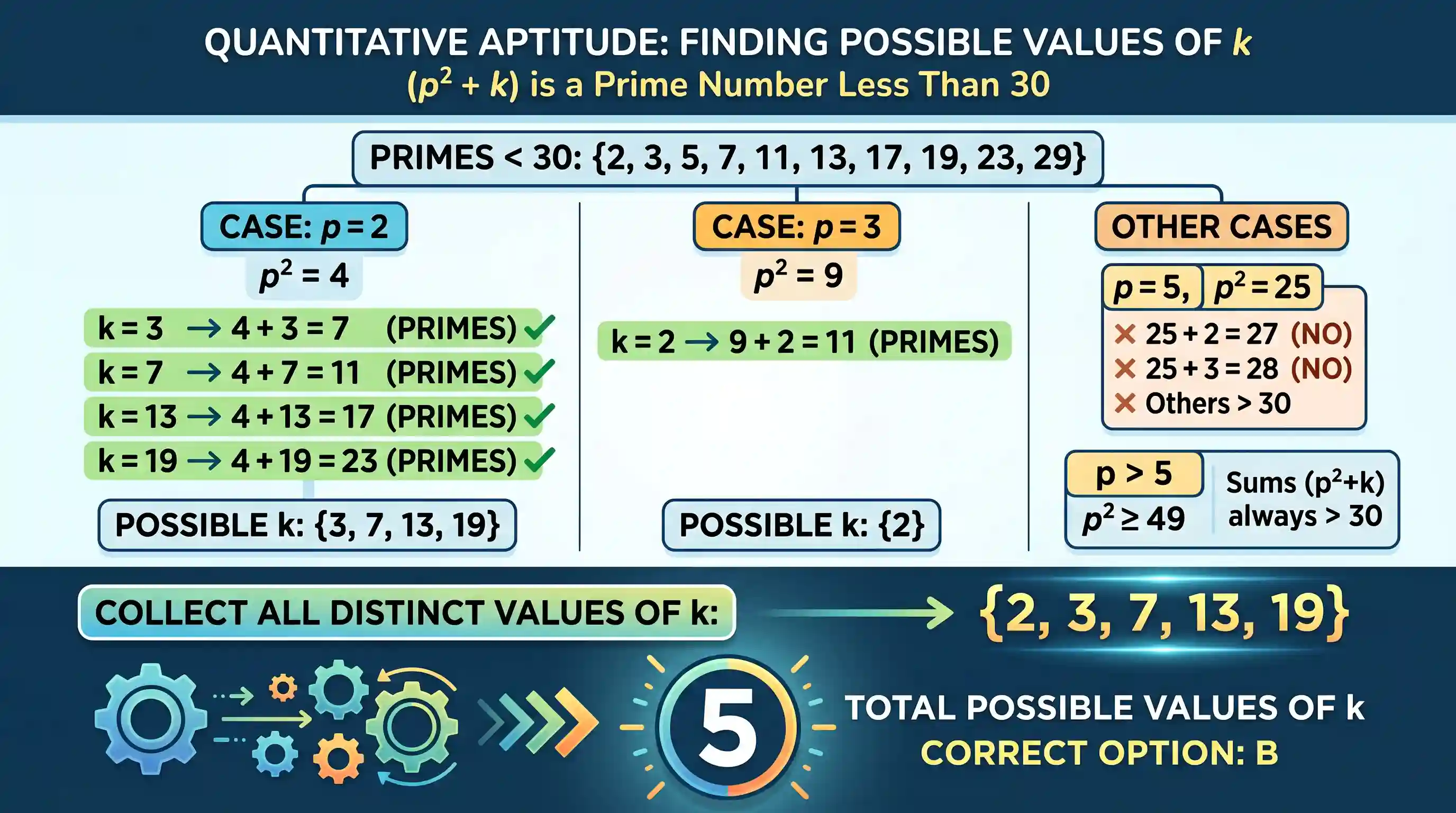
To solve this, we need to find prime numbers p and k such that (p^2 + k) is also a prime number less than 30. The prime numbers less than 30 are: 2, 3, 5, 7, 11, 13, 17, 19, 23, 29.
Let's test possible values for p (which must be a prime number):
Case 1: p = 2 p^2 = 4. We need (4 + k) to be a prime number less than 30. Let's test prime values for k:
- If k = 2, 4 + 2 = 6 (not prime)
- If k = 3, 4 + 3 = 7 (prime, less than 30). So k=3 is a possible value.
- If k = 5, 4 + 5 = 9 (not prime)
- If k = 7, 4 + 7 = 11 (prime, less than 30). So k=7 is a possible value.
- If k = 11, 4 + 11 = 15 (not prime)
- If k = 13, 4 + 13 = 17 (prime, less than 30). So k=13 is a possible value.
- If k = 17, 4 + 17 = 21 (not prime)
- If k = 19, 4 + 19 = 23 (prime, less than 30). So k=19 is a possible value.
- If k = 23, 4 + 23 = 27 (not prime)
- If k = 29, 4 + 29 = 33 (not prime, and greater than 30) For p=2, the possible values of k are: 3, 7, 13, 19.
Case 2: p = 3 p^2 = 9. We need (9 + k) to be a prime number less than 30. Let's test prime values for k:
- If k = 2, 9 + 2 = 11 (prime, less than 30). So k=2 is a possible value.
- If k = 3, 9 + 3 = 12 (not prime)
- If k = 5, 9 + 5 = 14 (not prime)
- If k = 7, 9 + 7 = 16 (not prime)
- If k = 11, 9 + 11 = 20 (not prime)
- If k = 13, 9 + 13 = 22 (not prime)
- If k = 17, 9 + 17 = 26 (not prime)
- If k = 19, 9 + 19 = 28 (not prime)
- If k = 23, 9 + 23 = 32 (not prime, and greater than 30) For p=3, the possible value of k is: 2.
Case 3: p = 5 p^2 = 25. We need (25 + k) to be a prime number less than 30. Let's test prime values for k:
- If k = 2, 25 + 2 = 27 (not prime)
- If k = 3, 25 + 3 = 28 (not prime) Any prime k greater than or equal to 5 would make (25 + k) greater than or equal to 30, so it cannot be a prime less than 30. For p=5, there are no possible values of k.
Case 4: p > 5 If p is a prime greater than 5, then p^2 will be greater than 25 (e.g., if p=7, p^2=49). Since k is a prime number, the smallest k can be is 2. So (p^2 + k) would be at least (49 + 2) = 51, which is greater than 30. Therefore, no possible values for p greater than 5.
Combining all possible distinct values of k found: From p=2, k values are: 3, 7, 13, 19. From p=3, k value is: 2.
The set of all distinct possible values of k is {2, 3, 7, 13, 19}. There are 5 possible values for k.
The final answer is B
Related questions
More UPSC Prelims practice from the same subject and topic.
- Prelims 2025CSATQuantitative Aptitude
A natural number N is such that it can be expressed as N = p + q + r , where p, q and r are distinct factors of N. How many numbers below 50 have this property?
- Prelims 2025CSATQuantitative Aptitude
Three prime numbers p, q and r, each less than 20, are such that p - q = q - r . How many distinct possible values can we get for (p + q + r) ?
- Prelims 2025CSATQuantitative Aptitude
How many possible values of (p + q + r) are there satisfying (1)/(p) + (1)/(q) + (1)/(r) = 1 , where p, q and r are natural numbers (not necessarily distinct)?
- Prelims 2025CSATQuantitative Aptitude
A 4-digit number N is such that when divided by 3, 5, 6, 9 leaves a remainder 1, 3, 4, 7 respectively. What is the smallest value of N?
- Prelims 2025CSATQuantitative Aptitude
What is the unit digit in the multiplication of 1× 3× 5× 7× 9× … × 999 ?
- Prelims 2025CSATQuantitative Aptitude
Consider the first 100 natural numbers. How many of them are not divisible by any one of 2, 3, 5, 7 and 9?