There are n sets of numbers each having only three positive integers with LCM equal to 1001 and HCF equal to 1. What is the value of n?

- A6
- B7
- C8
- DMore than 8Correct
Explanation
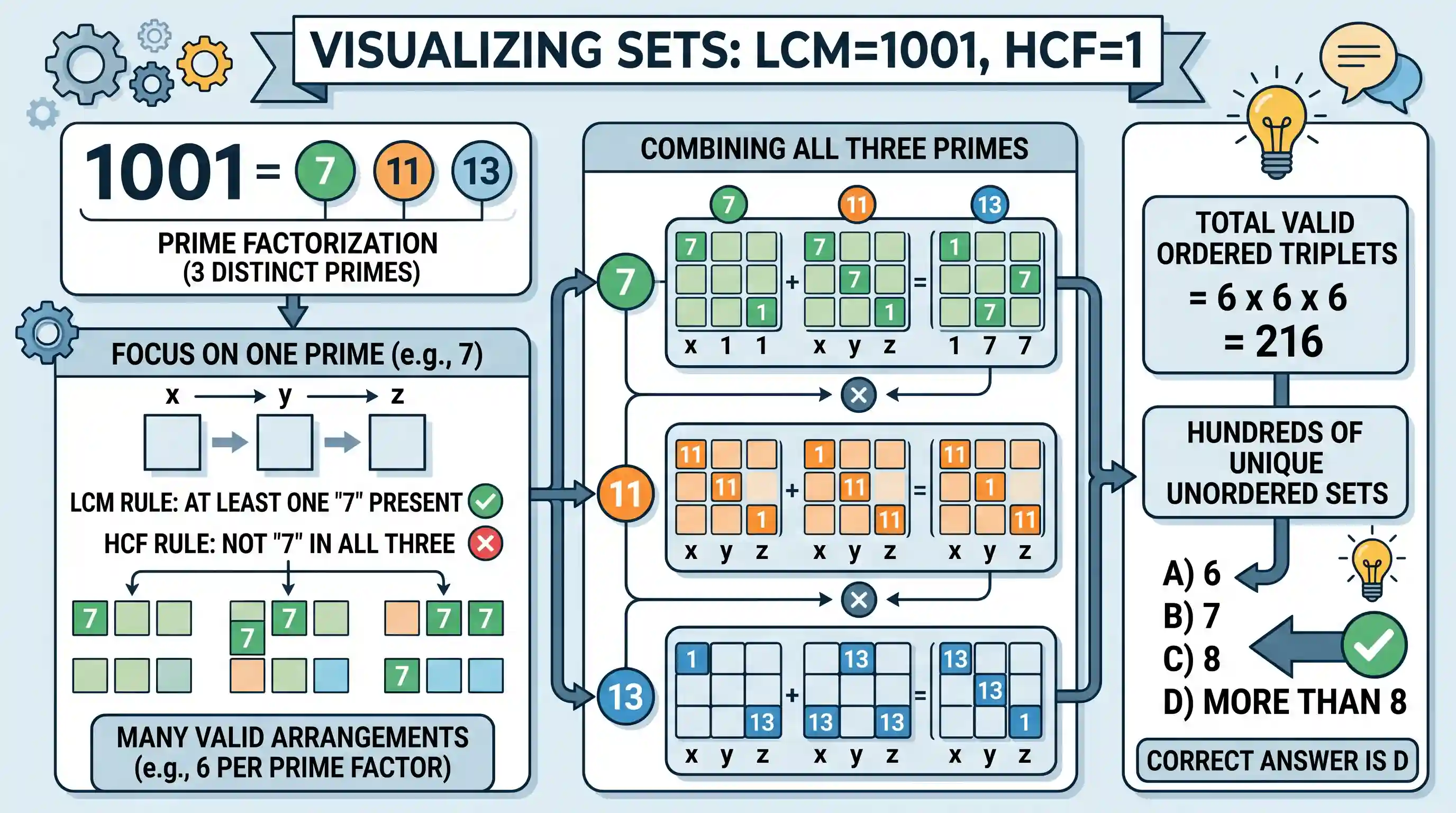
To solve this, first find the prime factorization of 1001, which is 7 times 11 times 13. These are three distinct prime numbers.
Let the three integers in a set be x, y, and z. For their Least Common Multiple (LCM) to be 1001, the prime factors 7, 11, and 13 must be distributed among x, y, and z. Specifically, for each prime factor, at least one of the three numbers must contain it, and none can have a higher power of that prime.
For their Highest Common Factor (HCF) to be 1, it is required that no single prime factor is present in all three numbers simultaneously.
The number of ways to distribute these three primes across three numbers under these conditions is quite large. For a single prime factor like 7, there are several valid distributions across x, y, and z. Since there are three independent prime factors, the total number of combinations is the product of the ways to distribute each prime.
Mathematically, for each prime, there are 6 ways to distribute it such that it appears in at least one number but not in all three. With three primes, there are 6 times 6 times 6, which equals 216 ordered triplets. Even after accounting for the fact that the sets are unordered and the numbers must be positive integers, the total number of unique sets far exceeds 8.
Therefore, the value of n is more than 8.
Related questions
More UPSC Prelims practice from the same subject and topic.
- Prelims 2025CSATQuantitative Aptitude
A natural number N is such that it can be expressed as N = p + q + r , where p, q and r are distinct factors of N. How many numbers below 50 have this property?
- Prelims 2025CSATQuantitative Aptitude
Three prime numbers p, q and r, each less than 20, are such that p - q = q - r . How many distinct possible values can we get for (p + q + r) ?
- Prelims 2025CSATQuantitative Aptitude
How many possible values of (p + q + r) are there satisfying (1)/(p) + (1)/(q) + (1)/(r) = 1 , where p, q and r are natural numbers (not necessarily distinct)?
- Prelims 2025CSATQuantitative Aptitude
A 4-digit number N is such that when divided by 3, 5, 6, 9 leaves a remainder 1, 3, 4, 7 respectively. What is the smallest value of N?
- Prelims 2025CSATQuantitative Aptitude
What is the unit digit in the multiplication of 1× 3× 5× 7× 9× … × 999 ?
- Prelims 2025CSATQuantitative Aptitude
Consider the first 100 natural numbers. How many of them are not divisible by any one of 2, 3, 5, 7 and 9?