A natural number N is such that it can be expressed as N = p + q + r , where p, q and r are distinct factors of N. How many numbers below 50 have this property?

- A6
- B7
- C8Correct
- D9
Explanation
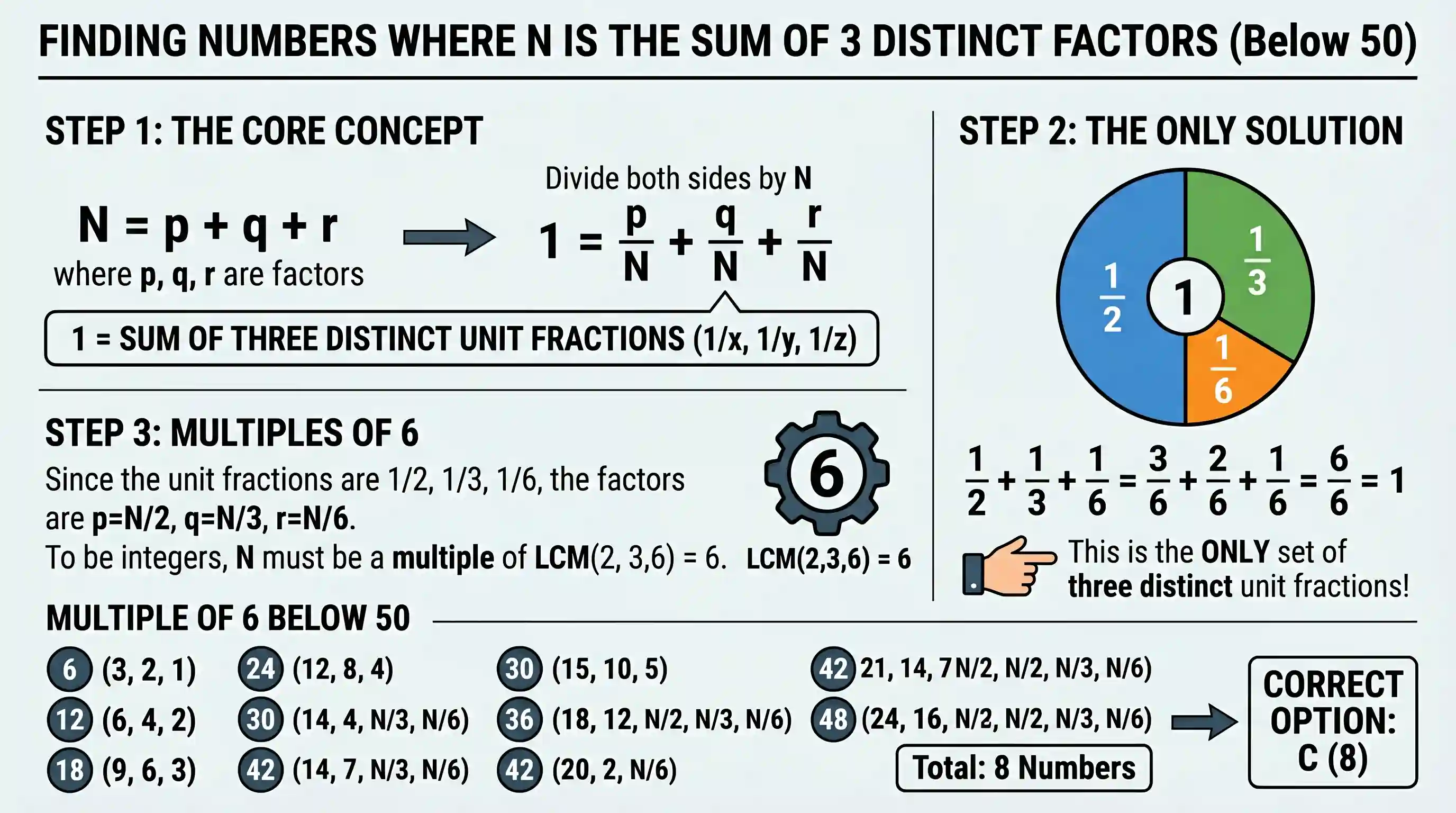
To solve this, we are looking for numbers where N is the sum of three of its distinct factors. Let the factors be p, q, and r. If we divide both sides of the equation N = p + q + r by N, we get 1 = p/N + q/N + r/N.
Since p, q, and r are factors of N, the fractions p/N, q/N, and r/N must be unit fractions like 1/2, 1/3, 1/4, etc. We need to find three distinct unit fractions that add up to 1. The only set of three distinct unit fractions that sum to 1 is 1/2 + 1/3 + 1/6.
This means that for N to satisfy the condition, its three factors must be N/2, N/3, and N/6. For these to be integers, N must be a multiple of the least common multiple of 2, 3, and 6, which is 6.
Therefore, any number that is a multiple of 6 will satisfy this property because N/2 + N/3 + N/6 = (3N + 2N + N) / 6 = 6N / 6 = N.
The multiples of 6 below 50 are 6, 12, 18, 24, 30, 36, 42, and 48. Counting these, we find there are exactly 8 such numbers. Thus, the correct option is C.
Related questions
More UPSC Prelims practice from the same subject and topic.
- Prelims 2025CSATQuantitative Aptitude
Three prime numbers p, q and r, each less than 20, are such that p - q = q - r . How many distinct possible values can we get for (p + q + r) ?
- Prelims 2025CSATQuantitative Aptitude
How many possible values of (p + q + r) are there satisfying (1)/(p) + (1)/(q) + (1)/(r) = 1 , where p, q and r are natural numbers (not necessarily distinct)?
- Prelims 2025CSATQuantitative Aptitude
A 4-digit number N is such that when divided by 3, 5, 6, 9 leaves a remainder 1, 3, 4, 7 respectively. What is the smallest value of N?
- Prelims 2025CSATQuantitative Aptitude
What is the unit digit in the multiplication of 1× 3× 5× 7× 9× … × 999 ?
- Prelims 2025CSATQuantitative Aptitude
Consider the first 100 natural numbers. How many of them are not divisible by any one of 2, 3, 5, 7 and 9?
- Prelims 2025CSATQuantitative Aptitude
Let both p and k be prime numbers such that (p² + k) is also a prime number less than 30 What is the number of possible values of k?