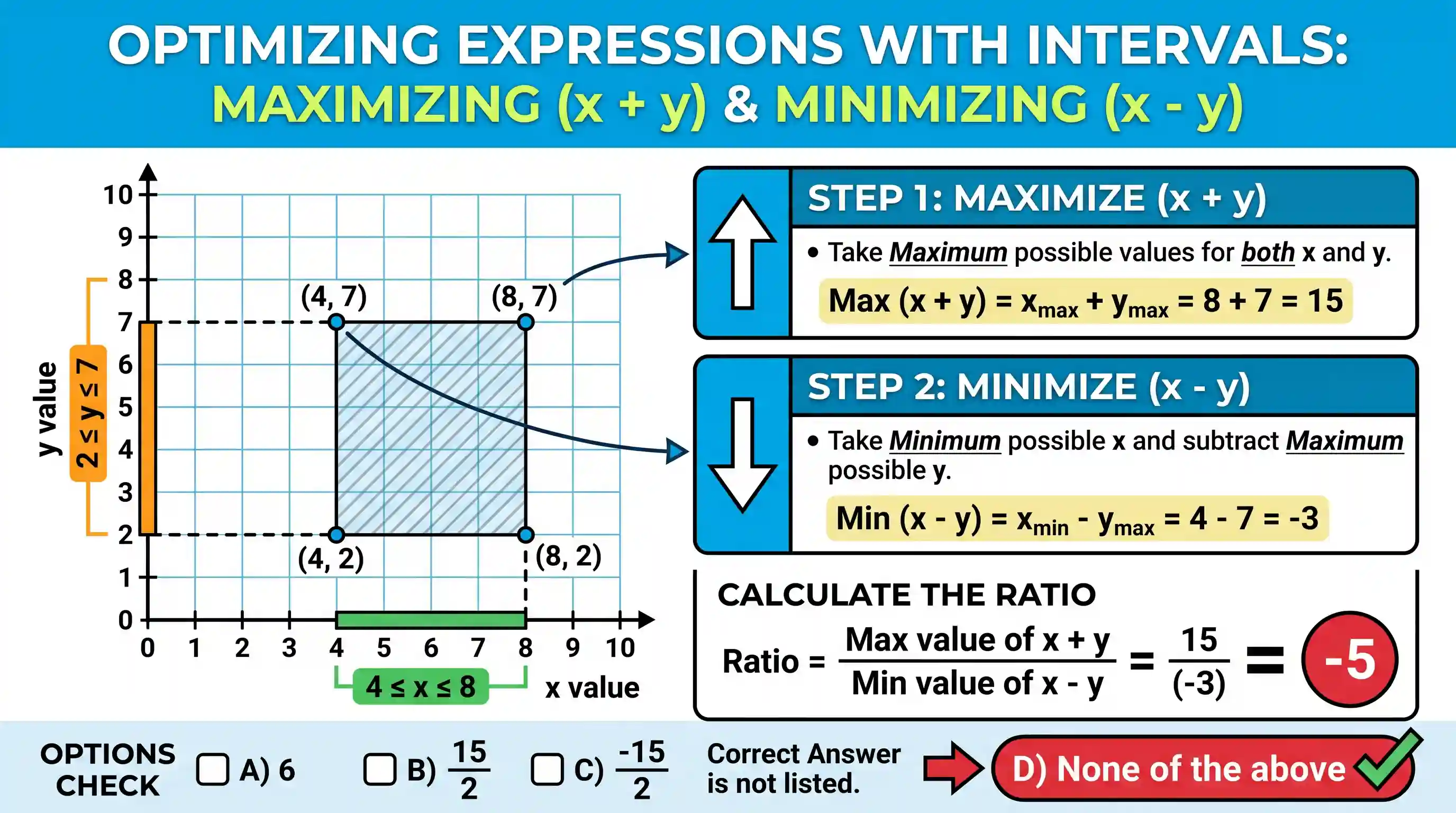
If 4 ≤ x ≤ 8 and 2 ≤ y ≤ 7 , then what is the ratio of maximum value of (x + y) to minimum value of (x - y) ?

- A6
- B(15)/(2)
- C-(15)/(2)
- DNone of the aboveCorrect
Explanation
To find the ratio, we first need to determine the maximum value of (x + y) and the minimum value of (x - y).
Given ranges: 4 <= x <= 8 2 <= y <= 7
-
Maximum value of (x + y): To maximize (x + y), we take the maximum possible values for both x and y. Max (x + y) = x_max + y_max = 8 + 7 = 15.
-
Minimum value of (x - y): To minimize (x - y), we take the minimum possible value for x and the maximum possible value for y. This makes the subtracted part as large as possible, resulting in the smallest difference. Min (x - y) = x_min - y_max = 4 - 7 = -3.
-
Ratio of maximum value of (x + y) to minimum value of (x - y): Ratio = (Max (x + y)) / (Min (x - y)) Ratio = 15 / (-3) Ratio = -5
Now, let's check the given options: A) 6 B) (15)/(2) = 7.5 C) -(15)/(2) = -7.5 D) None of the above
Our calculated ratio is -5, which is not present in options A, B, or C. Therefore, the correct answer is D.
Related questions
More UPSC Prelims practice from the same subject and topic.
- Prelims 2025CSATQuantitative Aptitude
A question is given followed by two Statements I and II. Consider the Question and the Statements and mark the correct option. Is (p + q)² - 4p q , where p , q are natural numbers, positive? Statement…
- Prelims 2025CSATQuantitative Aptitude
Let p + q = 10 , where p , q are integers. Value-I = Maximum value of p × q when p , q are positive integers. Value-II = Maximum value of p × q when p ≥ - 6 , q ≥ - 4 . Which one of the following is c…
- Prelims 2025CSATQuantitative Aptitude
Let x be a real number between 0 and 1. Which of the following statements is/are correct? I. x² > x³ . II. x > √(x) . Select the correct answer using the code given below:
- Prelims 2025CSATQuantitative Aptitude
A natural number N is such that it can be expressed as N = p + q + r , where p, q and r are distinct factors of N. How many numbers below 50 have this property?
- Prelims 2025CSATQuantitative Aptitude
Three prime numbers p, q and r, each less than 20, are such that p - q = q - r . How many distinct possible values can we get for (p + q + r) ?
- Prelims 2025CSATQuantitative Aptitude
How many possible values of (p + q + r) are there satisfying (1)/(p) + (1)/(q) + (1)/(r) = 1 , where p, q and r are natural numbers (not necessarily distinct)?