A question is given followed by two Statements I and II. Consider the Question and the Statements and mark the correct option. Is (p + q)² - 4p q , where p , q are natural numbers, positive? Statement I: p q . Which one of the following is correct in respect of the above Question and the Statements?

- AThe Question can be answered by using one of the Statements alone, but cannot be answered using the other statement alone.
- BThe Question can be answered by using either Statement alone.Correct
- CThe Question can be answered by using both the Statements together, but cannot be answered using either Statement alone.
- DThe Question can be answered even without using any of the Statements.
Explanation
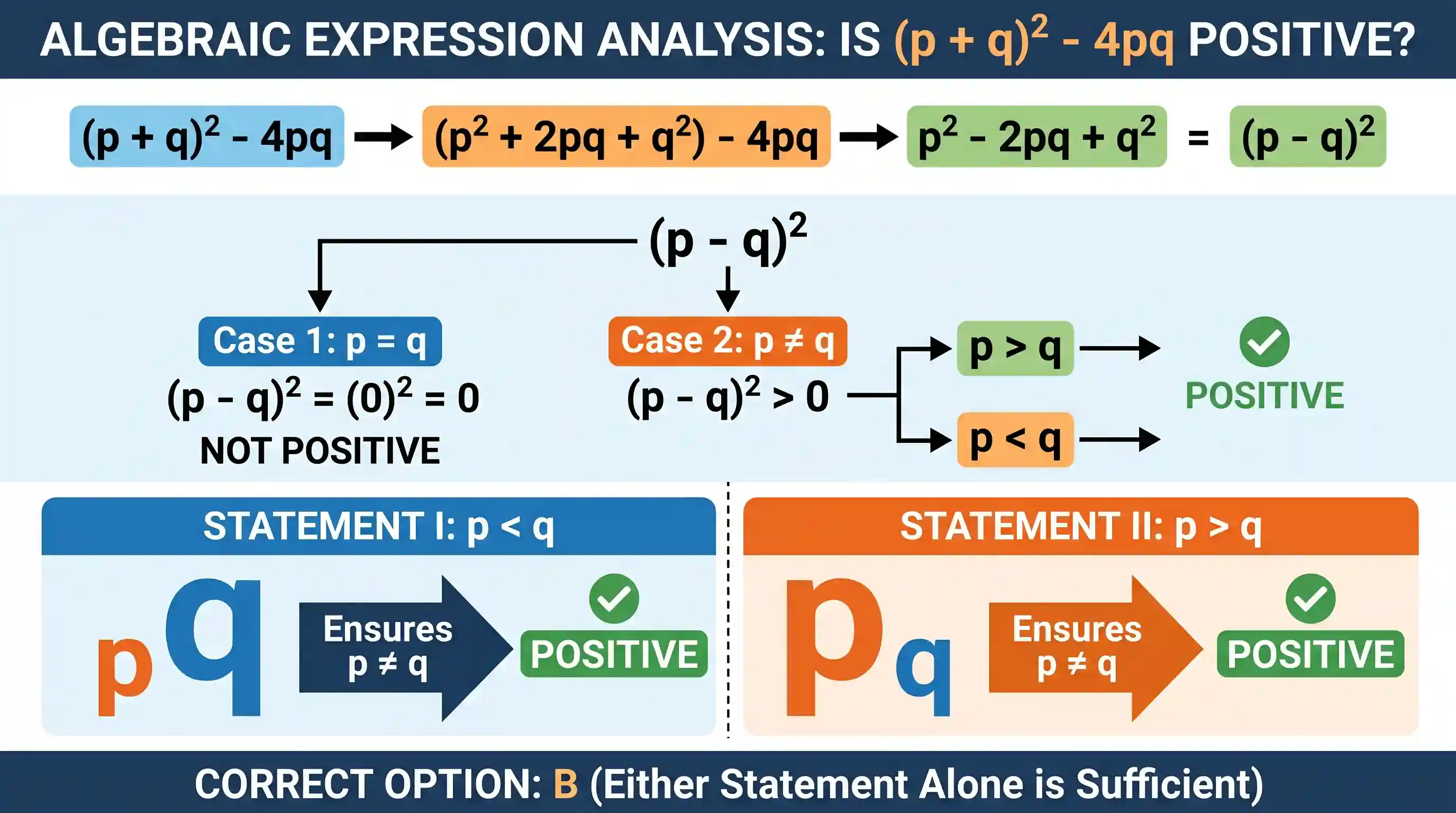
The given expression is (p + q)squared - 4pq. Let's simplify this expression: (p + q)squared - 4pq = (psquared + 2pq + qsquared) - 4pq = psquared - 2pq + qsquared = (p - q)squared
The question now becomes: Is (p - q)squared positive? We know that p and q are natural numbers, meaning p >= 1 and q >= 1.
Analysis of the simplified expression: A squared term, like (p - q)squared, is always greater than or equal to zero. It is positive if (p - q) is not equal to zero, i.e., if p is not equal to q. It is zero if (p - q) is equal to zero, i.e., if p = q.
Now let's evaluate the statements:
Statement I: p q If p > q, then p - q will be a positive integer (e.g., if p=2, q=1, then p-q = 1). Since p - q is a non-zero integer, (p - q)squared will be a positive integer (e.g., (1)squared = 1). So, if Statement II is true, the answer to the question "Is (p - q)squared positive?" is YES. Therefore, Statement II alone is sufficient to answer the question.
Considering the options: A) The Question can be answered by using one of the Statements alone, but cannot be answered using the other statement alone. (Incorrect, as both are sufficient) B) The Question can be answered by using either Statement alone. (Correct, as both Statement I and Statement II are individually sufficient) C) The Question can be answered by using both the Statements together, but cannot be answered using either Statement alone. (Incorrect, as both are sufficient alone) D) The Question can be answered even without using any of the Statements. (Incorrect, because if p = q, then (p - q)squared = 0, which is not positive. Without the statements, we don't know if p=q or p!=q. The statements ensure p!=q.)
Thus, the correct option is B because either statement alone is sufficient to answer the question.
The final answer is B.
Related questions
More UPSC Prelims practice from the same subject and topic.
- Prelims 2025CSATQuantitative Aptitude
If 4 ≤ x ≤ 8 and 2 ≤ y ≤ 7 , then what is the ratio of maximum value of (x + y) to minimum value of (x - y) ?
- Prelims 2025CSATQuantitative Aptitude
Let p + q = 10 , where p , q are integers. Value-I = Maximum value of p × q when p , q are positive integers. Value-II = Maximum value of p × q when p ≥ - 6 , q ≥ - 4 . Which one of the following is c…
- Prelims 2025CSATQuantitative Aptitude
Let x be a real number between 0 and 1. Which of the following statements is/are correct? I. x² > x³ . II. x > √(x) . Select the correct answer using the code given below:
- Prelims 2025CSATQuantitative Aptitude
A natural number N is such that it can be expressed as N = p + q + r , where p, q and r are distinct factors of N. How many numbers below 50 have this property?
- Prelims 2025CSATQuantitative Aptitude
Three prime numbers p, q and r, each less than 20, are such that p - q = q - r . How many distinct possible values can we get for (p + q + r) ?
- Prelims 2025CSATQuantitative Aptitude
How many possible values of (p + q + r) are there satisfying (1)/(p) + (1)/(q) + (1)/(r) = 1 , where p, q and r are natural numbers (not necessarily distinct)?