Let p + q = 10 , where p , q are integers. Value-I = Maximum value of p × q when p , q are positive integers. Value-II = Maximum value of p × q when p ≥ - 6 , q ≥ - 4 . Which one of the following is correct?

- AValue-I < Value-II
- BValue-II < Value-I
- CValue-I = Value-IICorrect
- DCannot be determined due to insufficient data
Explanation
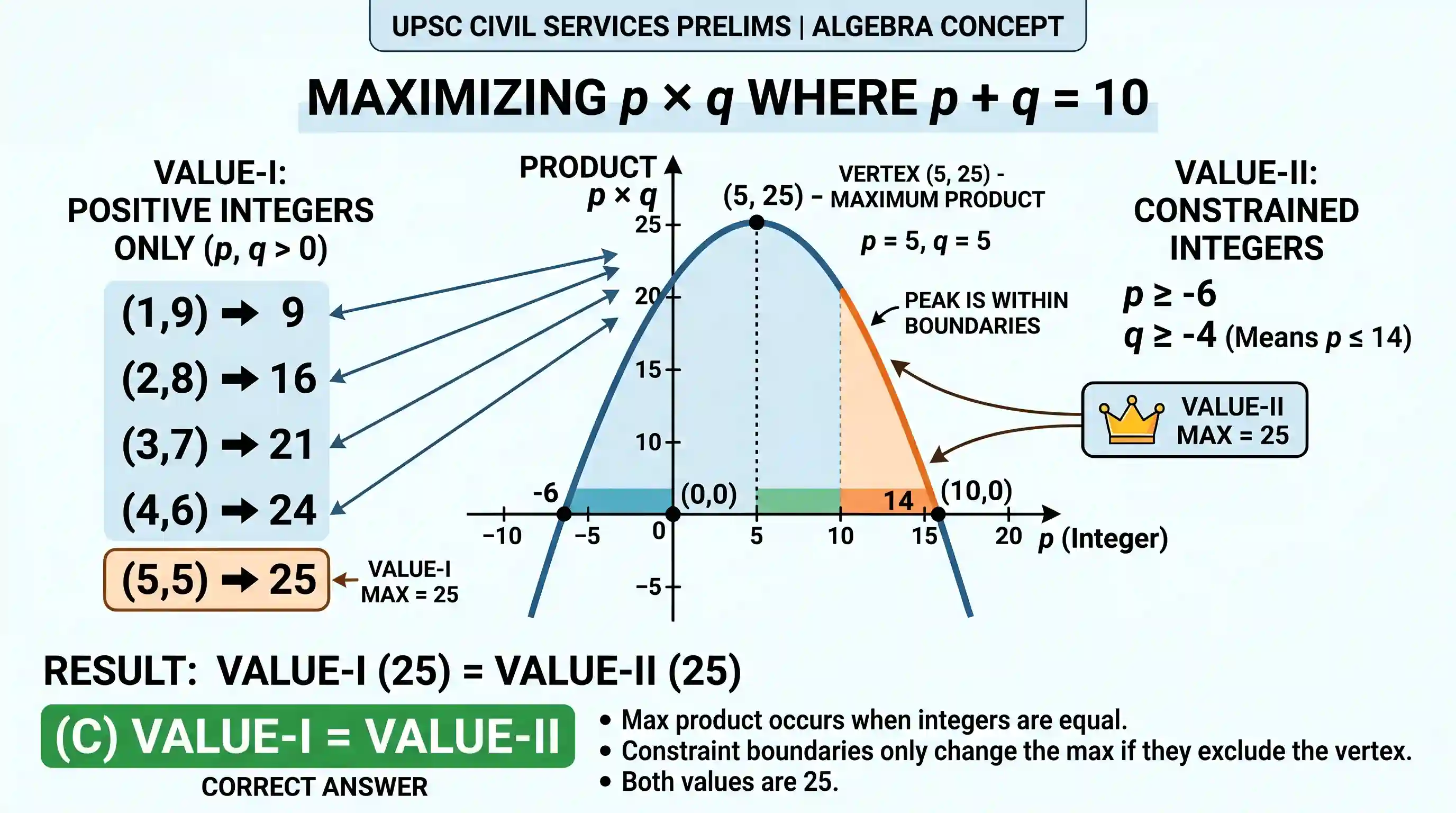
To find the maximum value of p * q when p + q = 10, we can express q as 10 - p. The expression becomes p * (10 - p) = 10p - p^2. This is a downward-opening parabola, and its maximum value occurs at the vertex, which is p = -10 / (2 * -1) = 5. When p = 5, q = 10 - 5 = 5. The product p * q is 5 * 5 = 25.
Value-I: Maximum value of p * q when p, q are positive integers. The integers p and q must be positive and sum to 10. To maximize their product, they should be as close as possible. The closest positive integers are p = 5 and q = 5. For p = 5, q = 5: p * q = 5 * 5 = 25. All other pairs of positive integers (e.g., 4, 6 or 3, 7) will yield a smaller product. So, Value-I = 25.
Value-II: Maximum value of p * q when p >= -6, q >= -4. We already established that the absolute maximum of p * q for p + q = 10 occurs at p = 5, q = 5, giving a product of 25. We need to check if these values satisfy the given constraints: For p = 5: Is p >= -6? Yes, 5 >= -6. For q = 5: Is q >= -4? Yes, 5 >= -4. Since p=5 and q=5 satisfy the constraints and yield the absolute maximum product, Value-II is also 25.
Comparing the values: Value-I = 25 Value-II = 25 Therefore, Value-I = Value-II.
The correct option is C.
Related questions
More UPSC Prelims practice from the same subject and topic.
- Prelims 2025CSATQuantitative Aptitude
If 4 ≤ x ≤ 8 and 2 ≤ y ≤ 7 , then what is the ratio of maximum value of (x + y) to minimum value of (x - y) ?
- Prelims 2025CSATQuantitative Aptitude
A question is given followed by two Statements I and II. Consider the Question and the Statements and mark the correct option. Is (p + q)² - 4p q , where p , q are natural numbers, positive? Statement…
- Prelims 2025CSATQuantitative Aptitude
Let x be a real number between 0 and 1. Which of the following statements is/are correct? I. x² > x³ . II. x > √(x) . Select the correct answer using the code given below:
- Prelims 2025CSATQuantitative Aptitude
A natural number N is such that it can be expressed as N = p + q + r , where p, q and r are distinct factors of N. How many numbers below 50 have this property?
- Prelims 2025CSATQuantitative Aptitude
Three prime numbers p, q and r, each less than 20, are such that p - q = q - r . How many distinct possible values can we get for (p + q + r) ?
- Prelims 2025CSATQuantitative Aptitude
How many possible values of (p + q + r) are there satisfying (1)/(p) + (1)/(q) + (1)/(r) = 1 , where p, q and r are natural numbers (not necessarily distinct)?