Consider a set of 11 numbers: Value-I = Minimum value of the average of the numbers of the set when they are consecutive integers ≥ - 5 . Value-II = Minimum value of the product of the numbers of the set when they are consecutive non-negative integers. Which one of the following is correct?

- AValue-I < Value-II
- BValue-II < Value-I
- CValue-I = Value-IICorrect
- DCannot be determined due to insufficient data
Explanation
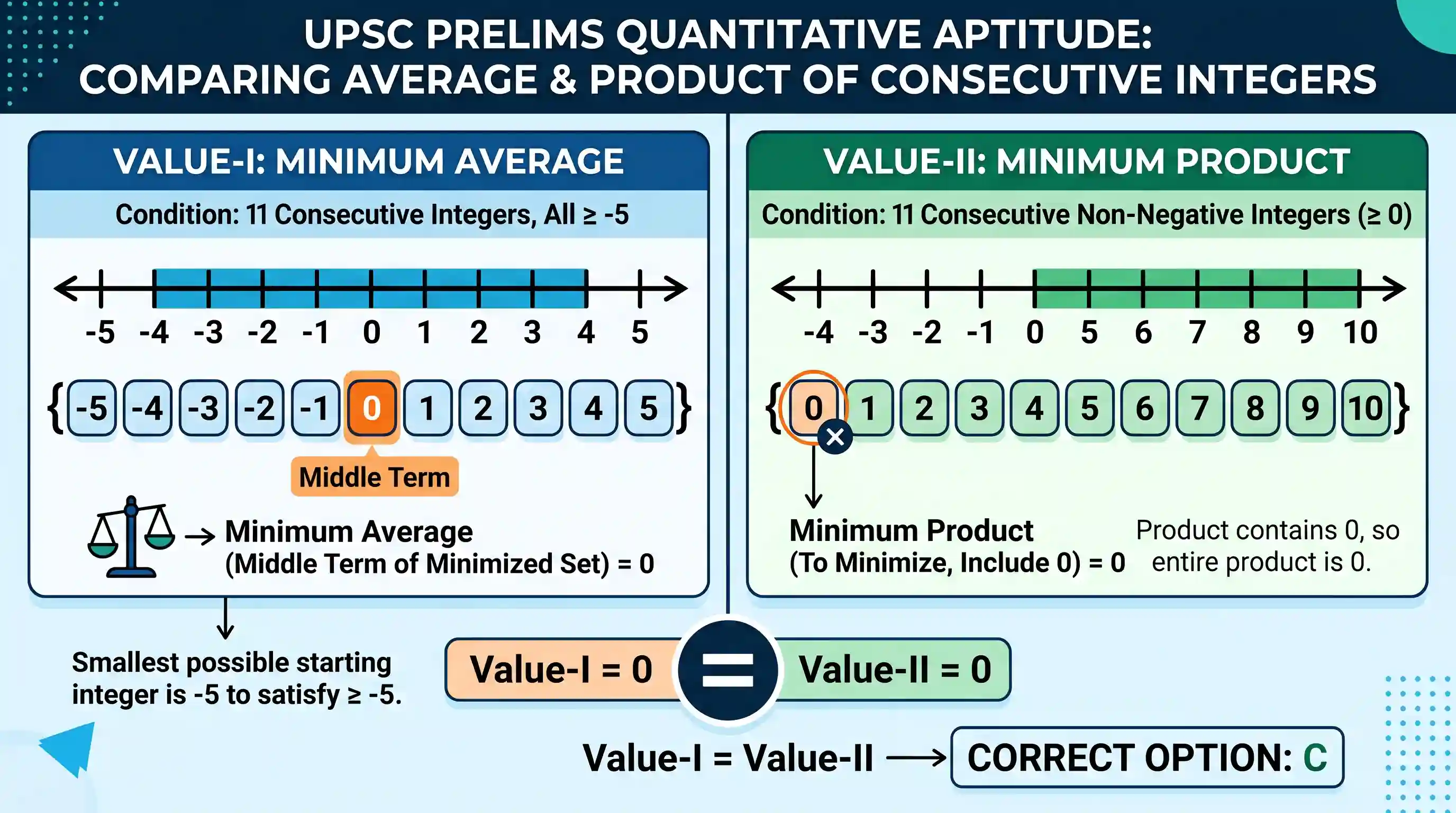
To calculate Value-I: The set consists of 11 consecutive integers. Let the first integer be 'x'. The numbers are x, x+1, ..., x+10. The average of 11 consecutive integers is the middle term, which is x+5. The condition is that all numbers must be >= -5. This means x >= -5. To find the minimum value of the average (x+5), we must choose the smallest possible 'x'. The smallest 'x' that satisfies x >= -5 is x = -5. If x = -5, the numbers are -5, -4, -3, -2, -1, 0, 1, 2, 3, 4, 5. All are >= -5. The average is -5 + 5 = 0. So, Value-I = 0.
To calculate Value-II: The set consists of 11 consecutive non-negative integers. Non-negative means >= 0. Let the first integer be 'y'. The numbers are y, y+1, ..., y+10. We need to find the minimum value of their product: P = y * (y+1) * ... * (y+10). The condition is that all numbers must be non-negative, so y >= 0. To minimize the product, we should choose the smallest possible 'y'. The smallest 'y' that satisfies y >= 0 is y = 0. If y = 0, the numbers are 0, 1, 2, 3, 4, 5, 6, 7, 8, 9, 10. The product P = 0 * 1 * 2 * ... * 10 = 0. So, Value-II = 0.
Comparing Value-I and Value-II: Value-I = 0 Value-II = 0 Therefore, Value-I = Value-II.
The correct option is C.
Related questions
More UPSC Prelims practice from the same subject and topic.
- Prelims 2025CSATQuantitative Aptitude
A natural number N is such that it can be expressed as N = p + q + r , where p, q and r are distinct factors of N. How many numbers below 50 have this property?
- Prelims 2025CSATQuantitative Aptitude
Three prime numbers p, q and r, each less than 20, are such that p - q = q - r . How many distinct possible values can we get for (p + q + r) ?
- Prelims 2025CSATQuantitative Aptitude
How many possible values of (p + q + r) are there satisfying (1)/(p) + (1)/(q) + (1)/(r) = 1 , where p, q and r are natural numbers (not necessarily distinct)?
- Prelims 2025CSATQuantitative Aptitude
A 4-digit number N is such that when divided by 3, 5, 6, 9 leaves a remainder 1, 3, 4, 7 respectively. What is the smallest value of N?
- Prelims 2025CSATQuantitative Aptitude
What is the unit digit in the multiplication of 1× 3× 5× 7× 9× … × 999 ?
- Prelims 2025CSATQuantitative Aptitude
Consider the first 100 natural numbers. How many of them are not divisible by any one of 2, 3, 5, 7 and 9?