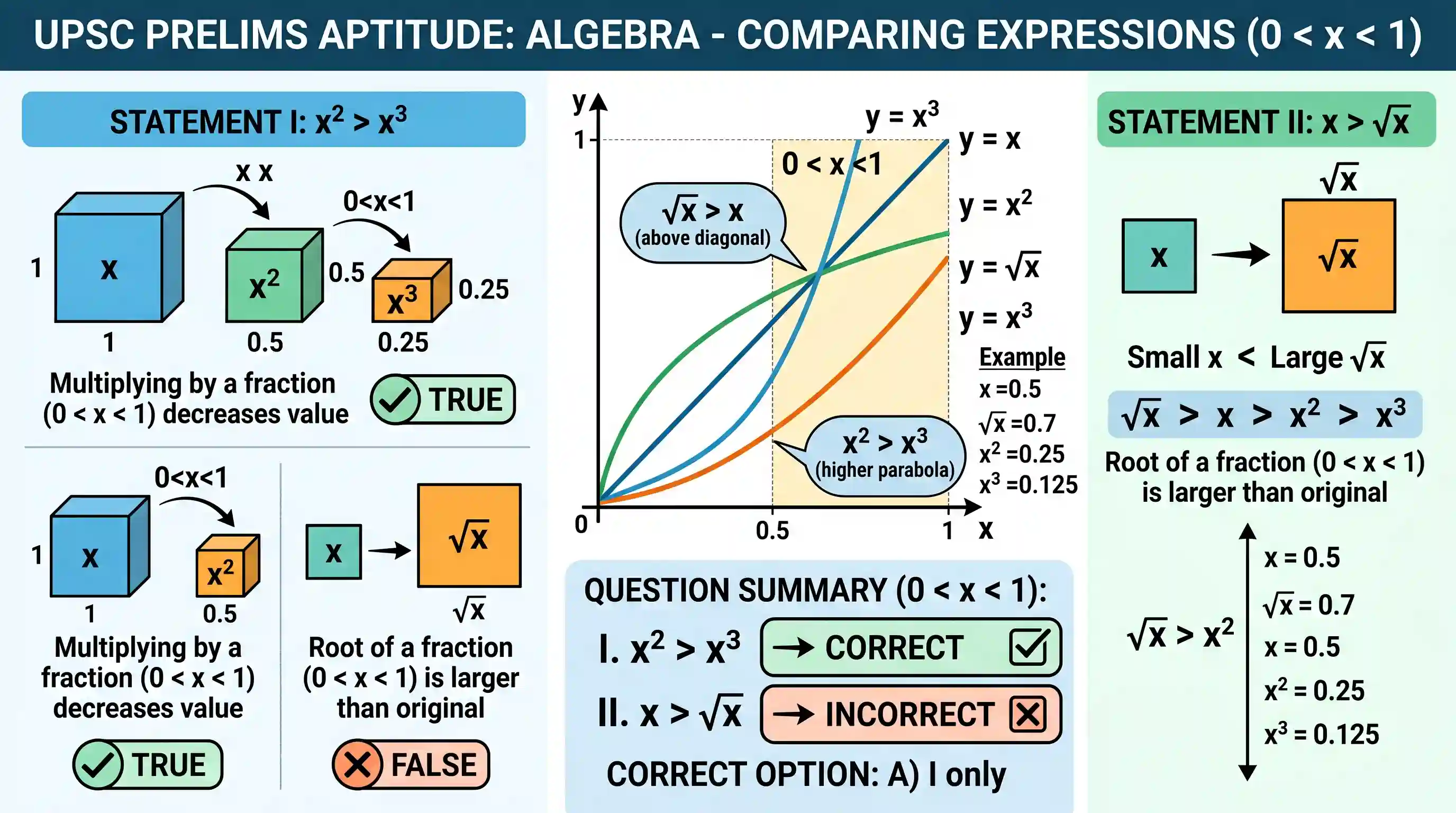
Let x be a real number between 0 and 1. Which of the following statements is/are correct? I. x² > x³ . II. x > √(x) . Select the correct answer using the code given below:

- AI onlyCorrect
- BII only
- CBoth I and II
- DNeither I nor II
Explanation
Statement I: x² > x³ Since x is a positive number (between 0 and 1), we can divide both sides by x³ without changing the inequality sign. x²/x³ > x³/x³ 1/x > 1 Given that 0 x³. So, Statement I is correct.
Statement II: x > √(x) Since x is positive, we can square both sides of the inequality without changing its direction: x² > x Rearrange the inequality: x² - x > 0 Factor out x: x(x - 1) > 0 Given that 0 0. So, Statement II is incorrect. (In fact, for 0 < x < 1, x < √(x). For example, if x = 0.25, then √(x) = 0.5, and 0.25 < 0.5).
Since only Statement I is correct, the answer is A.
The final answer is A
Related questions
More UPSC Prelims practice from the same subject and topic.
- Prelims 2025CSATQuantitative Aptitude
If 4 ≤ x ≤ 8 and 2 ≤ y ≤ 7 , then what is the ratio of maximum value of (x + y) to minimum value of (x - y) ?
- Prelims 2025CSATQuantitative Aptitude
A question is given followed by two Statements I and II. Consider the Question and the Statements and mark the correct option. Is (p + q)² - 4p q , where p , q are natural numbers, positive? Statement…
- Prelims 2025CSATQuantitative Aptitude
Let p + q = 10 , where p , q are integers. Value-I = Maximum value of p × q when p , q are positive integers. Value-II = Maximum value of p × q when p ≥ - 6 , q ≥ - 4 . Which one of the following is c…
- Prelims 2025CSATQuantitative Aptitude
A natural number N is such that it can be expressed as N = p + q + r , where p, q and r are distinct factors of N. How many numbers below 50 have this property?
- Prelims 2025CSATQuantitative Aptitude
Three prime numbers p, q and r, each less than 20, are such that p - q = q - r . How many distinct possible values can we get for (p + q + r) ?
- Prelims 2025CSATQuantitative Aptitude
How many possible values of (p + q + r) are there satisfying (1)/(p) + (1)/(q) + (1)/(r) = 1 , where p, q and r are natural numbers (not necessarily distinct)?