What would happen if phytoplankton of an ocean is completely destroyed for some reason? 1. The ocean as a carbon sink would be adversely affected. 2. The food chains in the ocean would be adversely affected. 3. The density of ocean water would drastically decrease. Select the correct answer using the codes given below:

- A1 and 2 onlyCorrect
- B2 only
- C3 only
- D1, 2 and 3
Explanation
Phytoplankton are microscopic marine algae that form the base of the ocean food web and play a critical role in global biogeochemical cycles.
-
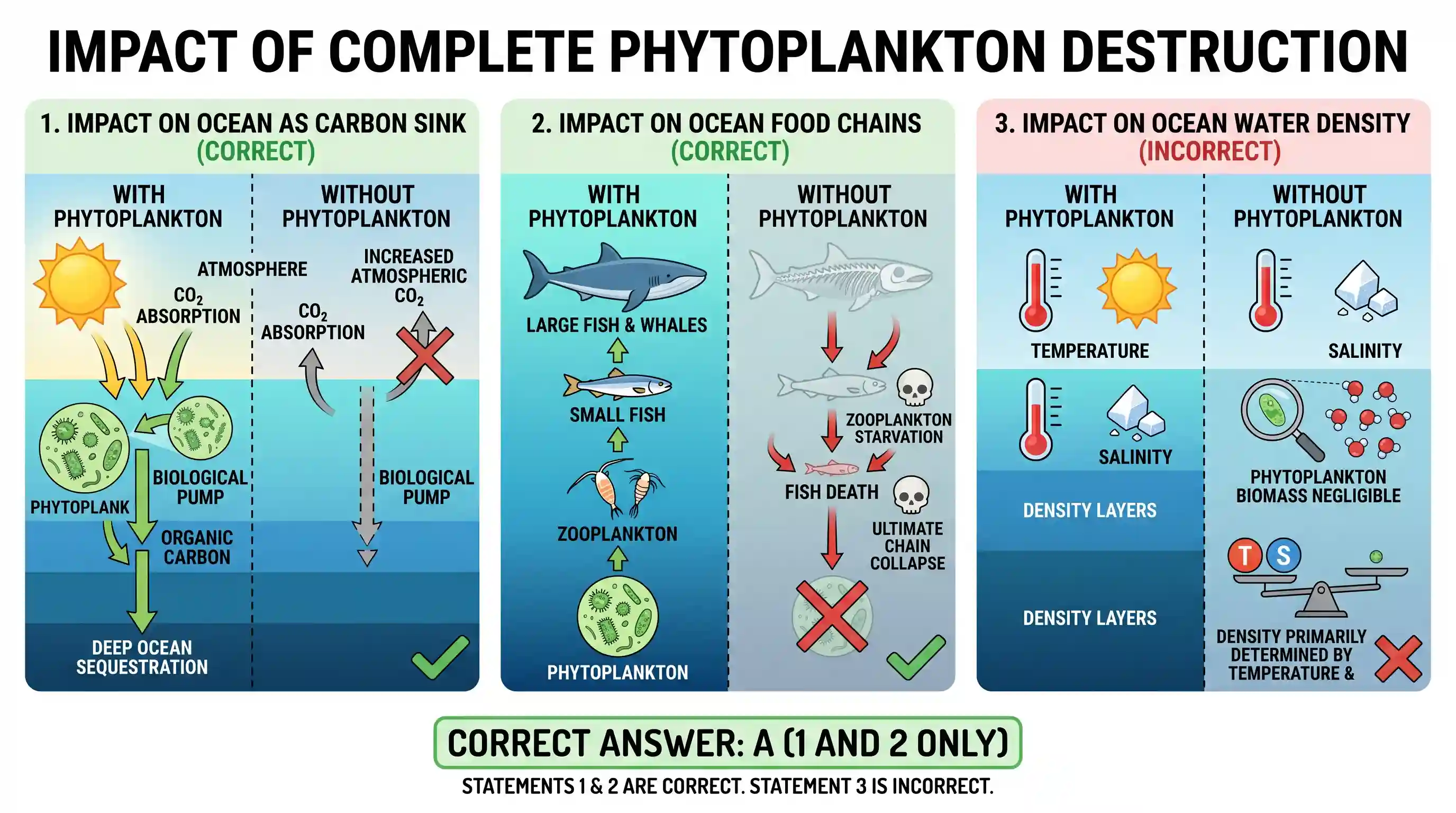
The ocean as a carbon sink would be adversely affected. This is correct. Phytoplankton perform photosynthesis, absorbing vast amounts of carbon dioxide from the atmosphere and surface waters. They are a major component of the biological pump, which sequesters carbon into the deep ocean. Their destruction would significantly reduce the ocean's capacity to absorb and store carbon, thus adversely affecting its role as a carbon sink.
-
The food chains in the ocean would be adversely affected. This is correct. Phytoplankton are the primary producers in most marine ecosystems. They are consumed by zooplankton, which in turn are consumed by larger organisms like fish, and so on. Their complete destruction would remove the foundation of the marine food web, leading to the collapse of nearly all ocean food chains.
-
The density of ocean water would drastically decrease. This is incorrect. Ocean water density is primarily determined by temperature and salinity. While phytoplankton contribute to the overall biomass in the water, their mass is negligible compared to the vast volume and mass of ocean water. Their destruction would not cause a drastic or even significant change in the overall density of ocean water.
Therefore, statements 1 and 2 are correct.
Related questions
More UPSC Prelims practice from the same subject and topic.
- Prelims 2012GS1geography
If National Water Mission is properly and completely implemented, how will it impact the country? 1. Part of the water needs of urban areas will be met through recycling of wastewater. 2. The water re…
- Prelims 2012GS1geography
Consider the following statements: Chlorofluorocarbons, known as ozone-depleting substances, are used 1. in the production of plastic foams 2. in the production of tubeless tyres 3. in cleaning certai…
- Prelims 2012GS1geography
Electrically charged particles from space travelling at speeds of several hundred km/sec can severely harm living beings if they reach the surface of the Earth. What prevents them from reaching the su…
- Prelims 2012GS1geography
Government of India encourages the cultivation of 'sea buckthorn'. What is the importance of this plant? 1. It helps in controlling soil erosion and in preventing desertification. 2. It is a rich sour…
- Prelims 2012GS1geography
With reference to the wetlands of India, consider the following statements: 1. The country's total geographical area under the category of wetlands is recorded more in Gujarat as compared to other Sta…
- Prelims 2012GS1geography
The acidification of oceans is increasing. Why is this phenomenon a cause of concern? 1. The growth and survival of calcareous phytoplankton will be adversely affected. 2. The growth and survival of c…