Consider the following agricultural practices: 1. Contour bunding 2. Relay cropping 3. Zero tillage In the context of global climate change, which of the above helps/help in carbon sequestration/storage in the soil?

- A1 and 2 only
- B3 onlyCorrect
- C1, 2 and 3
- DNone of them
Explanation
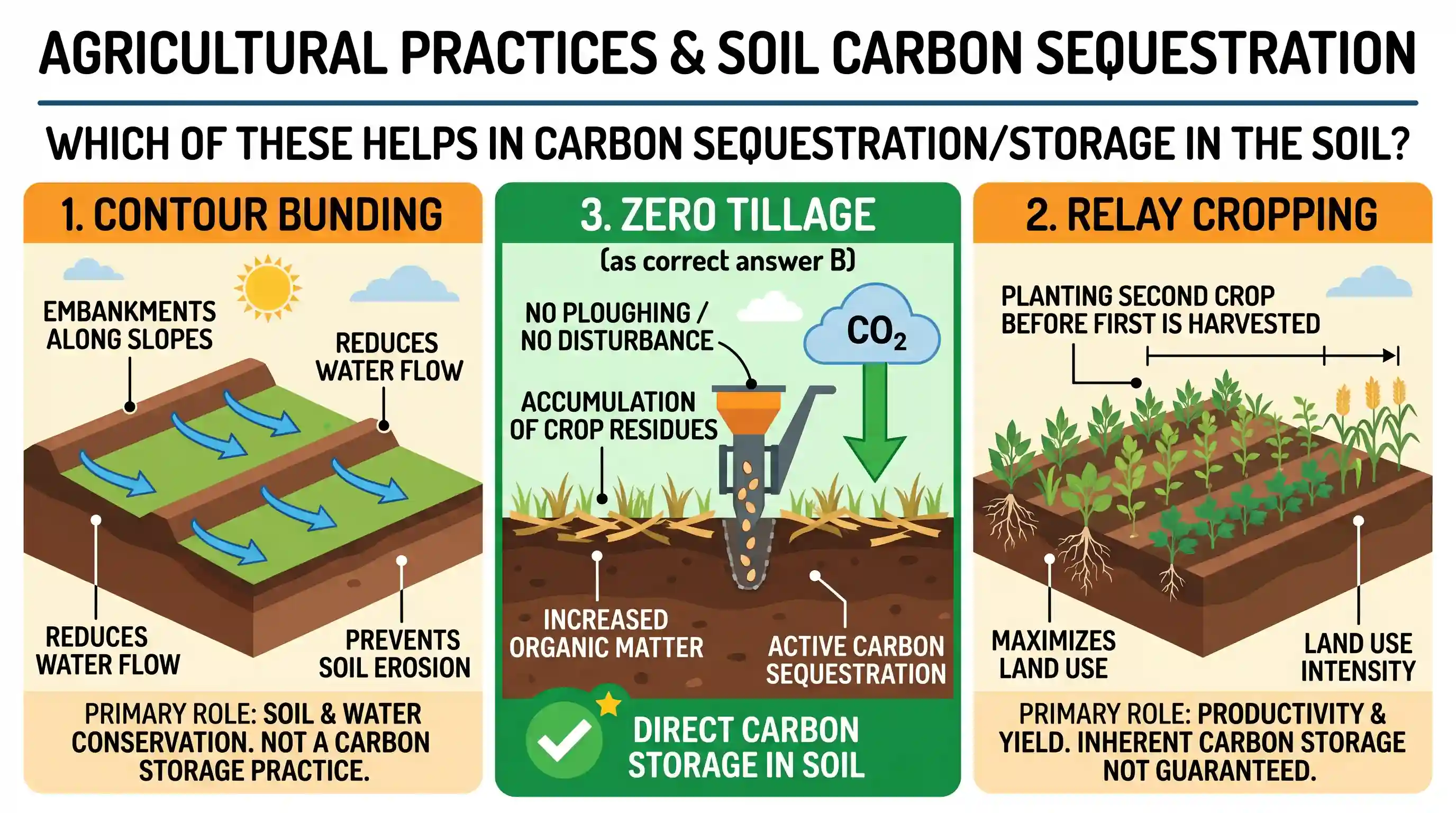
The correct answer is B because zero tillage is the primary practice among the three specifically recognized for direct carbon sequestration in the soil.
Zero tillage involves planting crops without prior soil disturbance through ploughing. This lack of disturbance prevents the oxidation of soil organic matter and keeps carbon trapped within the soil layers. It also promotes the accumulation of crop residues which decompose into organic carbon.
In contrast, contour bunding is primarily a physical soil and water conservation technique used to prevent erosion on slopes. While it helps maintain soil health, it is not fundamentally a carbon storage practice. Relay cropping is a method of planting a second crop before the first is harvested to maximize land use, but it does not inherently guarantee increased carbon storage in the same direct way that eliminating tillage does.
According to standard ecological and agricultural assessments often used by the UPSC, zero tillage is the most definitive answer for carbon sequestration in this context.
Related questions
More UPSC Prelims practice from the same subject and topic.
- Prelims 2012GS1geography
If National Water Mission is properly and completely implemented, how will it impact the country? 1. Part of the water needs of urban areas will be met through recycling of wastewater. 2. The water re…
- Prelims 2012GS1geography
Consider the following statements: Chlorofluorocarbons, known as ozone-depleting substances, are used 1. in the production of plastic foams 2. in the production of tubeless tyres 3. in cleaning certai…
- Prelims 2012GS1geography
Electrically charged particles from space travelling at speeds of several hundred km/sec can severely harm living beings if they reach the surface of the Earth. What prevents them from reaching the su…
- Prelims 2012GS1geography
Government of India encourages the cultivation of 'sea buckthorn'. What is the importance of this plant? 1. It helps in controlling soil erosion and in preventing desertification. 2. It is a rich sour…
- Prelims 2012GS1geography
With reference to the wetlands of India, consider the following statements: 1. The country's total geographical area under the category of wetlands is recorded more in Gujarat as compared to other Sta…
- Prelims 2012GS1geography
The acidification of oceans is increasing. Why is this phenomenon a cause of concern? 1. The growth and survival of calcareous phytoplankton will be adversely affected. 2. The growth and survival of c…