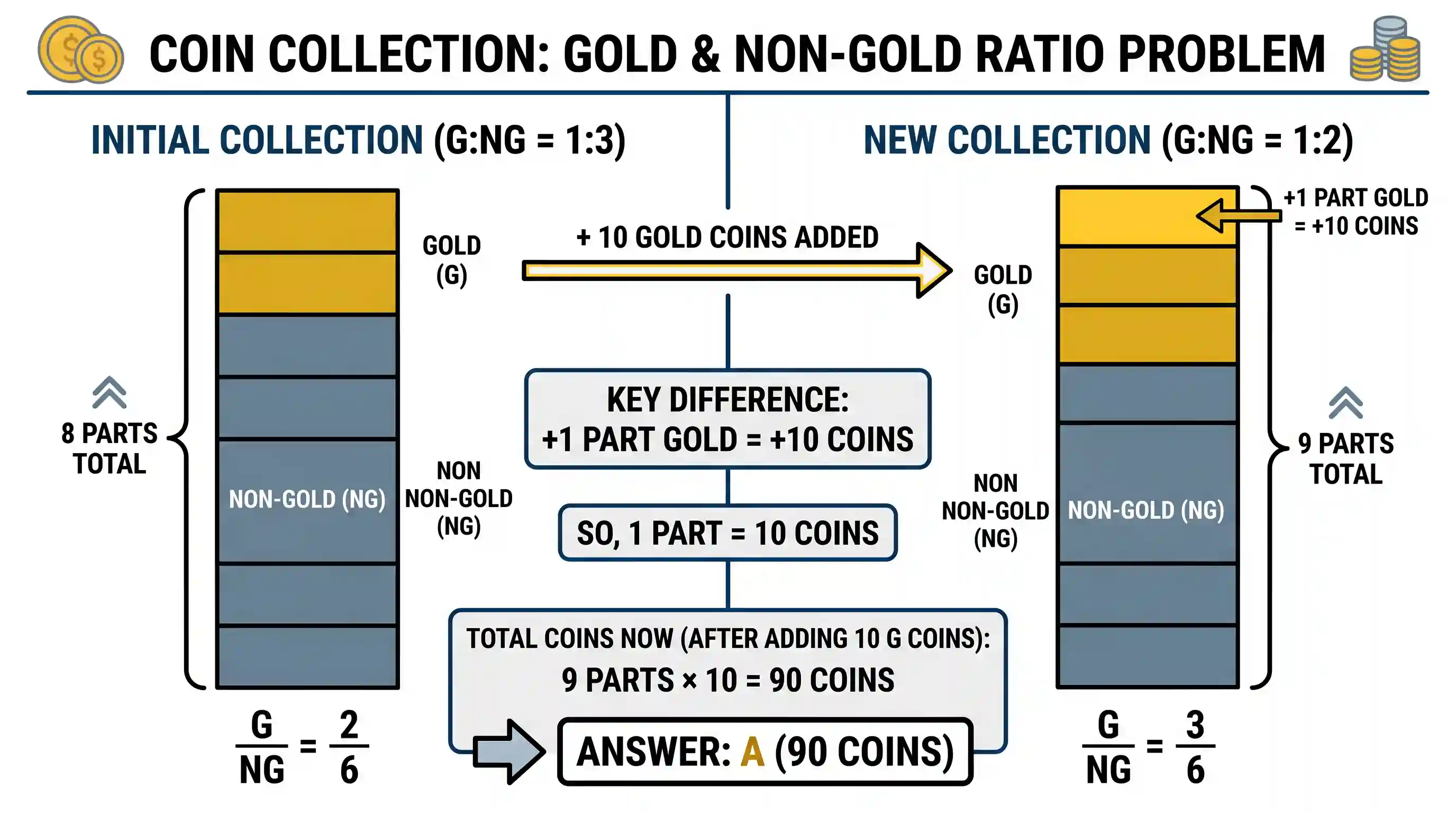
In a rare coin collection, there is one gold coin for every three non-gold coins. 10 more gold coins are added to the collection and the ratio of gold coins to non-gold coins would be 1: 2. Based on the information; the total number of coins in the collection now becomes

- A90Correct
- B80
- C60
- D50
Explanation
Let G be the initial number of gold coins and N be the initial number of non-gold coins.
-
From the first statement, "one gold coin for every three non-gold coins": G / N = 1 / 3 This implies N = 3G.
-
From the second statement, "10 more gold coins are added... the ratio of gold coins to non-gold coins would be 1:2": The new number of gold coins is G + 10. The number of non-gold coins remains N. So, (G + 10) / N = 1 / 2
-
Substitute N = 3G (from step 1) into the equation from step 2: (G + 10) / (3G) = 1 / 2
-
Cross-multiply to solve for G: 2 * (G + 10) = 1 * (3G) 2G + 20 = 3G 20 = 3G - 2G G = 20
-
Now that we have G, find N using N = 3G: N = 3 * 20 = 60
-
The question asks for the total number of coins in the collection NOW (after adding 10 gold coins). New number of gold coins = G + 10 = 20 + 10 = 30 Number of non-gold coins = N = 60 Total number of coins NOW = 30 + 60 = 90
Therefore, the total number of coins in the collection now is 90.
Analyzing the options: A) 90: This matches our calculated total number of coins after adding 10 gold coins. B) 80: This would be the initial total number of coins (20 gold + 60 non-gold), not the total after adding more. C) 60: This is the number of non-gold coins. D) 50: This is incorrect.
The final answer is A.
Related questions
More UPSC Prelims practice from the same subject and topic.
- Prelims 2013CSATQuantitative Aptitude
A sum of Rs. 700 has to be used to give seven cash prizes to the students of a school for their overall academic performance. If each prize is Rs. 20 less than its preceding prize, what is the least v…
- Prelims 2013CSATQuantitative Aptitude
The tank-full petrol in Arun's motor-cycle lasts for 10 days. If he starts using 25% more everyday, how many days will the tank-full petrol last?
- Prelims 2013CSATQuantitative Aptitude
If the number of female Physics professors in the age group 25 - 34 equals 25% of all the Physics professors in that age group, then what is the number of male Physics professors in the age group 25 -…
- Prelims 2013CSATQuantitative Aptitude
Four friends, A, B, C and D distribute some money among themselves in such a manner that A gets one less than B, C gets 5 more than D, D gets 3 more than B. Who gets the smallest amount?
- Prelims 2013CSATQuantitative Aptitude
There are some balls of red, green and yellow colour lying on a table. There are as many red balls as there are yellow balls. There are twice as many yellow balls as there are green ones. The number o…
- Prelims 2013CSATQuantitative Aptitude
In a class of 45 students, a boy is ranked 20th. When two boys joined, his rank was dropped by one. What is his new rank from the end?