There are some balls of red, green and yellow colour lying on a table. There are as many red balls as there are yellow balls. There are twice as many yellow balls as there are green ones. The number of red balls

- Ais equal to the sum of yellow and green balls
- Bis double the number of green ballsCorrect
- Cis equal to yellow balls minus green balls
- Dcannot be ascertained.
Explanation
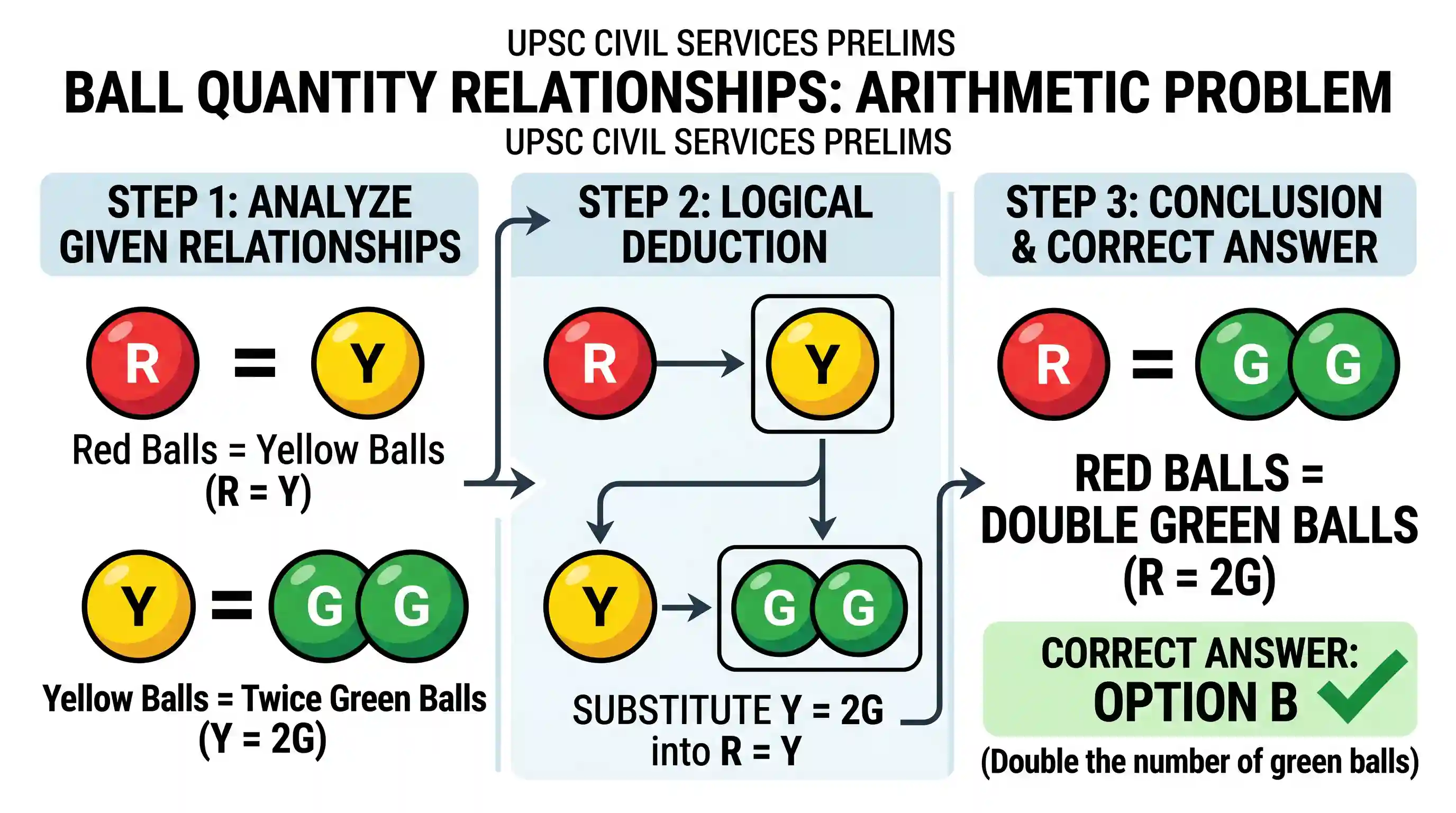
Let R be the number of red balls, Y be the number of yellow balls, and G be the number of green balls.
From the first statement: "There are as many red balls as there are yellow balls." This means R = Y.
From the second statement: "There are twice as many yellow balls as there are green ones." This means Y = 2 * G.
Now, we want to find the relationship for the number of red balls (R). Since R = Y and Y = 2G, we can substitute Y in the first equation: R = 2G.
Let's analyze the options: A) is equal to the sum of yellow and green balls (R = Y + G). We know R = Y, so Y = Y + G, which implies G = 0. This is not generally true. B) is double the number of green balls (R = 2G). This matches our derived relationship. So, B is correct. C) is equal to yellow balls minus green balls (R = Y - G). We know R = Y, so Y = Y - G, which implies G = 0. This is not generally true. D) cannot be ascertained. We were able to ascertain the relationship, so this is incorrect.
Thus, the number of red balls is double the number of green balls.
The final answer is B
Related questions
More UPSC Prelims practice from the same subject and topic.
- Prelims 2013CSATQuantitative Aptitude
In a rare coin collection, there is one gold coin for every three non-gold coins. 10 more gold coins are added to the collection and the ratio of gold coins to non-gold coins would be 1: 2. Based on t…
- Prelims 2013CSATQuantitative Aptitude
A sum of Rs. 700 has to be used to give seven cash prizes to the students of a school for their overall academic performance. If each prize is Rs. 20 less than its preceding prize, what is the least v…
- Prelims 2013CSATQuantitative Aptitude
The tank-full petrol in Arun's motor-cycle lasts for 10 days. If he starts using 25% more everyday, how many days will the tank-full petrol last?
- Prelims 2013CSATQuantitative Aptitude
If the number of female Physics professors in the age group 25 - 34 equals 25% of all the Physics professors in that age group, then what is the number of male Physics professors in the age group 25 -…
- Prelims 2013CSATQuantitative Aptitude
Four friends, A, B, C and D distribute some money among themselves in such a manner that A gets one less than B, C gets 5 more than D, D gets 3 more than B. Who gets the smallest amount?
- Prelims 2013CSATQuantitative Aptitude
In a class of 45 students, a boy is ranked 20th. When two boys joined, his rank was dropped by one. What is his new rank from the end?