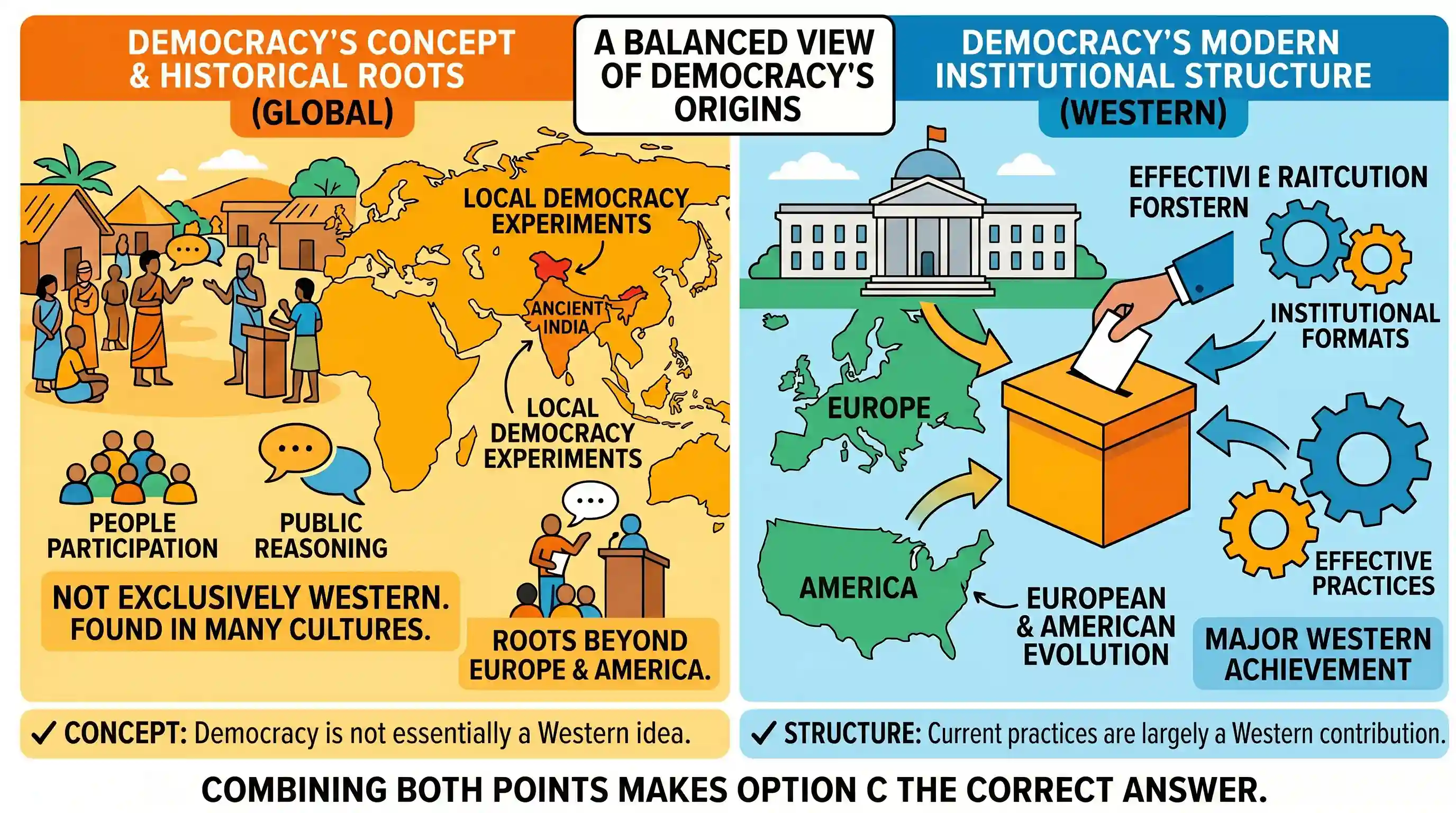
Passage-1 The subject of democracy has become severely muddled because of the way the rhetoric surrounding it has been used in recent years, There IS, increasingly, an oddly confused dichotomy between those who want to 'impose' democracy on countries in the non-Western world (in these countries' 'own interest', of course) and those who are opposed to such imposition' (because of the respect for the countries'own ways'). But the entire language of 'imposition', used by both sides, is extraordinarily inappropriate since it makes the implicit assumption that democracy belongs exclusively to the West, taking it to be a quintessentially 'Western' idea which has originated and flourished only in the West. But the thesis and the pessimism it generates about the possibility of democratic practice in the world would be extremely hard to justify. There were several experiments in local democracy in ancient India. Indeed, in understanding the roots of democracy in the world, we have to take an interest in the history of people participation and public reasoning in different parts of the world. We have to look beyond thinking of democracy only in terms of European and American evolution. We would fail to understand the pervasive demands for participatory living, on which Aristotle spoke with far- reaching insight, if we take democracy to be a kind of a specialized cultural product of the West. It cannot, of course, be doubted that the institutional structure of the contemporary practice of democracy is largely the product of European and American experience over the last few centuries. This is extremely important to recognize since these developments in institutional formats were immensely innovative and ultimately effective. There can be little doubt that there is a major 'Western' achievement here. Which of the following is closest to the view of democracy as mentioned in the above passage?

- AThe subject of democracy is a muddle due to a desire to portray it as a Western concept, 'alien' to non-Western countries
- BThe language or imposition of democracy is inappropriate. There is, however, a need to consider this concept in the backdrop of culture of 'own ways' of non-Western society
- CWhile democracy is not essentially a Western idea belonging exclusively to the West, the institutional structure of current democratic practices has been their contributionCorrect
- DNone of the statements (a), (b) and (c) given above is correct.
Explanation
The passage argues that the idea of democracy being exclusively Western is a misconception. It points out that there were experiments in local democracy in ancient India and that the roots of democracy are found in various parts of the world, not just Europe and America. However, the passage also explicitly acknowledges that "the institutional structure of the contemporary practice of democracy is largely the product of European and American experience over the last few centuries" and calls this a "major 'Western' achievement."
Let's analyze the options:
A) The subject of democracy is a muddle due to a desire to portray it as a Western concept, 'alien' to non-Western countries. This option captures part of the passage's argument (the muddle and the portrayal as Western), but it doesn't encompass the full nuanced view, particularly the acknowledgment of Western institutional contributions. The passage attributes the muddle to the 'imposition' rhetoric, which assumes it's Western, rather than a specific 'desire to portray'.
B) The language or imposition of democracy is inappropriate. There is, however, a need to consider this concept in the backdrop of culture of 'own ways' of non-Western society. The first part is correct; the passage states the language of 'imposition' is inappropriate. However, the second part is misleading. The passage challenges the idea that democracy is alien to non-Western 'own ways' by giving examples like ancient India. It argues against the implicit assumption that non-Western 'own ways' are incompatible with democracy, rather than suggesting we need to consider democracy in the backdrop of those 'own ways' in a way that might suggest incompatibility.
C) While democracy is not essentially a Western idea belonging exclusively to the West, the institutional structure of current democratic practices has been their contribution. This option perfectly encapsulates the two main points of the passage:
- "democracy is not essentially a Western idea belonging exclusively to the West" - This aligns with the passage's argument that the assumption of democracy being quintessentially Western is hard to justify, citing ancient Indian examples and the need to look beyond European evolution.
- "the institutional structure of current democratic practices has been their contribution" - This directly matches the passage's statement: "It cannot, of course, be doubted that the institutional structure of the contemporary practice of democracy is largely the product of European and American experience... There can be little doubt that there is a major 'Western' achievement here."
Therefore, option C is the closest and most accurate representation of the view of democracy as mentioned in the passage.
The final answer is C
Related questions
More UPSC Prelims practice from the same subject and topic.
- Prelims 2013CSATReading Comprehension
Read the following passage and answer the two items that follow. Your answers to these items should be based on the passage only. Passage Ecological - research over the last quarter of the century has…
- Prelims 2013CSATReading Comprehension
What is the purpose of maintaining the continuity of forested landscapes and corridors? 1. Preservation of biodiversity. 2. Management of mineral resources. 3. Grant of forest lands for human activiti…
- Prelims 2013CSATReading Comprehension
Read the following passages and answer the items that follow passage. Your answers to these items should be based on the passages only The law in many parts of the world increasingly restricts the dis…
- Prelims 2013CSATReading Comprehension
Read the following passages and answer the items that follow passage. Your answers to these items should be based on the passages only The law in many parts of the world increasingly restricts the dis…
- Prelims 2013CSATReading Comprehension
Read the following passages and answer the items that follow passage. Your answers to these items should be based on the passages only The law in many parts of the world increasingly restricts the dis…
- Prelims 2013CSATReading Comprehension
Read the following passages and answer the items that follow passage. Your answers to these items should be based on the passages only . The law in many parts of the world increasingly restricts the d…