Passage-1 The subject of democracy has become severely muddled because of the way the rhetoric surrounding it has been used in recent years, There IS, increasingly, an oddly confused dichotomy between those who want to 'impose' democracy on countries in the non-Western world (in these countries' 'own interest', of course) and those who are opposed to such imposition' (because of the respect for the countries 'own ways'). But the entire language of 'imposition', used by both sides, is extraordinarily inappropriate since it makes the implicit assumption that democracy belongs exclusively to the West, taking it to be a quintessentially 'Western' idea which has originated and flourished only in the West. But the thesis and the pessimism it generates about the possibility of democratic practice in the world would be extremely hard to justify. There were several experiments in local democracy in ancient India. Indeed, in understanding the roots of democracy in the world, we have to take an interest in the history of people participation and public reasoning in different parts of the world. We have to look beyond thinking of democracy only in terms of European and American evolution. We would fail to understand the pervasive demands for participatory living, on which Aristotle spoke with far- reaching insight, if we take democracy to be a kind of a specialized cultural product of the West. It cannot, of course, be doubted that the institutional structure of the contemporary practice of democracy is largely the product of European and American experience over the last few centuries. This is extremely important to recognize since these developments in institutional formats were immensely innovative and ultimately effective. There can be little doubt that there is a major 'Western' achievement here. With reference to the passage, the following assumptions have been made: 1. The author gives primary importance to physical and material help in eradicating human misery. 2. Charitable homes, hospitals, etc. can remove human misery to a great extent. Which of the assumptions is/are valid?

- A1 only
- B2 only
- CBoth 1 and 2
- DNeither 1 nor 2Correct
Explanation
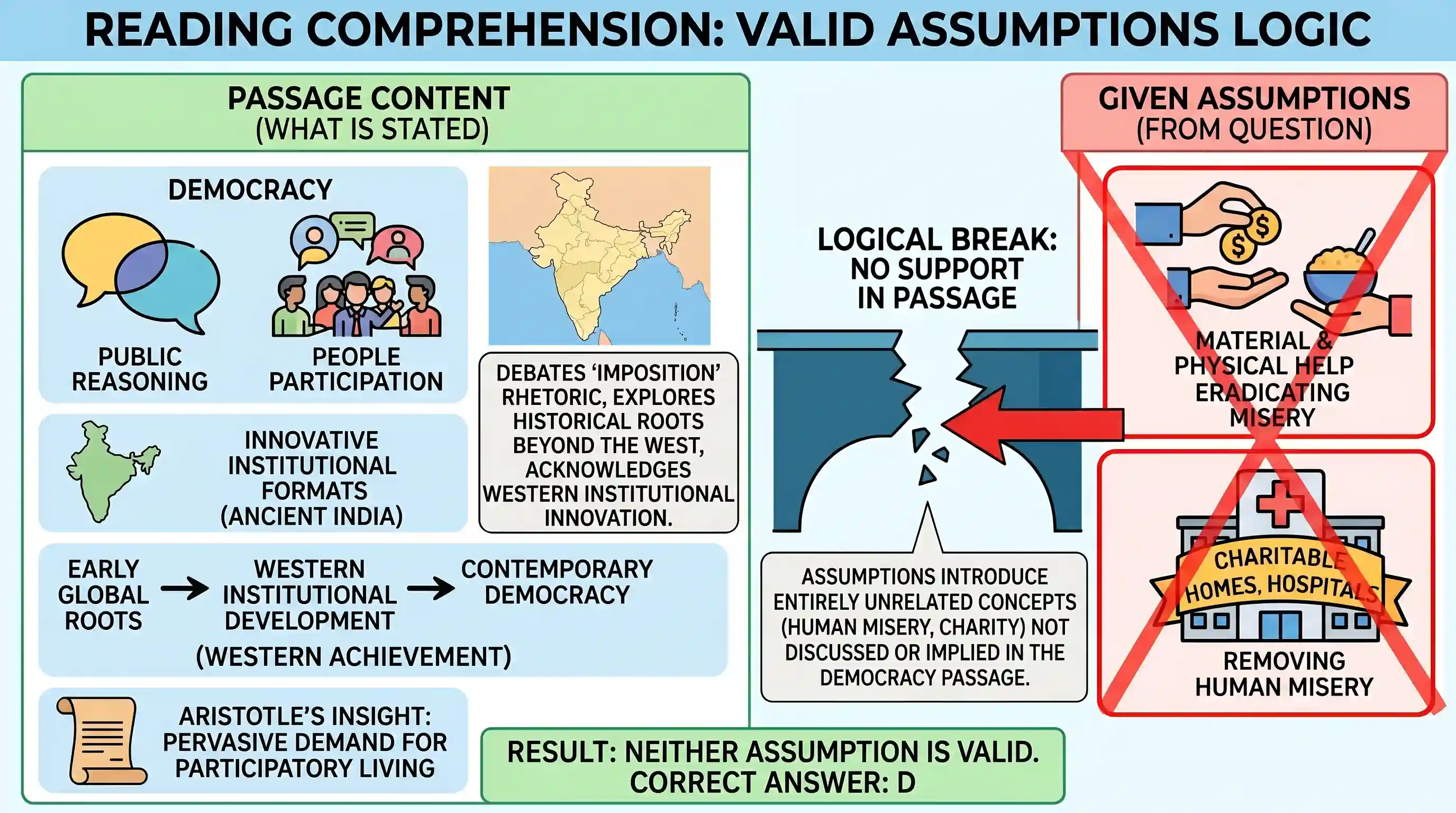
The passage discusses the concept of democracy, its origins, and the flawed assumption that it is exclusively a Western idea. It argues against the rhetoric of 'imposing' democracy and highlights its roots in various parts of the world, including ancient India. The passage acknowledges the Western contribution to the institutional structure of contemporary democracy but emphasizes the universal demand for participatory living.
Let's analyze the given assumptions:
-
The author gives primary importance to physical and material help in eradicating human misery. The passage does not mention human misery, physical help, or material help at all. Its focus is entirely on the intellectual and historical understanding of democracy. Therefore, this assumption cannot be inferred from the passage.
-
Charitable homes, hospitals, etc. can remove human misery to a great extent. Similar to the first statement, the passage makes no mention of charitable homes, hospitals, or their role in addressing human misery. These topics are completely outside the scope and theme of the provided text. Therefore, this assumption cannot be inferred from the passage.
Since neither statement 1 nor statement 2 is supported or even alluded to in the passage, both assumptions are invalid.
The final answer is D) Neither 1 nor 2.
Related questions
More UPSC Prelims practice from the same subject and topic.
- Prelims 2013CSATReading Comprehension
Read the following passage and answer the two items that follow. Your answers to these items should be based on the passage only. Passage Ecological - research over the last quarter of the century has…
- Prelims 2013CSATReading Comprehension
What is the purpose of maintaining the continuity of forested landscapes and corridors? 1. Preservation of biodiversity. 2. Management of mineral resources. 3. Grant of forest lands for human activiti…
- Prelims 2013CSATReading Comprehension
Read the following passages and answer the items that follow passage. Your answers to these items should be based on the passages only The law in many parts of the world increasingly restricts the dis…
- Prelims 2013CSATReading Comprehension
Read the following passages and answer the items that follow passage. Your answers to these items should be based on the passages only The law in many parts of the world increasingly restricts the dis…
- Prelims 2013CSATReading Comprehension
Read the following passages and answer the items that follow passage. Your answers to these items should be based on the passages only The law in many parts of the world increasingly restricts the dis…
- Prelims 2013CSATReading Comprehension
Read the following passages and answer the items that follow passage. Your answers to these items should be based on the passages only . The law in many parts of the world increasingly restricts the d…