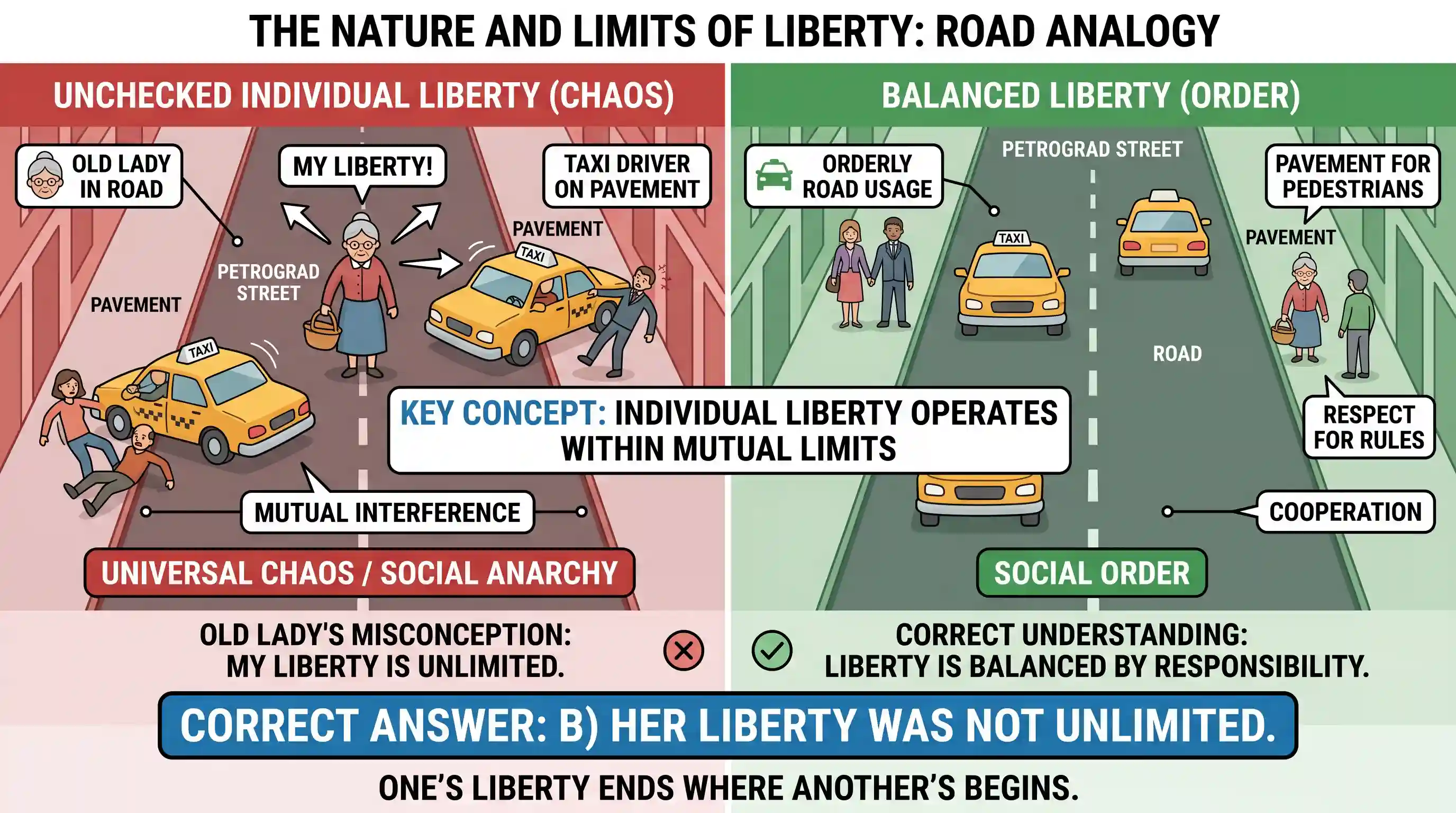
English Passage - 3 A stout old lady was walking with her basket down the middle of a street in Petrograd to the great confusion of the traffic and no small peril to herself. It was pointed out to her that the pavement was the place for foot-passengers, but she replied, "I'm going to walk where I like. We've got liberty now." It did not occur to the dear lady that if liberty entitled the foot-passenger to walk down the middle of the road it also entitled the taxi-driver to drive on the pavement, and that the end of such liberty would be universal chaos. Everything would be getting in everybody else's way and nobody would get anywhere. Individual liberty would have become social anarchy. The old lady failed to realise that

- Ashe was not really free
- Bher liberty was not unlimitedCorrect
- Cshe was an old person
- Droads are made for motor vehicles only.
Explanation
The old lady failed to realize that her liberty, like everyone else's, operates within a social framework and is therefore not unlimited. The passage clearly explains that if everyone exercised such absolute liberty, it would lead to "universal chaos" and "social anarchy," because individual liberties must be balanced to allow society to function.
Analysis of options: A) she was not really free - This is incorrect. She was exercising a form of freedom, but one that was misunderstood and potentially harmful. The passage doesn't deny her freedom, but questions its scope. B) her liberty was not unlimited - This is correct. The passage explicitly argues that if her liberty to walk anywhere was unlimited, then a taxi driver's liberty to drive anywhere (including the pavement) would also be unlimited, leading to chaos. This highlights the necessity of limits on individual liberty in a society. C) she was an old person - This is irrelevant to the central theme of the passage, which is about the nature of liberty. Her age is merely a descriptive detail. D) roads are made for motor vehicles only - While roads are primarily for vehicles, the passage's main point is not just about traffic rules, but about the fundamental concept of limited liberty in society. Option B provides a more comprehensive and accurate explanation derived from the passage's core argument.
Related questions
More UPSC Prelims practice from the same subject and topic.
- Prelims 2013CSATReading Comprehension
Read the following passage and answer the two items that follow. Your answers to these items should be based on the passage only. Passage Ecological - research over the last quarter of the century has…
- Prelims 2013CSATReading Comprehension
What is the purpose of maintaining the continuity of forested landscapes and corridors? 1. Preservation of biodiversity. 2. Management of mineral resources. 3. Grant of forest lands for human activiti…
- Prelims 2013CSATReading Comprehension
Read the following passages and answer the items that follow passage. Your answers to these items should be based on the passages only The law in many parts of the world increasingly restricts the dis…
- Prelims 2013CSATReading Comprehension
Read the following passages and answer the items that follow passage. Your answers to these items should be based on the passages only The law in many parts of the world increasingly restricts the dis…
- Prelims 2013CSATReading Comprehension
Read the following passages and answer the items that follow passage. Your answers to these items should be based on the passages only The law in many parts of the world increasingly restricts the dis…
- Prelims 2013CSATReading Comprehension
Read the following passages and answer the items that follow passage. Your answers to these items should be based on the passages only . The law in many parts of the world increasingly restricts the d…