Indicate the response you find most appropriate. Choose only one response for each item. The responses will be evaluated based on the level of appropriateness for the given situation. Please attempt all the items. There is no penalty for, wrong answers for these six items. You are the head of your office. There are certain houses reserved for the allotment to the office staff and you have been given the discretion to do so. A set of rules for the allotment of the houses has been laid down by you and has been made public. Your personal secretary, who is very close to you, comes to you and pleads that as his father is seriously ill,he should be given priority in allotment of a house. The office secretariat that examined the request as per the rules turns down the request and recommends the procedure to be followed according to the rules. You do not want to annoy your personal secretary. In such circumstances, what would you do?

- ACall him over to your room and personally explain why the allotment cannot be doneCorrect
- BAllot the house to him to win his loyalty
- CAgree with the office note to show that you are not biased and that you do not indulge in favouritism
- DKeep the file with you and not pass any orders.
Explanation
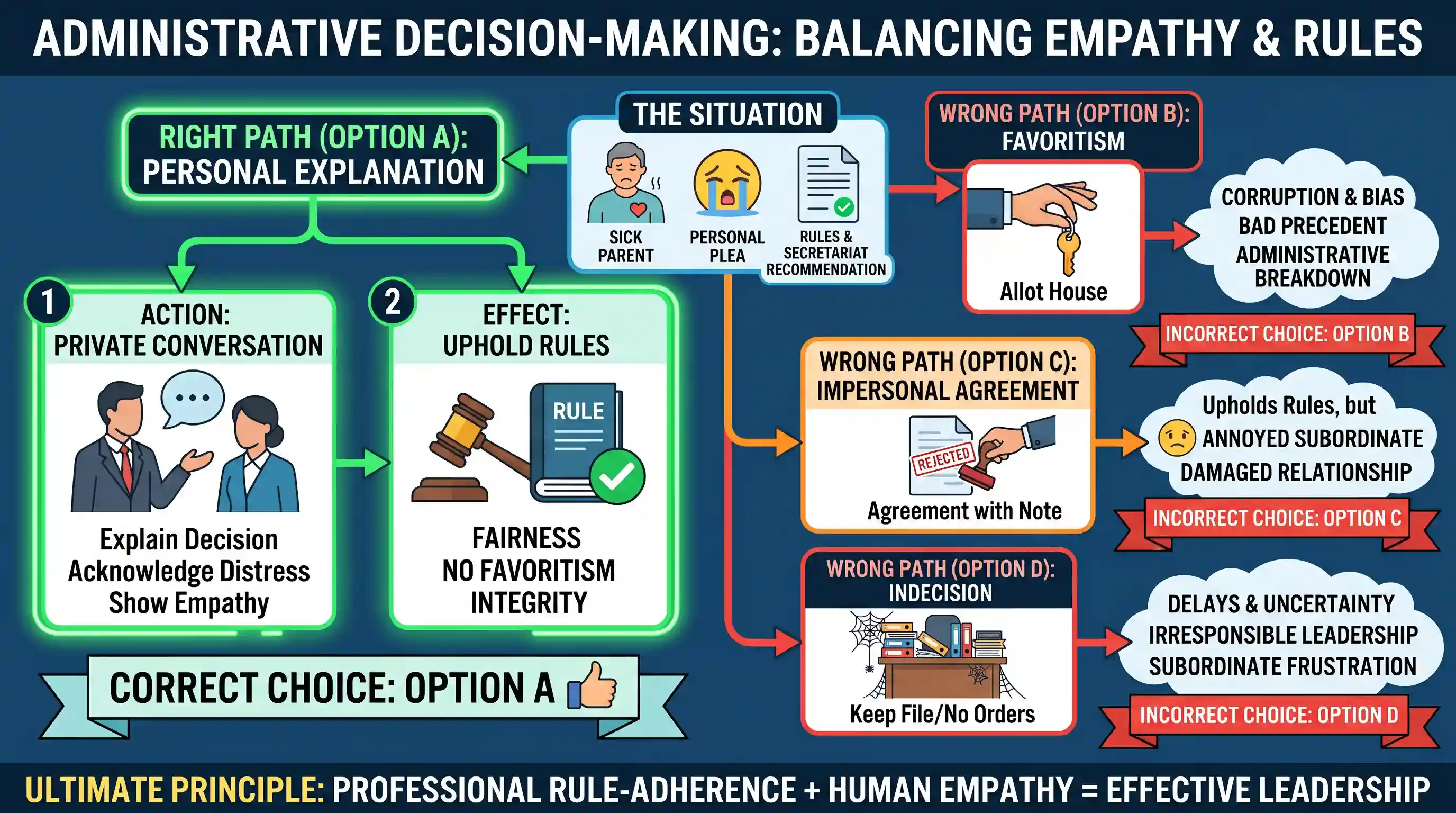
The situation presents a conflict between upholding established rules and showing empathy to a close subordinate in distress.
Let's analyze each option:
A) Call him over to your room and personally explain why the allotment cannot be done: This is the most appropriate response. It upholds the rules and the recommendation of the office secretariat, demonstrating fairness and integrity. By personally explaining the decision, you show empathy and respect for your secretary's situation, even if you cannot grant his request. This approach helps to mitigate his disappointment and prevents him from feeling ignored or unfairly treated, thus addressing the desire not to annoy him. It balances professionalism with human understanding.
B) Allot the house to him to win his loyalty: This is a clear act of favoritism and a violation of the established rules. It undermines the integrity of the office, sets a bad precedent, and could lead to accusations of bias and corruption. This is unethical and unacceptable for a public servant.
C) Agree with the office note to show that you are not biased and that you do not indulge in favouritism: While agreeing with the office note is correct in principle, simply doing so without any personal interaction might be perceived as cold or dismissive by your secretary, potentially annoying him more. Option A achieves the same objective of upholding rules but adds the crucial element of personal explanation and empathy.
D) Keep the file with you and not pass any orders: This demonstrates indecisiveness and a lack of leadership. It delays the resolution of the matter, causes uncertainty, and is an irresponsible way to handle official duties. It does not resolve the conflict and could frustrate the secretary further.
Therefore, option A is the best choice as it upholds ethical standards and rules while demonstrating empathetic and responsible leadership.
Related questions
More UPSC Prelims practice from the same subject and topic.
- Prelims 2013CSATDecision Making
While travelling in a Delhi-registered commercial taxi from Delhi to an adjacent city (another State), your taxi driver informs you that as he has no permit for running the taxi in that city, he will …
- Prelims 2013CSATDecision Making
A person lives in a far off village which is almost two hours by bus. The villager's neighbour is a very powerful landlord who is trying to occupy the poor villager's land by force. You are the Distri…
- Prelims 2013CSATDecision Making
There IS a shortage of sugar in your District where you are the District Magistrate. The Government has ordered that only a maximum amount of 30 kg sugar is to be released for wedding celebrations. A …
- Prelims 2013CSATDecision Making
You are in-charge of implementing the Family Planning programme in an area where there is a strong opposition to the present policy. You want to convince the residents of the need for keeping small fa…
- Prelims 2013CSATDecision Making
You are a teacher in a University and are setting a question paper on a particular subject. One of your colleagues, whose son is preparing for the examination on that subject, comes to you and informs…
- Prelims 2022CSATDecision Making
How best can the problems of floods and droughts be addressed so that the losses are minimal and the system becomes resilient? In this context, one important point that needs to be noted is that India…