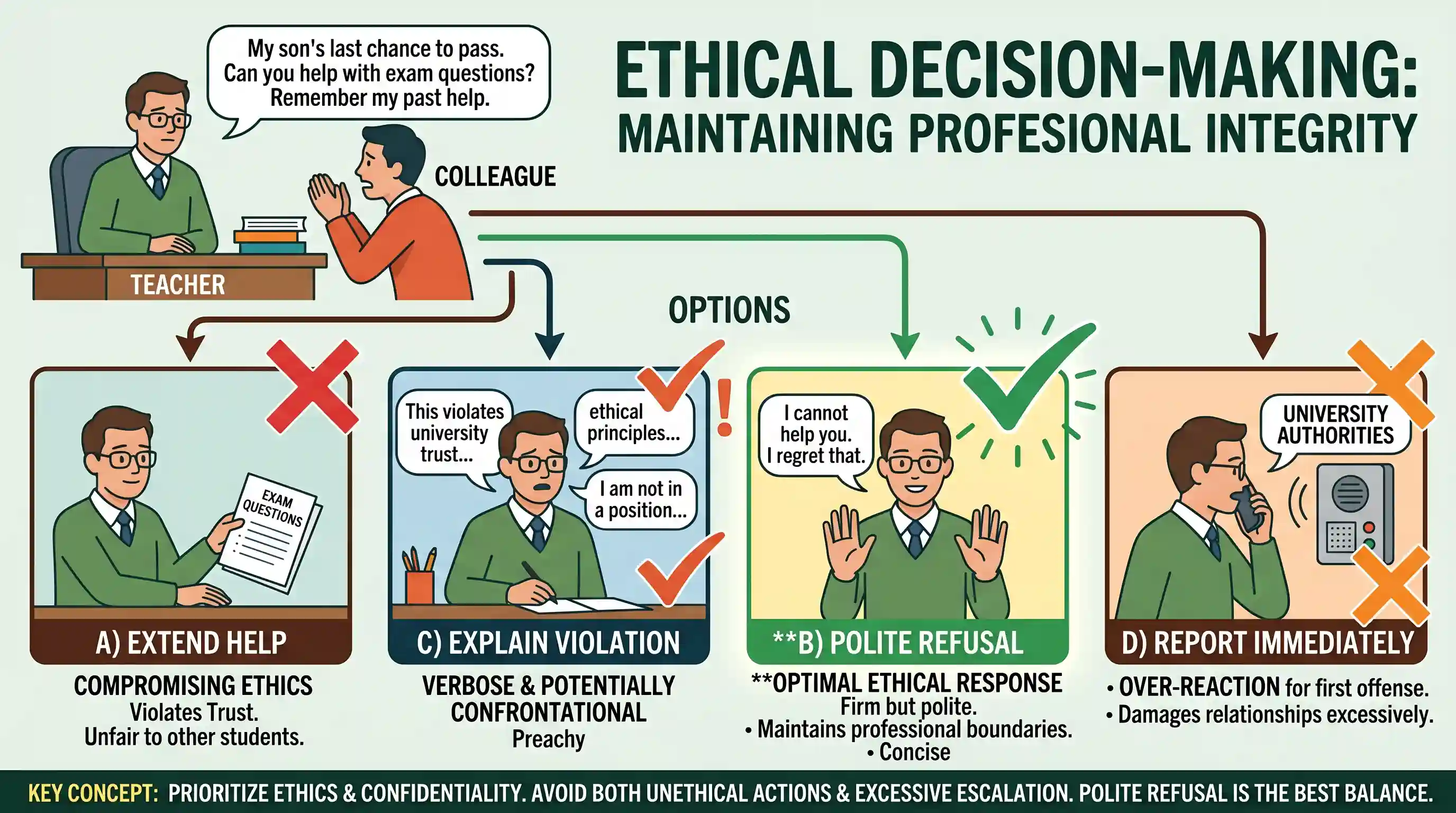
You are a teacher in a University and are setting a question paper on a particular subject. One of your colleagues, whose son is preparing for the examination on that subject, comes to you and informs you that it is his son's last chance to pass that examination and whether you could help him by indicating what questions are going to be in the examination. In the past, your colleague had helped you in another matter. Your colleague informs you that his son will suffer from depression if he fails in this examination. In such circumstances, what would you do?

- AIn view of the help he had given you, extend your help to him
- BRegret that you cannot be of any help to himCorrect
- CExplain to your colleague that this would be violating the trust of the University authorities and you are not in a position to help him
- DReport the conduct of your colleague to the higher authorities.
Explanation
The correct answer is B. Here's why:
Analysis of Options:
A) In view of the help he had given you, extend your help to him This is incorrect. Prioritizing personal obligation or past favors over professional ethics, fairness, and the integrity of the examination system is a clear act of professional misconduct. It would be unfair to other students and violate the trust placed in you by the university.
B) Regret that you cannot be of any help to him This is the correct option. It represents a polite but firm refusal to engage in unethical behavior. It upholds your professional integrity, maintains the fairness and confidentiality of the examination, and sets clear boundaries without being confrontational or unnecessarily escalating the situation. It acknowledges the colleague's difficulty (by expressing regret) but prioritizes ethical standards.
C) Explain to your colleague that this would be violating the trust of the University authorities and you are not in a position to help him While this option also involves a refusal and provides a valid ethical justification, it is slightly more verbose and potentially more confrontational than a simple "regret that you cannot be of any help." Option B achieves the same ethical outcome (refusal) in a more concise and less preachy manner, which is often preferred in such scenarios to maintain professional relationships while upholding ethics. The core ethical action is the refusal, and B delivers that clearly and politely.
D) Report the conduct of your colleague to the higher authorities. This is incorrect as a first response. While the colleague's request is unethical, immediately reporting them might be an overreaction and could unnecessarily damage professional relationships, especially given the past help and the emotional context (son's potential depression). The primary immediate duty is to refuse the unethical request, not necessarily to punish the colleague. Reporting should be considered if the colleague persists or if there's a pattern of such behavior.
Conclusion: Option B is the most balanced, ethical, and professional response. It upholds integrity firmly yet politely, without escalating the situation unnecessarily or compromising professional relationships.
Related questions
More UPSC Prelims practice from the same subject and topic.
- Prelims 2013CSATDecision Making
Indicate the response you find most appropriate. Choose only one response for each item. The responses will be evaluated based on the level of appropriateness for the given situation. Please attempt a…
- Prelims 2013CSATDecision Making
While travelling in a Delhi-registered commercial taxi from Delhi to an adjacent city (another State), your taxi driver informs you that as he has no permit for running the taxi in that city, he will …
- Prelims 2013CSATDecision Making
A person lives in a far off village which is almost two hours by bus. The villager's neighbour is a very powerful landlord who is trying to occupy the poor villager's land by force. You are the Distri…
- Prelims 2013CSATDecision Making
There IS a shortage of sugar in your District where you are the District Magistrate. The Government has ordered that only a maximum amount of 30 kg sugar is to be released for wedding celebrations. A …
- Prelims 2013CSATDecision Making
You are in-charge of implementing the Family Planning programme in an area where there is a strong opposition to the present policy. You want to convince the residents of the need for keeping small fa…
- Prelims 2022CSATDecision Making
How best can the problems of floods and droughts be addressed so that the losses are minimal and the system becomes resilient? In this context, one important point that needs to be noted is that India…