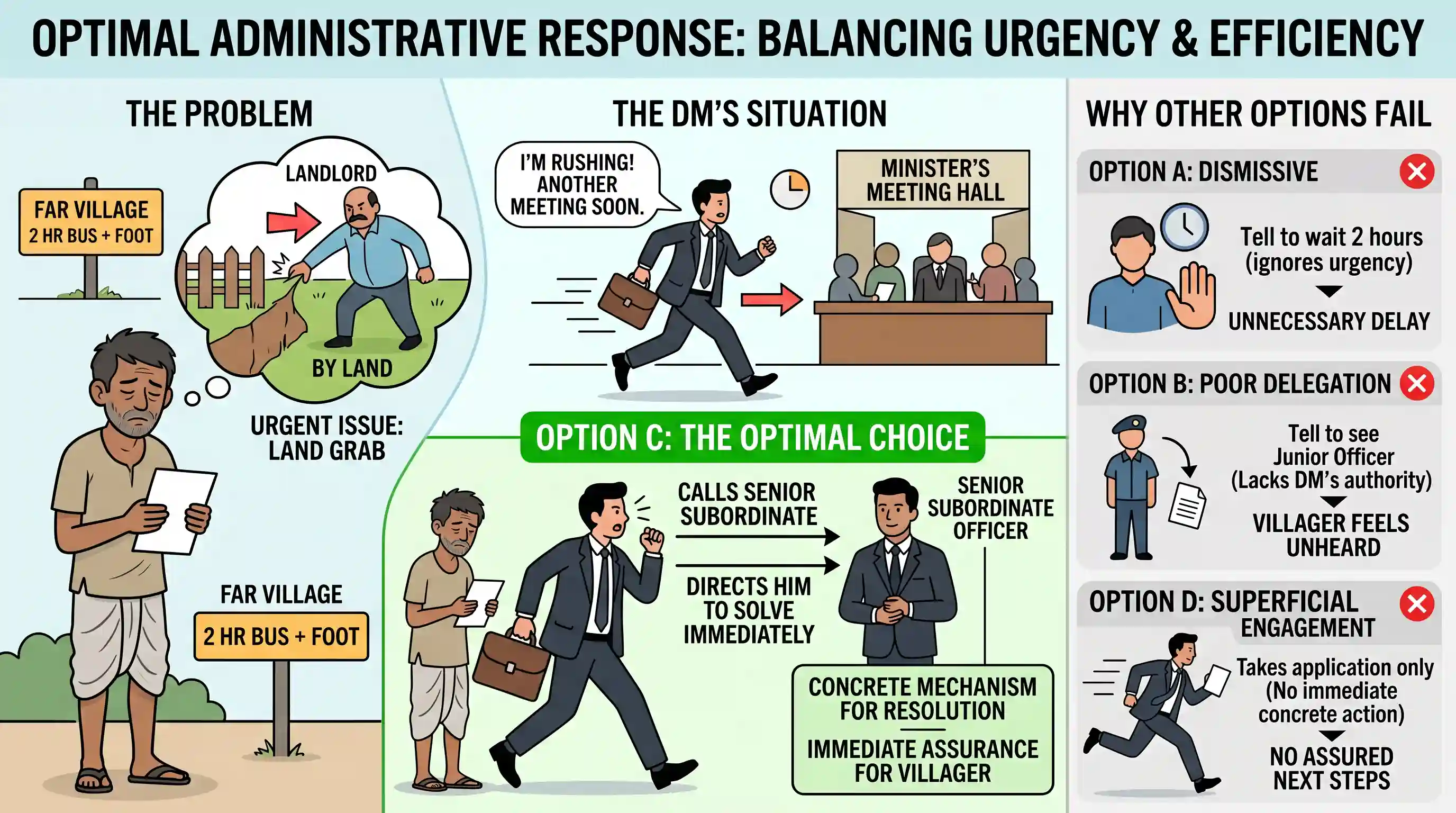
A person lives in a far off village which is almost two hours by bus. The villager's neighbour is a very powerful landlord who is trying to occupy the poor villager's land by force. You are the District Magistrate and busy in a meeting called by a local Minister. The villager has come all the way, by bus and on foot, to see you and give an application seeking protection from the powerful landlord. The villager keeps on waiting outside the meeting hall for an hour. You come out of the meeting and are rushing to another meeting. The villager follows you to submit his application. What would you do?

- ATell him to wait for another two hours till you come back from your next meeting
- BTell him that the matter is actually to be dealt by a junior officer and that he should give the application to him
- CCall one of your senior subordinate officers and ask him to solve the villager's problemCorrect
- DQuickly take the application from him, ask him a few relevant questions regarding his problem and then proceed to the meeting.
Explanation
The correct answer is C because it demonstrates an optimal balance of empathy, administrative efficiency, and effective problem-solving, especially given the District Magistrate's (DM) time constraints and the villager's urgent and vulnerable situation.
Analysis of options:
A) Tell him to wait for another two hours till you come back from your next meeting This option shows a lack of empathy and sensitivity. The villager has already traveled far and waited an hour. Making him wait longer for an uncertain outcome is dismissive and could exacerbate his urgent problem, which involves a powerful landlord trying to occupy land by force.
B) Tell him that the matter is actually to be dealt by a junior officer and that he should give the application to him While delegation is part of administration, simply directing the villager to a junior officer without any personal intervention or assurance from the DM might make the villager feel unheard, especially given the power imbalance with the landlord. The villager came to the DM, the highest authority, seeking serious intervention.
C) Call one of your senior subordinate officers and ask him to solve the villager's problem This is the most appropriate action. The DM acknowledges the villager's presence and the urgency of the issue. By calling a senior subordinate and instructing them to solve the problem, the DM ensures that the matter is given immediate and serious attention by a competent authority. This provides immediate assurance to the villager that their problem is being addressed effectively, without the DM having to personally get bogged down in details while rushing to another meeting. It leverages the administrative hierarchy efficiently and empathetically.
D) Quickly take the application from him, ask him a few relevant questions regarding his problem and then proceed to the meeting. While taking the application and asking questions shows direct engagement, it might not be the most effective immediate solution. Given the DM is rushing, this might be a superficial action without ensuring a concrete mechanism for resolution is immediately set in motion. The villager might still be left wondering about the next steps. Option C goes further by immediately tasking a senior officer with the responsibility to solve the problem, ensuring action rather than just receipt of information.
Related questions
More UPSC Prelims practice from the same subject and topic.
- Prelims 2013CSATDecision Making
Indicate the response you find most appropriate. Choose only one response for each item. The responses will be evaluated based on the level of appropriateness for the given situation. Please attempt a…
- Prelims 2013CSATDecision Making
While travelling in a Delhi-registered commercial taxi from Delhi to an adjacent city (another State), your taxi driver informs you that as he has no permit for running the taxi in that city, he will …
- Prelims 2013CSATDecision Making
There IS a shortage of sugar in your District where you are the District Magistrate. The Government has ordered that only a maximum amount of 30 kg sugar is to be released for wedding celebrations. A …
- Prelims 2013CSATDecision Making
You are in-charge of implementing the Family Planning programme in an area where there is a strong opposition to the present policy. You want to convince the residents of the need for keeping small fa…
- Prelims 2013CSATDecision Making
You are a teacher in a University and are setting a question paper on a particular subject. One of your colleagues, whose son is preparing for the examination on that subject, comes to you and informs…
- Prelims 2022CSATDecision Making
How best can the problems of floods and droughts be addressed so that the losses are minimal and the system becomes resilient? In this context, one important point that needs to be noted is that India…