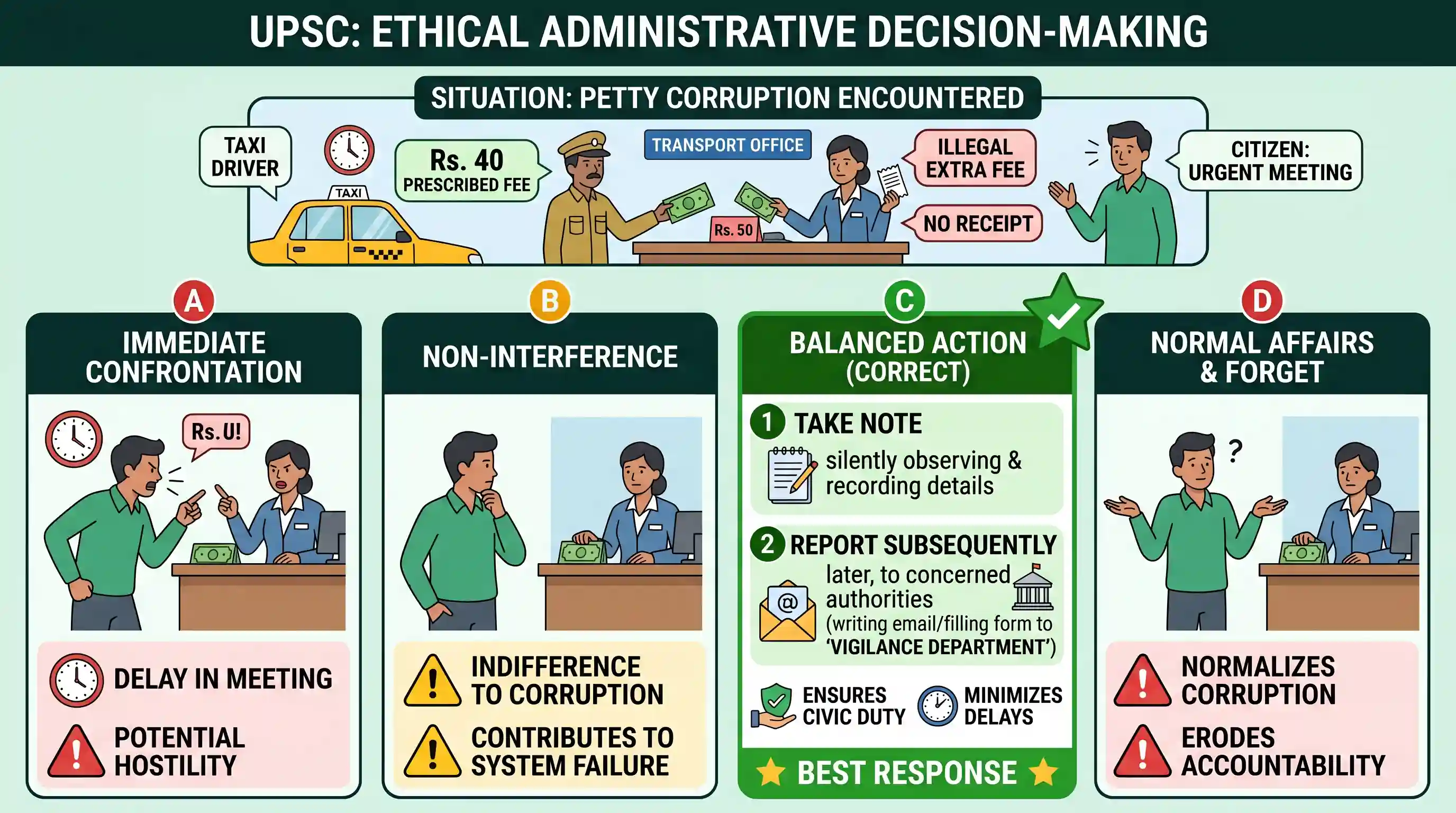
While travelling in a Delhi-registered commercial taxi from Delhi to an adjacent city (another State), your taxi driver informs you that as he has no permit for running the taxi in that city, he will stop at its Transport Office and pay the prescribed fee of Rs. forty for a day. While paying the fee at the counter you find that the transport clerk is taking an extra fifty rupees for which no receipt is being given. You are in a hurry for your meeting. In such circumstances, what would you do?

- AGo up to the counter and ask the clerk to give back the money which he has illegally taken
- BDo not interfere at all as this is a matter between the taxi driver and the tax authorities
- CTake note of the incident and subsequently report the matter to the concerned authoritiesCorrect
- DTreat it as a normal affair and simply forget about it.
Explanation
The situation describes an act of petty corruption at a government office. The question asks for the most appropriate course of action for a responsible citizen.
A) Go up to the counter and ask the clerk to give back the money which he has illegally taken: This is a direct confrontation. While morally correct, it could lead to arguments, delays, or even hostile reactions, especially when you are in a hurry for a meeting. It might not be the most practical or effective immediate solution.
B) Do not interfere at all as this is a matter between the taxi driver and the tax authorities: This option suggests indifference to an act of corruption. As a responsible citizen, ignoring such incidents contributes to the normalization of corruption and is not an ideal response.
C) Take note of the incident and subsequently report the matter to the concerned authorities: This is the most balanced and responsible approach. It allows you to proceed with your urgent meeting without immediate confrontation, while still fulfilling your civic duty to report corruption through proper channels. Reporting the incident to higher authorities is the correct way to address such misconduct and ensure accountability.
D) Treat it as a normal affair and simply forget about it: This option normalizes corruption and shows a lack of civic responsibility. Ignoring such incidents allows corruption to persist and grow.
Therefore, C is the correct answer as it demonstrates civic responsibility, ethical conduct, and a practical approach to addressing corruption without compromising immediate commitments.
Related questions
More UPSC Prelims practice from the same subject and topic.
- Prelims 2013CSATDecision Making
Indicate the response you find most appropriate. Choose only one response for each item. The responses will be evaluated based on the level of appropriateness for the given situation. Please attempt a…
- Prelims 2013CSATDecision Making
A person lives in a far off village which is almost two hours by bus. The villager's neighbour is a very powerful landlord who is trying to occupy the poor villager's land by force. You are the Distri…
- Prelims 2013CSATDecision Making
There IS a shortage of sugar in your District where you are the District Magistrate. The Government has ordered that only a maximum amount of 30 kg sugar is to be released for wedding celebrations. A …
- Prelims 2013CSATDecision Making
You are in-charge of implementing the Family Planning programme in an area where there is a strong opposition to the present policy. You want to convince the residents of the need for keeping small fa…
- Prelims 2013CSATDecision Making
You are a teacher in a University and are setting a question paper on a particular subject. One of your colleagues, whose son is preparing for the examination on that subject, comes to you and informs…
- Prelims 2022CSATDecision Making
How best can the problems of floods and droughts be addressed so that the losses are minimal and the system becomes resilient? In this context, one important point that needs to be noted is that India…