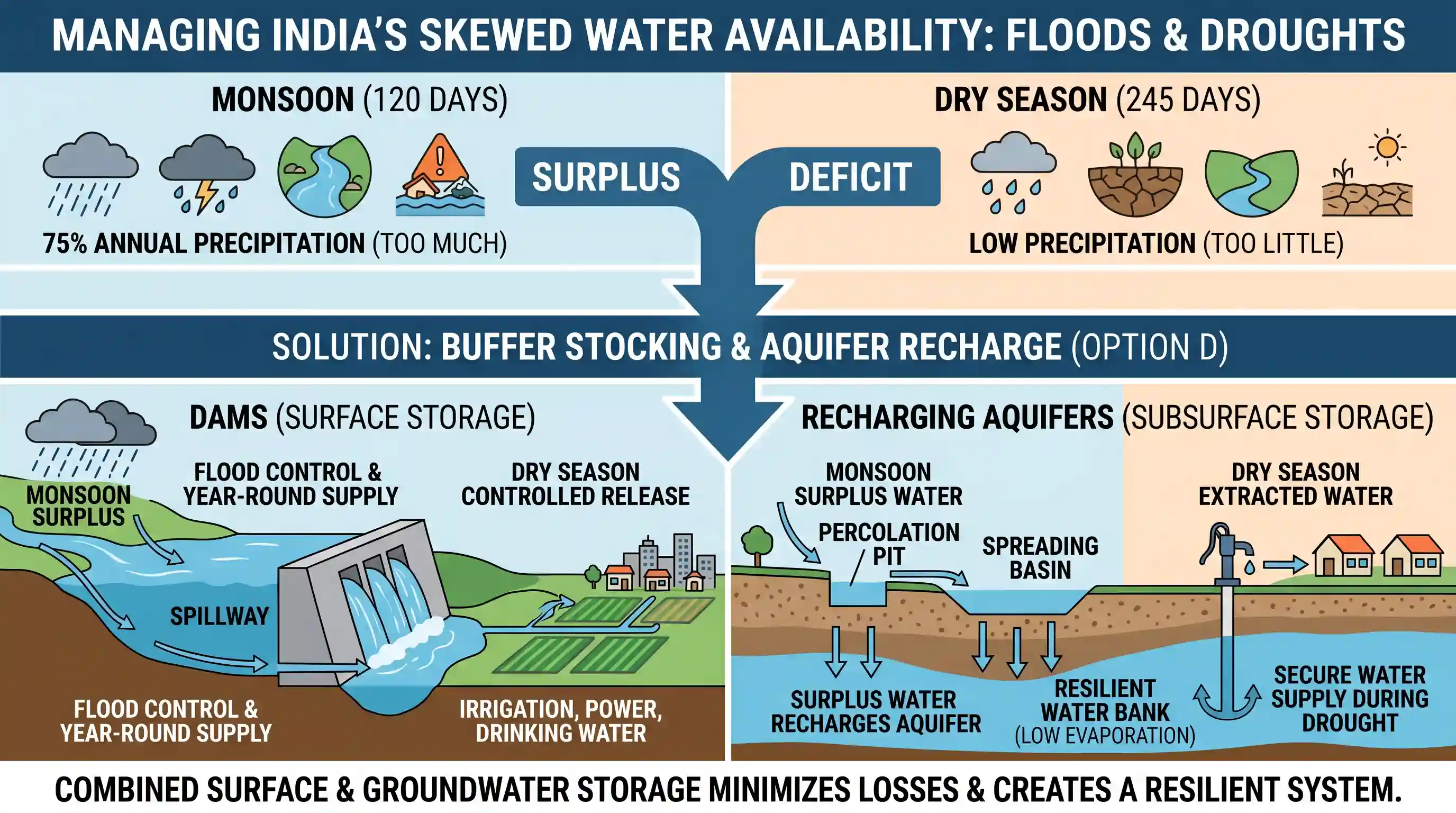
How best can the problems of floods and droughts be addressed so that the losses are minimal and the system becomes resilient? In this context, one important point that needs to be noted is that India gets 'too much' water (about 75% of annual precipitation) during 120 days (June to September) and 'too little' for the remaining 245 days. This skewed water availability has to be managed and regulated for its consumption throughout the year. Which one of the following best reflects the practical, rational and lasting solution?

- AConstructing huge concrete storage tanks and canals across the country
- BChanging the cropping patterns and farming practices
- CInterlinking of rivers across the country
- DBuffer stocking of water through dams and recharging aquifersCorrect
Explanation
The problem highlights India's skewed water availability: too much water during the monsoon and too little for the rest of the year. The solution must manage and regulate this water for year-round consumption, minimize losses, and build resilience.
Let's analyze each option:
A) Constructing huge concrete storage tanks and canals across the country: While canals transport water and tanks store some, this option is not the primary or most efficient way to manage vast quantities of water across a diverse landscape. Huge concrete tanks are expensive, have a large footprint, and might not be environmentally ideal for large-scale storage compared to other methods. Canals are for distribution, not primary storage for flood/drought management.
B) Changing the cropping patterns and farming practices: This is crucial for demand-side management and water conservation, making agriculture more water-efficient. However, it does not directly address the fundamental problem of storing the monsoon surplus to mitigate floods and provide water during droughts. It's a complementary measure, not the core solution for regulating the overall water availability.
C) Interlinking of rivers across the country: This ambitious project aims to transfer surplus water from one basin to a deficit one. While it could potentially balance regional disparities, it faces immense practical, environmental, social, and political challenges. The scale of disruption, cost, ecological impact, and potential for interstate disputes make it less practical, rational, and lasting as a primary, standalone solution compared to direct storage methods. It also doesn't primarily focus on buffering water over time.
D) Buffer stocking of water through dams and recharging aquifers: This is the most comprehensive and balanced solution.
- Dams (surface storage): Capture monsoon floodwaters, preventing downstream damage and storing water for release during dry periods (irrigation, drinking, power). This directly addresses the "too much water" problem by holding it back and the "too little water" problem by making it available later.
- Recharging aquifers (groundwater storage): Allows surplus surface water to percolate and replenish underground water tables. This is a natural, decentralized, and highly resilient form of storage. Groundwater is less prone to evaporation losses than surface reservoirs, helps maintain base flows in rivers, and provides a critical buffer during droughts. A combination of surface (dams) and subsurface (aquifers) storage provides a robust, diversified, and resilient system to manage the temporal imbalance of water, directly addressing both floods and droughts in a practical, rational, and lasting way.
Therefore, buffer stocking of water through dams and recharging aquifers best reflects the practical, rational, and lasting solution.
Related questions
More UPSC Prelims practice from the same subject and topic.
- Prelims 2013CSATDecision Making
Indicate the response you find most appropriate. Choose only one response for each item. The responses will be evaluated based on the level of appropriateness for the given situation. Please attempt a…
- Prelims 2013CSATDecision Making
While travelling in a Delhi-registered commercial taxi from Delhi to an adjacent city (another State), your taxi driver informs you that as he has no permit for running the taxi in that city, he will …
- Prelims 2013CSATDecision Making
A person lives in a far off village which is almost two hours by bus. The villager's neighbour is a very powerful landlord who is trying to occupy the poor villager's land by force. You are the Distri…
- Prelims 2013CSATDecision Making
There IS a shortage of sugar in your District where you are the District Magistrate. The Government has ordered that only a maximum amount of 30 kg sugar is to be released for wedding celebrations. A …
- Prelims 2013CSATDecision Making
You are in-charge of implementing the Family Planning programme in an area where there is a strong opposition to the present policy. You want to convince the residents of the need for keeping small fa…
- Prelims 2013CSATDecision Making
You are a teacher in a University and are setting a question paper on a particular subject. One of your colleagues, whose son is preparing for the examination on that subject, comes to you and informs…