If 15× 14× 13× … × 3× 2× 1 = 3^m× n where m and n are positive integers, then what is the maximum value of m?

- A7
- B6Correct
- C5
- D4
Explanation
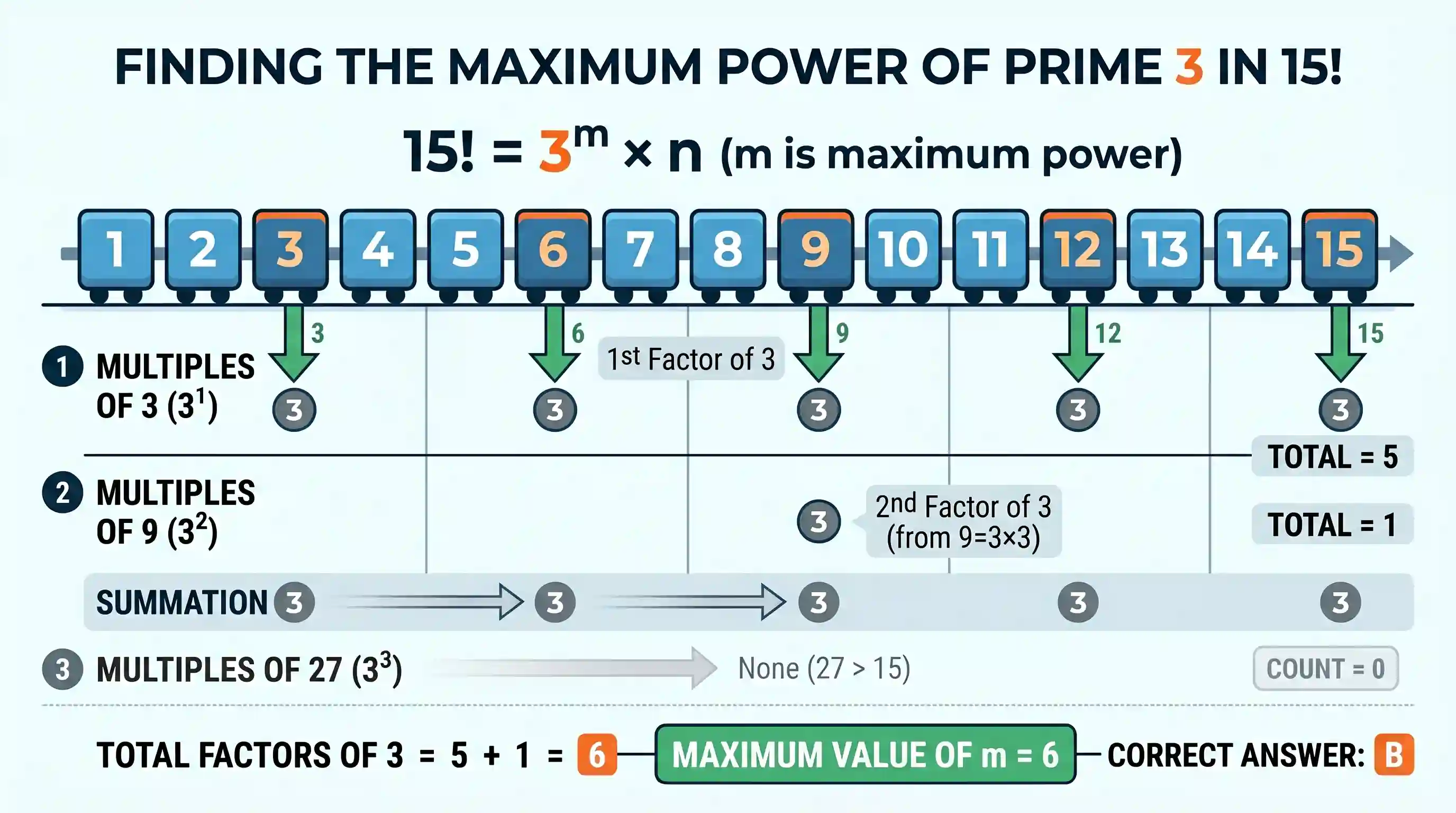
To find the maximum value of 'm', we need to determine the highest power of 3 that divides 15 factorial (15!). This is equivalent to counting the total number of times the prime factor 3 appears in the product 15 × 14 × 13 × … × 3 × 2 × 1.
We can do this by counting the multiples of 3, then the multiples of 3^2 (9), and so on, within the range of 1 to 15.
-
Count numbers from 1 to 15 that are multiples of 3: These are 3, 6, 9, 12, 15. There are 5 such numbers. Each of these contributes at least one factor of 3.
-
Count numbers from 1 to 15 that are multiples of 3^2 (which is 9): Only 9 is a multiple of 9. This number contributes an additional factor of 3 (since 9 = 3 x 3, one '3' was already counted when we considered multiples of 3).
-
Count numbers from 1 to 15 that are multiples of 3^3 (which is 27): There are no multiples of 27 within this range (as 27 > 15).
Summing the counts: Total number of factors of 3 = (Number of multiples of 3) + (Number of multiples of 9) Total factors of 3 = 5 + 1 = 6.
Therefore, the maximum value of m is 6.
The final answer is B
Related questions
More UPSC Prelims practice from the same subject and topic.
- Prelims 2022CSATQuantitative Aptitude
An Identity Card has the number ABCDEFG, not necessarily in that order, where each letter represents a distinct digit (1, 2, 4, 5, 7, 8, 9 only). The number is divisible by 9. After deleting the first…
- Prelims 2022CSATQuantitative Aptitude
Which number amongst 2⁴⁰, 3²¹, 4¹⁸ and 8¹² is the smallest?
- Prelims 2022CSATQuantitative Aptitude
The digits 1 to 9 are arranged in three rows in such a way that each row contains three digits, and the number formed in the second row is twice the number formed in the first row; and the number form…
- Prelims 2022CSATQuantitative Aptitude
How many 3-digit natural numbers (without repetition of digits) are there such that each digit is odd and the number is divisible by 5?
- Prelims 2022CSATQuantitative Aptitude
Consider the Question and two Statements given below : Question : Is x an integer? Statement- 1 : x / 3 is not an integer. Statement- 2 : 3 xis an integer. Which one of the following is correct in res…
- Prelims 2022CSATQuantitative Aptitude
How many seconds in total are there in x weeks, x days, x hours, x minutes and x seconds?