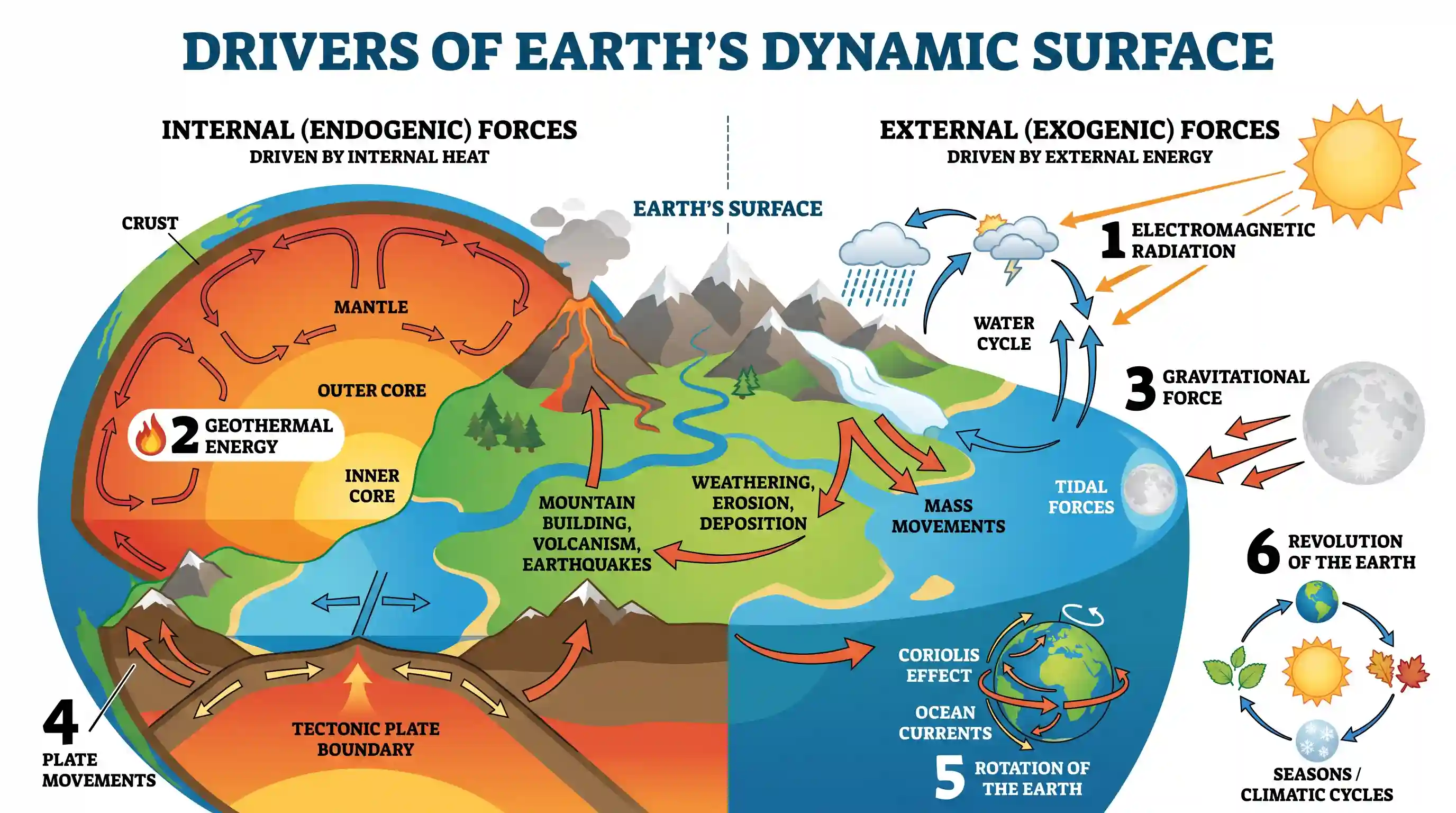
Consider the following : 1. Electromagnetic radiation 2. Geothermal energy 3. Gravitational force 4. Plate movements 5. Rotation of the earth 6. Revolution of the earth Which of the above are responsible for bringing dynamic changes on the surface of the earth?

- A1, 2, 3 and 4 only
- B1, 3, 5 and 6 only
- C2, 4, 5 and 6 only
- D1, 2, 3, 4, 5 and 6Correct
Explanation
Correct Answer: D) 1, 2, 3, 4, 5 and 6
Dynamic changes on the Earth's surface are produced by both endogenic (internal) and exogenic (external) forces. All six factors listed contribute, directly or indirectly, to these changes:
-
Electromagnetic radiation - Solar radiation (a form of EM radiation) is the primary driver of weathering, evaporation, the hydrological cycle, atmospheric circulation and the resulting erosion/deposition that constantly reshape the surface.
-
Geothermal energy - The Earth's internal heat drives plate tectonics, volcanism, mountain building and earthquakes — the principal endogenic forces.
-
Gravitational force - Gravity drives mass movements (landslides, slumping), the flow of rivers and glaciers, and tidal forces that erode coasts; it underlies almost every gradational process.
-
Plate movements - Cause continental drift, orogeny, ocean-basin formation, earthquakes and volcanism, producing large-scale surface change.
-
Rotation of the earth - Generates the Coriolis effect, influencing wind systems, ocean currents and the diurnal cycle, all of which affect weathering and erosion.
-
Revolution of the earth - Produces the seasons, controlling temperature and precipitation regimes, glaciation cycles and biogeographic processes that shape the surface over time.
Since every listed factor contributes to dynamic changes on the Earth's surface, option D is correct.
Related questions
More UPSC Prelims practice from the same subject and topic.
- Prelims 2013GS1geography
Which one of the following pairs is correctly matched?
- Prelims 2013GS1geography
Which of the following can be found as pollutants in the drinking water in some parts of India? 1. Arsenic 2. Sorbitol 3. Fluoride 4. Formaldehyde 5. Uranium Select the correct answer using the codes …
- Prelims 2013GS1geography
The Narmada river flows to the west, while most other large peninsular rivers flow to the east. Why? 1. It occupies a linear rift valley. 2. It flows between the Vindhyas and the Satpuras. 3. The land…
- Prelims 2013GS1geography
On the planet earth, most of the freshwater exists as ice caps and glaciers. Out of the remaining freshwater, the largest proportion (a) is found in atmosphere as moisture and clouds (b) is found in f…
- Prelims 2013GS1geography
Consider the following pairs : 1. Nokrek Bio-sphere Reserve: Garo Hills 2. Logtak (Loktak) Lake : Barail Range 3. Namdapha National Park: Dafla Hills Which of the above pairs is/are correctly matched?
- Prelims 2013GS1geography
On the earth planet, most of the non-saline water exists as ice caps and glaciers. The largest part of the remaining non-saline water is found as