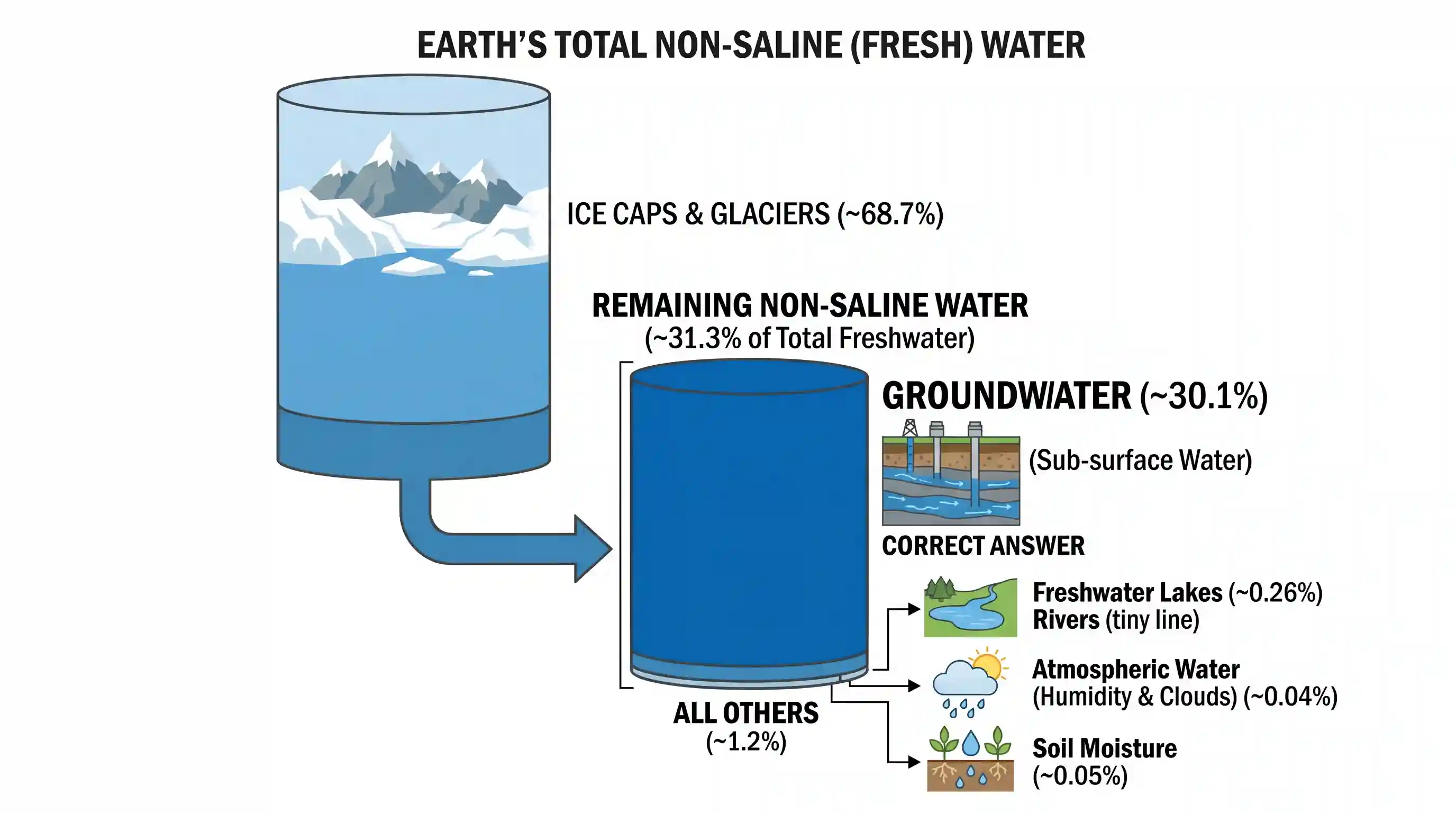
On the earth planet, most of the non-saline water exists as ice caps and glaciers. The largest part of the remaining non-saline water is found as

- AHumidity and clouds in the atmosphere
- BNon-saline water lakes and rivers
- CGroundwaterCorrect
- DSoil moisture
Explanation
Correct Answer: C) Groundwater
Let's break down why:
Groundwater constitutes the largest reservoir of freshwater after ice caps and glaciers. Approximately 30.1% of the world's freshwater is found underground. This is a significant amount, crucial for sustaining ecosystems and human populations. A) Humidity and clouds in the atmosphere: While atmospheric water is vital for the water cycle, the total volume of water held in humidity and clouds is relatively small compared to groundwater. It's a transient reservoir. B) Non-saline water lakes and rivers: Lakes and rivers hold a substantial amount of freshwater, but their combined volume is significantly less than that of groundwater – only about 0.3% of the world’s freshwater. D) Soil moisture: Soil moisture is important for plant life, but the quantity of water stored in the soil is far less than groundwater. It's a very small percentage of the total non-saline water. Therefore, after ice caps and glaciers, groundwater is the largest remaining reservoir of non-saline water on Earth.
Related questions
More UPSC Prelims practice from the same subject and topic.
- Prelims 2013GS1geography
On the planet earth, most of the freshwater exists as ice caps and glaciers. Out of the remaining freshwater, the largest proportion (a) is found in atmosphere as moisture and clouds (b) is found in f…
- Prelims 2013GS1geography
The annual range of temperature in the interior of the continents is high as compared to coastal areas. What is/are the reason/reasons? 1. Thermal difference between land and water 2. Variation in alt…
- Prelims 2013GS1geography
"Climate is extreme, rainfall is scanty and the people used to be nomadic herders." The above statement best describes which of the following regions?
- Prelims 2013GS1geography
During a thunderstorm, the thunder in the skies is produced by the meeting of cumulonimbus clouds in the sky 1. 2. lightning that separates the nimbus clouds 3. violent upward movement of air and wate…
- Prelims 2013GS1geography
Consider the following phenomena : 1. Size of the sun at dusk 2. Colour of the sun at dawn 3. Moon being visible at dawn 4. Twinkle of stars in the sky 5. Polestar being visible in the sky Which of th…
- Prelims 2013GS1geography
Which one of the following pairs is correctly matched?