Consider the following phenomena : 1. Size of the sun at dusk 2. Colour of the sun at dawn 3. Moon being visible at dawn 4. Twinkle of stars in the sky 5. Polestar being visible in the sky Which of the above are optical illusions?

- A1, 2 and 3
- B3, 4 and 5
- C1, 2 and 4Correct
- D2, 3 and 5
Explanation
The correct answer is C) 1, 2 and 4. Let's break down why:
-
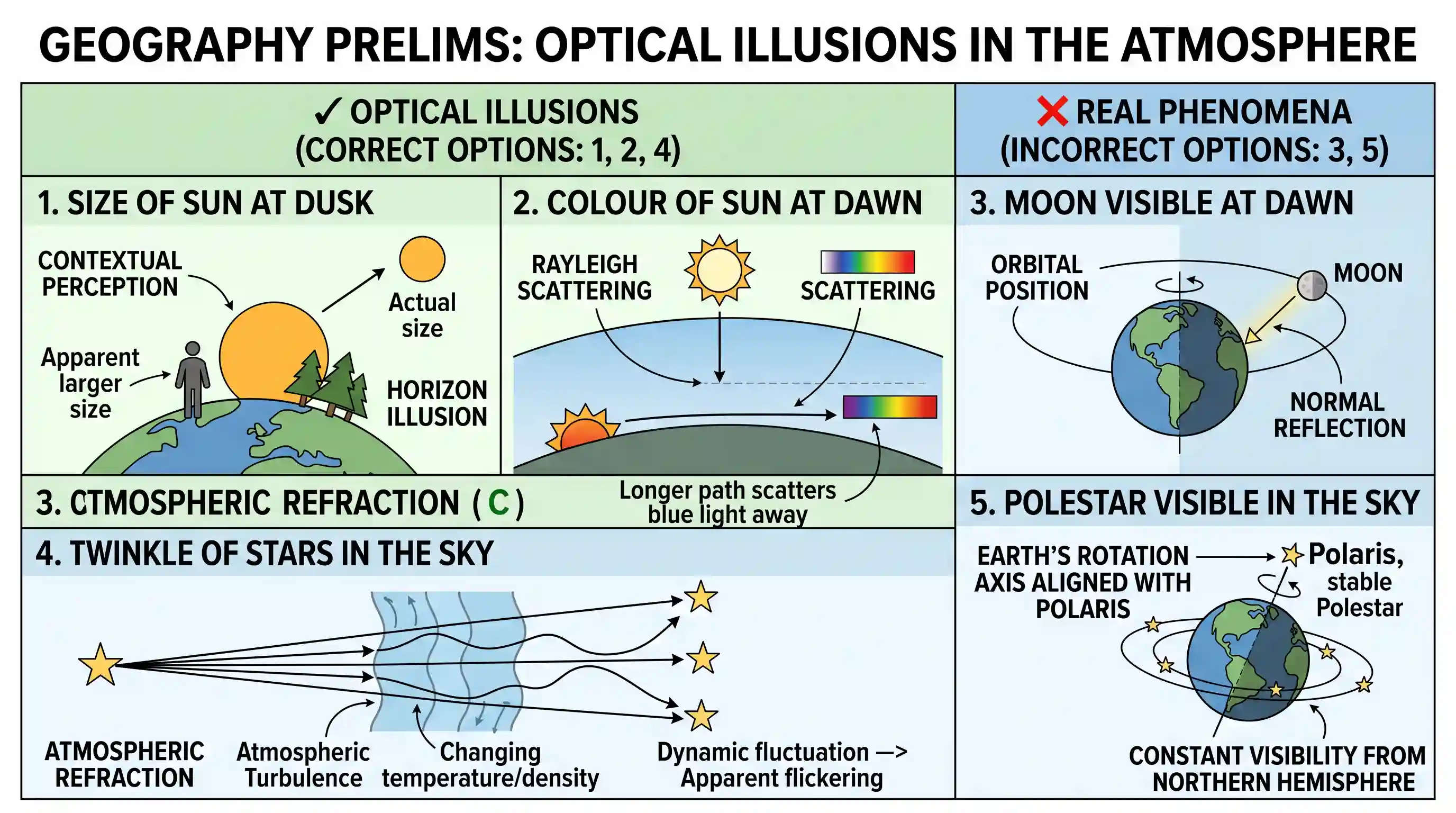
Size of the sun at dusk: This is an optical illusion known as the 'Moon Illusion' (also applies to the sun). The sun appears larger when near the horizon because our brains perceive it in relation to objects on the ground, creating a sense of depth. It's not an actual change in size.
-
Colour of the sun at dawn: The reddish/orange colour of the sun at dawn and dusk is due to Rayleigh scattering. Shorter wavelengths (blue light) are scattered away by the atmosphere, leaving longer wavelengths (red/orange) to reach our eyes. While a real phenomenon, the perception of the colour change is influenced by atmospheric conditions and our visual system, making it partially an illusion.
-
Moon being visible at dawn: This is not an illusion. The moon can be visible at dawn because of its orbital position and reflective properties. It's a perfectly normal astronomical occurrence.
-
Twinkle of stars in the sky: The twinkling of stars (scintillation) is caused by the refraction of starlight as it passes through turbulent layers of the Earth's atmosphere. This creates a fluctuating apparent position and brightness, making it an optical illusion.
-
Polestar being visible in the sky: The Polestar (Polaris) is visible in the Northern Hemisphere due to Earth's rotation and its alignment with the Earth's axis. Its visibility is a result of astronomical positioning, not an illusion.
Therefore, options A, B, and D are incorrect because they include phenomena that are not primarily optical illusions.
Related questions
More UPSC Prelims practice from the same subject and topic.
- Prelims 2013GS1geography
On the planet earth, most of the freshwater exists as ice caps and glaciers. Out of the remaining freshwater, the largest proportion (a) is found in atmosphere as moisture and clouds (b) is found in f…
- Prelims 2013GS1geography
On the earth planet, most of the non-saline water exists as ice caps and glaciers. The largest part of the remaining non-saline water is found as
- Prelims 2013GS1geography
The annual range of temperature in the interior of the continents is high as compared to coastal areas. What is/are the reason/reasons? 1. Thermal difference between land and water 2. Variation in alt…
- Prelims 2013GS1geography
"Climate is extreme, rainfall is scanty and the people used to be nomadic herders." The above statement best describes which of the following regions?
- Prelims 2013GS1geography
During a thunderstorm, the thunder in the skies is produced by the meeting of cumulonimbus clouds in the sky 1. 2. lightning that separates the nimbus clouds 3. violent upward movement of air and wate…
- Prelims 2013GS1geography
Which one of the following pairs is correctly matched?